
Water softener maintenance starts with monitoring salt, checking the controls and visible plumbing, and confirming that the unit still reduces water hardness. Cleaning and service requirements depend on your model and incoming water. Keep the owner’s manual nearby instead of applying one maintenance schedule to every softener.
This checklist covers household salt-based water softeners. Use it to organize routine observations and decide when to follow a specific cleaning procedure or call for service.
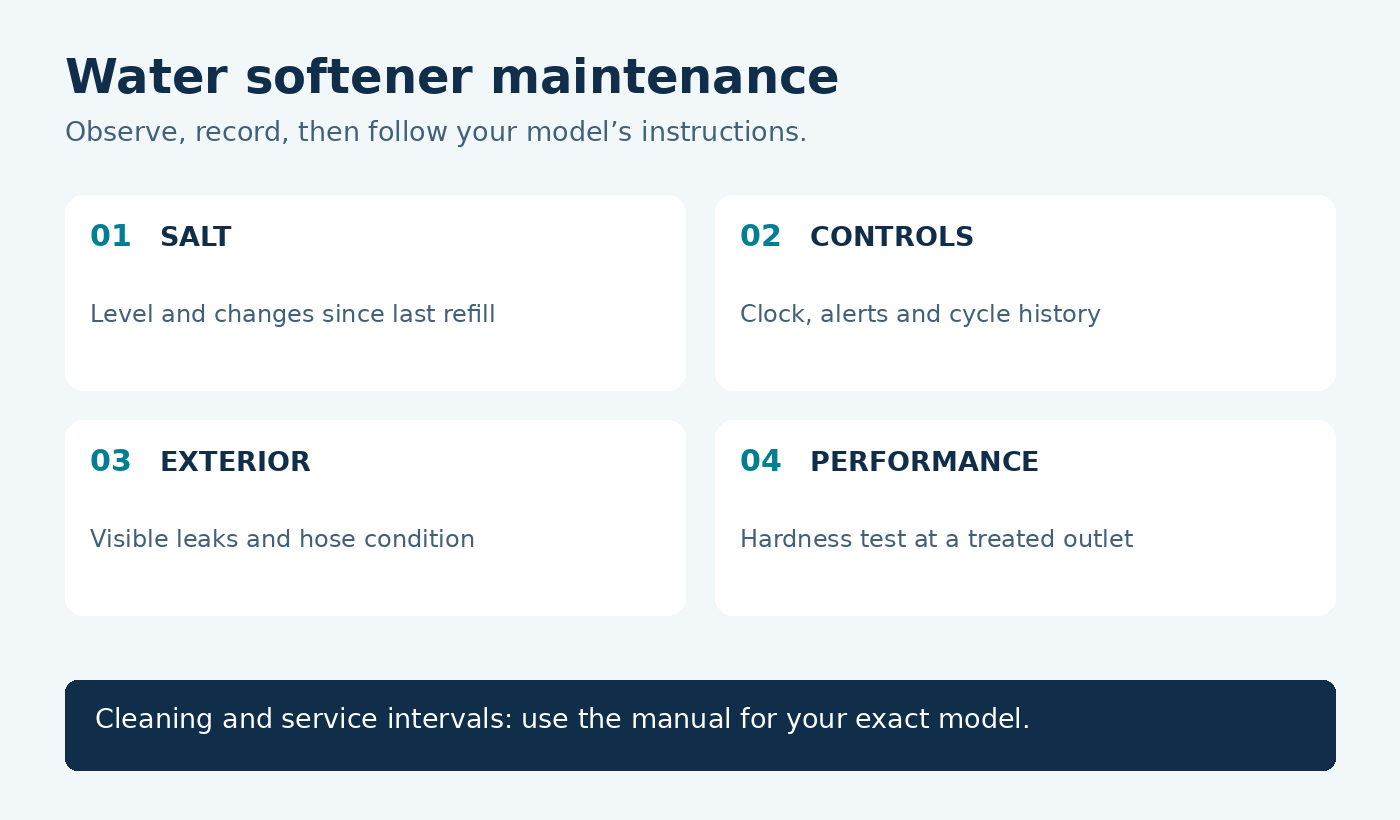
Diagram above: Four checks to record during routine maintenance. This is an organizational checklist, not a model-specific service schedule.
For product selection and application checks, see when to use a water softener cleaner. Internal deposit treatment is separate from physically cleaning the salt tank.
What maintenance does a water softener need?
Routine care includes replenishing the correct salt, watching for bridging or mushing, and responding to changes in performance. Culligan also recommends checking system notifications and the owner’s guide. A full-looking salt tank alone does not tell you whether the equipment is working. [1]
Before starting, record the make, model, serial number, and manual location. Identify the bypass using the installation instructions. Keep the manufacturer’s support contact with these details so you can describe a problem accurately.
A practical water softener maintenance checklist
Use the following table as a reminder system. Fill in the actual inspection and service dates from your manual, installer’s advice, and observations of your household’s use.
| Check | Look for | Record |
|---|---|---|
| Salt supply | Level relative to your model’s refill marks; any visible crust or sludge | Date, level, salt type, amount added |
| Controller | Clock, alerts, and available regeneration history | Error message or unexpected setting |
| Accessible exterior | Wet areas, damaged hoses, or changes around connections | Location and a photo if helpful |
| Softening performance | Hardness at an outlet that receives treated water | Sampling point, result, and units |
| Scheduled care | Tasks specified in the owner’s manual | Procedure reference and next due date |
1. Check the salt before adding more
Use the salt type and fill range specified for your unit. For example, Rheem’s general guidance recommends approximately one-quarter to one-half full for the units it covers. That example should not replace another model’s markings. Its guidance also warns that humid conditions, overfilling, and infrequent use can contribute to salt bridging. [2]
Record the level before refilling so you can compare it with the next check. If the level appears unchanged and hard water returns, investigate the cause instead of repeatedly covering the old salt with new bags.
2. Review the controls and regeneration information
Check the visible display for alerts and confirm the clock on electronically timed equipment, particularly after a power interruption. Photograph unfamiliar messages before changing anything. If cycle history is available, note changes alongside changes in household water use.
Rheem’s performance checks include hardness programming, bypass position, and whether its demand-controlled units register water use. Use your model’s instructions to check these features; button sequences and valve positions differ. [3]
3. Look for visible leaks and hose problems
Inspect accessible areas without removing pressurized connections. Note where moisture appears and whether the unit is regenerating. Keep this observation separate from troubleshooting: a photograph and the cycle stage are more useful to a technician than an assumed diagnosis. If moisture appears near the valve head or upper connections, see our guide to a water softener leaking at the top for what to record before arranging service.
Continuous drain flow deserves attention when the unit should have returned to service. Rheem identifies valve-position problems and excessive pressure among possible causes. Follow the model’s troubleshooting procedure or contact support; do not repeatedly force regeneration to try to stop the flow. [6]
4. Check actual softening performance
Use a hardness test at an outlet confirmed to receive softened water and follow the kit’s sampling instructions. Keep the result and its units with the date. Comparing repeated tests from the same location makes changes easier to recognize.
Do not judge operation only by how slippery the water feels. Rheem recommends checking the system and testing hardness; its recovery procedure includes a recharge followed by testing. Follow that sequence only as appropriate for your equipment and situation. [3]
If a performance check gives an unexpected hardness result, use the guided hardness and operating-state check. It separates sampling, regeneration and bypass questions before suggesting the next diagnostic guide.
How to store spare water softener salt
Storage of spare bags is different from the salt level inside the brine tank. Keep the product identifiable and follow the storage directions on its package. Morton’s Clean and Protect product data sheet calls for protection from wetting and direct sunlight and notes that prolonged UV exposure can damage the packaging. See the manufacturer’s product data sheet; do not apply its storage-life statement to every formulation.
- Choose a dry, protected indoor location and keep bags away from leaks or splash zones.
- For an opened bag, close the package and use a clean, dry, labeled lidded container if needed to keep dirt and moisture out. Retain the original label and lot information.
- Do not use a container that previously held chemicals. If a bag becomes contaminated or its contents cannot be identified, ask the supplier before putting it in the tank.
- Buy quantities you can handle and store properly. Do not overfill the brine tank just to finish an opened bag.
For the amount to add to the equipment, use our salt refill-level guide. For salt used over time, see monthly salt consumption.
Before a trip or seasonal shutdown
If you will leave the home heated, check the vacation-mode and absence checklist. If the softener could freeze, use the winterization planning guide and the procedure for your model. These are different tasks: bypassing does not drain the appliance.
When should you clean the tank or other components?
Salt tank and brinewell
Inspect for residue when the salt supply is low enough to see the tank’s condition. Rheem describes tank and brinewell cleaning as an occasional task, including after certain periods of inactivity or salt bridging. Its procedure includes removing salt, bypassing the unit, handling the brinewell assembly, wiping the tank, and reassembling and refilling it. [4]
Read the complete procedure before emptying anything. Removable parts, isolation steps, and refill quantities are model-specific. A general maintenance checklist cannot supply those details for every installation.
Injector, venturi, drain hose, and cleaners
Find these tasks in your manual rather than assuming that adding salt is the only maintenance required. Whirlpool’s general guidance, for example, calls for annual venturi and drain-hose cleaning and its specified cleanser every four months. Those are recommendations for the covered Whirlpool equipment, not universal intervals or product recommendations for all brands. [5] During a visual check, follow the drain line from the valve to its discharge point and check that the hose is secure and the air gap is clear.
Keep the product name, dose, procedure, and due date together in your maintenance record. If the manual directs a task to a service provider, arrange service instead of improvising a disassembly or cleaning mixture.
If you are investigating a symptom rather than carrying out scheduled cleaning, follow the injector troubleshooting guide and record the observed brine-draw and drain behavior.
When to call for professional service
Contact your installer or manufacturer when a problem persists after the permitted basic checks, or when the required procedure is beyond your experience. Culligan recommends professional help for suspected internal clogs and certain cleaning or sanitizing situations. [1] If you notice weaker flow, use our water softener low water pressure checks to organize your observations before the service visit.
- Water escapes onto the floor or keeps rising toward an overflow.
- The drain runs continuously outside the expected cycle.
- An error returns or the controller cannot complete its cycle.
- Hardness remains elevated after the model’s recovery checks. Our guide to water softener resin replacement explains what to check before considering new media.
- A hose, valve, or tank appears damaged.
For active leakage, use the installation’s documented isolation procedure if you can do so safely and seek help promptly. Do not handle wet electrical equipment. Tell the technician the model, symptoms, error code, test results, and recent changes.
Household maintenance log
Create one dated entry per check. Keep each downloaded file so the next visit can be compared with an actual baseline.
Open the fill-in record and download a copy
Use “unknown” for details you cannot confirm. Entries stay in this page and are not submitted by this tool. Download a text copy before leaving; reloading clears the record.
No record prepared yet.
JavaScript is off. Copy the field labels into your own notes and keep your record there. The download buttons require JavaScript.
Keep each dated file with your previous settings and service records. Compare changes with the last entry before deciding what needs investigation. For an older unit, use those records with the repair-or-replace assessment.
Find the guide for your next task
Choose the guide that matches your observation or the maintenance task you are planning.
Salt and cleaning
Troubleshooting
Regeneration and testing
When deposits appear around the home
First identify the affected material. Cleaning an old deposit and checking current water hardness are separate tasks. Choose the guide for the actual surface:
- Laundry residue and clothes
- Dishwasher interior buildup
- Cloudy drinking glasses: film or etching
- Shower-head nozzles and uneven spray
- Glass shower doors and coatings
- Toilet-bowl deposits
- Faucet spots by finish
Sources
Manufacturer guidance reviewed September 25, 2026. Consult the manual for your exact model before carrying out maintenance.
- Culligan: Water softener maintenance
- Rheem: General Maintenance
- Rheem: How do I know if my softener is working?
- Rheem: How to Clean the Salt Tank and Brinewell
- Whirlpool: General Maintenance
- Rheem: Constant Draining
Updated October 27, 2026: added a fill-in household maintenance log with a downloadable text copy. Manufacturer-based guidance is not a report of hands-on testing.