
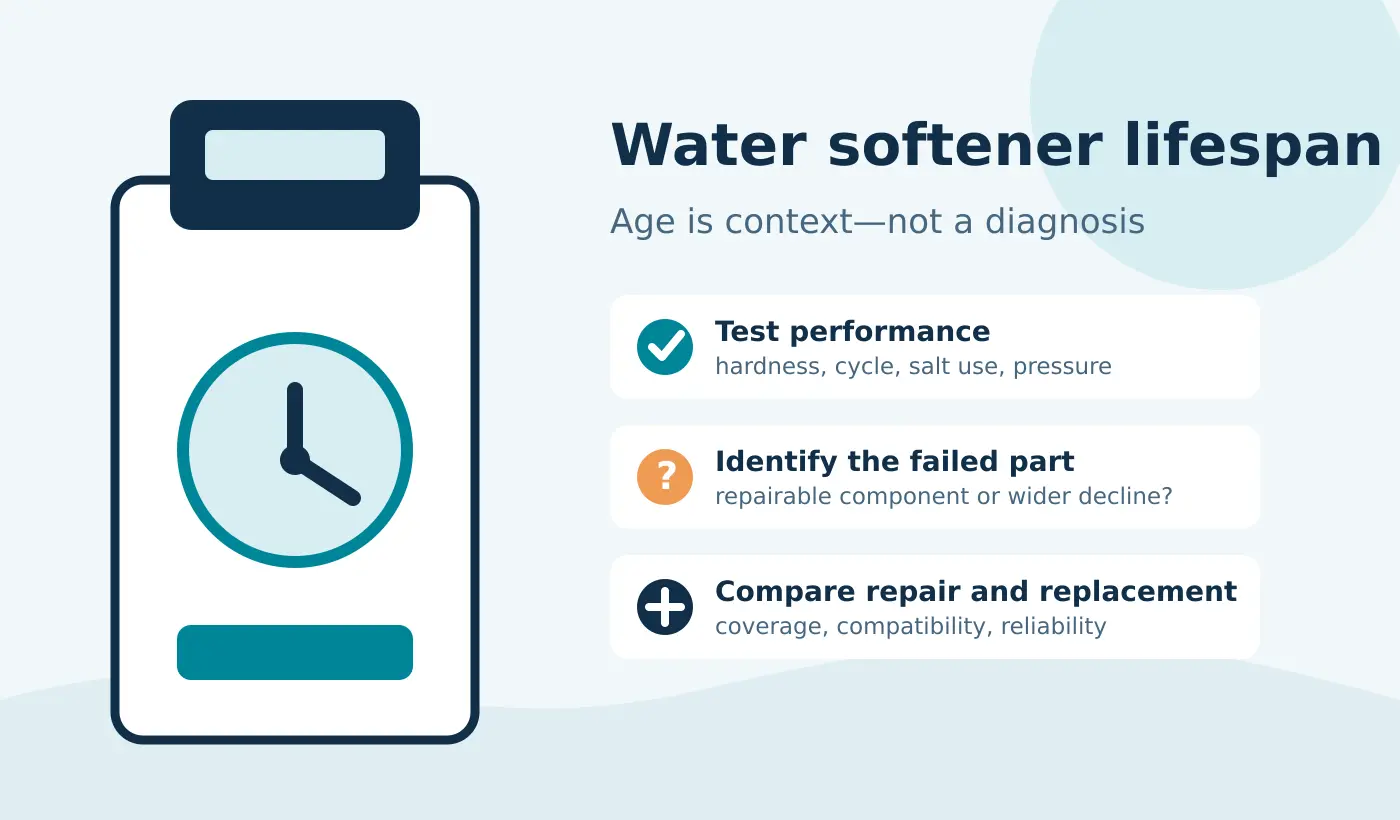
Culligan says a well-maintained, high-quality water softener may last 10–15 years or longer. Actual service life depends on water quality, household use, system design, and maintenance. Treat that as a manufacturer’s general reference—not a deadline for replacing a working unit or a guarantee that every unit will reach it. [1]
The practical question is whether your softener still treats water reliably and whether a specific, repairable problem explains any decline. Test performance, identify the failed component, and compare written repair and replacement options before deciding.
What affects a water softener’s lifespan?
The valve, resin, brine system and controller can need service at different times. A component fault does not automatically end the whole system’s useful life.
| Factor | Why it matters | Useful evidence |
|---|---|---|
| Incoming water | Hardness, iron, sediment, disinfectants, and other conditions can affect media and components | Current water analysis and the equipment’s treatment limits |
| Household demand | Water use and hardness load affect how often the unit regenerates | Metering or cycle history and household changes |
| Sizing and setup | An unsuitable capacity or incorrect programming can lead to poor performance or unnecessary cycles | Model specifications, hardness setting, and actual water use |
| Installation environment | Freezing, heat, pressure, drainage, and plumbing conditions may affect reliability | Installation manual and inspection of the site |
| Maintenance | Correct salt, permitted cleaning, and early attention to leaks or alerts help prevent avoidable problems | Maintenance log, service records, and owner’s manual |
| Parts and support | A repair is more practical when compatible parts and qualified service remain available | Manufacturer parts lookup, warranty, and written estimate |
GE identifies chlorine and heat as possible causes of earlier resin deterioration, and gives separate guidance for resin cleaning. Those observations do not establish a universal media replacement interval. [2] [3] For a diagnosed media problem, compare resin replacement options.
Use the maintenance checklist to document changes. Verify the hardness setting and whether cycles finish before blaming frequent regeneration on age.
Signs your water softener needs evaluation
One symptom is a reason to investigate, not proof that replacement is necessary. Look for a pattern supported by testing or a documented fault.
- Hardness at a confirmed softened-water outlet rises repeatedly after correct testing.
- The unit no longer meters water or begins the expected regeneration cycle.
- Regeneration fails to finish, produces recurring errors, or repeatedly leaves the valve out of service.
- Salt use changes substantially without a matching change in water use or settings.
- Pressure through the unit falls or drain flow persists outside regeneration.
- Leaks, cracking, corrosion, or damaged fittings are visible.
- Repairs become frequent or several major components show problems together.
Start with objective performance. Test untreated and softened water hardness at identified sampling points and record the units. Rheem’s operating check likewise uses hardness testing alongside controller and cycle checks. [4]
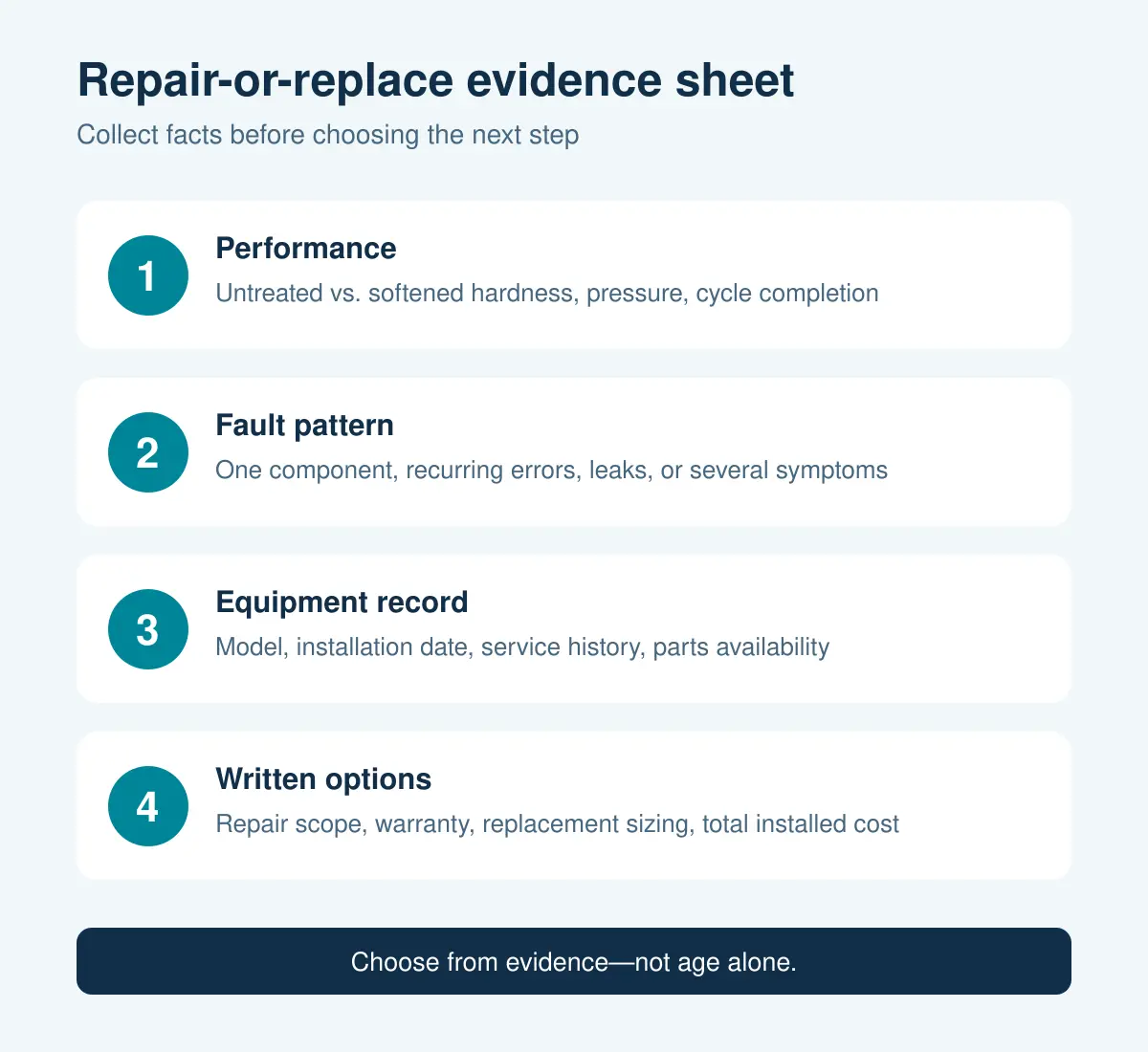
A repair-or-replace assessment you can document
- Identify the equipment. Record the brand, full model and serial number, installation date if known, rated specifications, and manual.
- Confirm the water path. Make sure the tested outlet receives treated water and the bypass is in the correct operating position.
- Measure performance. Test incoming and treated hardness using the same method and units. Note pressure changes and visible leaks.
- Observe one normal cycle if safe. Record metering, display messages, stage progression, drain behavior, and return to service. Do not force repeated cycles.
- Check maintenance history. Note salt type, cleaning performed under the manual, previous repairs, and changes in incoming water.
- Ask for a specific diagnosis. Request the failed component, evidence supporting the diagnosis, repair scope, compatible part, warranty, and expected availability.
- Compare a correctly sized replacement. Ask how the alternative was sized and which certified performance claims apply. WQA maintains listings for products certified under its Gold Seal program. [5]
Repair versus replacement decision matrix
| Finding | Repair proposal to request | Replacement comparison |
|---|---|---|
| One identified valve or control fault | Exact compatible part; labor; availability; warranty | Installed replacement scope and sizing; avoid replacing solely for the symptom |
| Confirmed media problem; tank and valve serviceable | Resin specification, amount and cause of damage | Compare complete work with a correctly sized new system |
| Several recurring faults or unavailable parts | List every fault and what remains after repair | Check removal, plumbing changes, startup and warranty exclusions |
| Results improve after correcting salt, settings or bypass | Document the restored hardness result | Monitor before paying for a replacement |
This is an editorial decision aid, not a diagnosis or a price estimate. Fill in actual written quotes: repair total $____; replacement installed total $____; excluded work ____; parts/labor warranty ____; expected downtime ____.
When repairing may make sense
A specific, serviceable fault favors comparing a repair when compatible parts are available and the remaining system suits your water and demand. Ask which test supports the diagnosis, what work is excluded, and how performance will be verified. A control, salt or setup problem can be mistaken for worn-out equipment. [4]
When replacement deserves serious consideration
Compare replacement when major faults recur, essential parts are unavailable, the vessel is damaged, or supported service cannot restore measured performance. Changing water conditions or household demand can also make the existing size unsuitable. Rheem lists repair history, efficiency and changing needs among upgrade considerations. [6]
An active leak, damaged tank or wet electrical equipment needs isolation and professional assessment before a purchasing comparison.
What to ask before buying a replacement
- What untreated hardness, iron, and other water conditions were used for sizing?
- What household demand and service flow were assumed?
- Which performance claims are independently certified, and where can they be verified?
- What salt and water settings will be used at commissioning?
- Which parts and labor are covered, for how long, and by whom?
- Who will remove the old unit and confirm the new bypass and drain installation?
- What maintenance does the exact model require?
Do not compare equipment only by a “grain” number or a salesperson’s lifespan claim. Compare verified performance, sizing, installation, warranty terms, service access, and expected operating requirements.
Use our replacement water softener sizing guide to organize the hardness, demand and capacity figures behind a quote.
Age and warranty questions
Is a 10-year-old water softener too old?
Not by age alone. Culligan publishes 10–15 years or longer as a general expectation for a well-maintained quality system, but actual life varies. Test its current performance and identify any fault before deciding. [1]
Does a warranty tell me how long the softener will last?
No. A warranty defines covered defects, parts, labor, exclusions, and time periods. It is not a guaranteed service-life forecast. Read the exact terms and keep the purchase and installation records.
Sources and model-specific guidance
Manufacturer and industry guidance reviewed September 26, 2026. Product examples are not universal service-life guarantees.
- Culligan: When to replace a water softener
- GE Appliances: Resin life and replacement
- GE Appliances: Resin beads and model-specific care
- Rheem: Checking whether a softener is working
- Water Quality Association: Certified product listings
- Rheem: When to consider an upgrade
Updated October 6, 2026: Added a repair-versus-replacement matrix and fields for actual written quotes.