
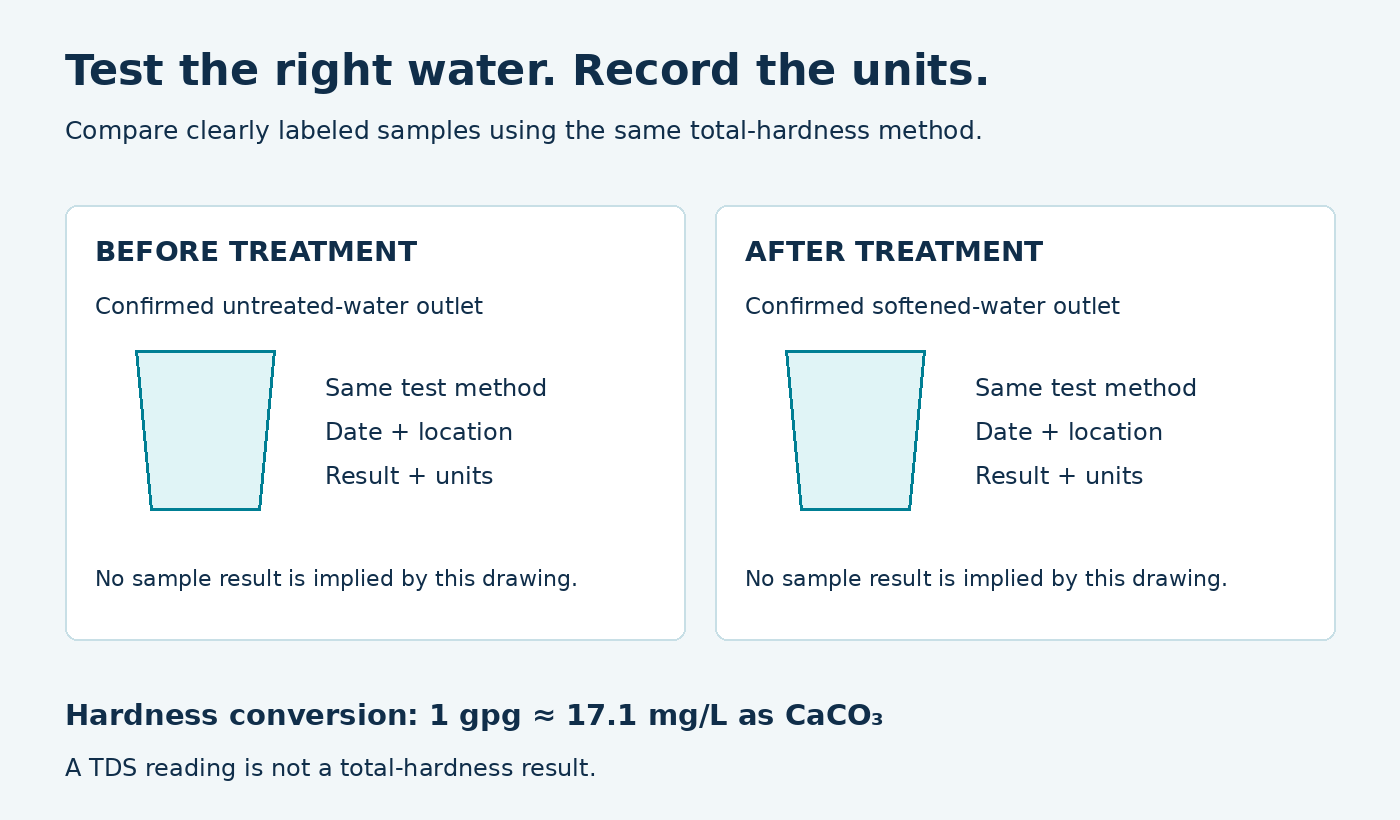
To test water hardness at home, use a total-hardness test, collect water from a known sampling point, and follow the kit’s instructions exactly. Record the result with its units. If you are checking a softener, compare untreated water with water from an outlet confirmed to receive softened water.
Hardness mainly reflects calcium and magnesium in water. It is commonly reported as an equivalent amount of calcium carbonate, written as CaCO₃. A hardness result describes this property; it is not a complete drinking-water safety assessment. [1]
Diagram above: Identify each sampling point and record the units. This illustration does not represent measured results.
To choose a softener, enter your untreated-water hardness and household water use in the water softener sizing calculator.
Already have hardness readings? Use the guided softener check to compare your results and choose the next observation before changing settings or ordering parts.
Using hardness results to choose humidifier water
A low hardness result does not establish that water has no dissolved solids. If you are testing water for a household humidifier, compare the appliance’s requirements with our guide to tap, distilled, softened, and RO water for humidifiers. Softener performance and humidifier water suitability are different questions.
Choose a water hardness test
| Method | Useful for | Check before using |
|---|---|---|
| Total-hardness strips | A quick screening result using a color chart | The chart’s range, steps, and read time |
| Drop-count titration kit | A numerical result based on a measured sample and color endpoint | Sample volume, reagent sequence, and calculation factor |
| Laboratory analysis | Documented testing or help resolving uncertain results | Whether total hardness is included and how to collect the sample |
Hach sells strips for screening and drop-count kits for quantitative testing. A strip’s color categories should not be treated as infinitely precise measurements. Choose a range that can distinguish the values you need, particularly when testing low hardness after a softener. [2] [3]
For independent laboratory testing, EPA points consumers toward state-certified drinking-water laboratories. Ask the laboratory specifically for total hardness and follow its sampling instructions; do not assume every testing package includes it. [4]
Where should you take the sample?
Decide whether you need the incoming supply’s hardness or the result after treatment. Label those samples separately. An outside faucet is not automatically an untreated-water outlet, and an indoor faucet is not proof that water passed through the softener. Confirm the plumbing arrangement with the installer if necessary.
For a softener check, use an appropriate cold-water outlet known to receive treated water. Avoid mixing hot and cold water or sampling through another treatment device unless that is what you intend to evaluate. Record the exact outlet so a later measurement can be repeated.
How to test water hardness
1. Prepare the sample
Read the test instructions before collecting water. Check reagent or strip condition, storage requirements, and expiration information. Use the supplied vessel or the clean container specified by the method. Follow its directions for flushing the outlet, rinsing the vessel, and measuring the sample volume.
For laboratory samples, use the laboratory’s container and handling instructions instead of applying a home-kit procedure.
2. Follow the kit’s procedure
With strips: follow the specified immersion and read times and compare against the chart supplied with that product. Record the chart category rather than inventing a more precise number between colors.
With a drop-count kit: measure the specified water volume, add the required reagents in order, and count titrant drops to the defined endpoint. Hach’s Model 5-B uses a color-change titration and reports hardness in grains per gallon under its standard procedure. Do not assume another kit uses the same drop factor, sample size, or endpoint. [3]
3. Record the result
Write down the method, sampling location, date, number or range, and units. If the result is beyond the kit’s scale, report it as beyond that range. Only dilute a sample if the method provides dilution instructions and the correct calculation.
An unexpected result is a reason to repeat the test carefully before changing the softener’s hardness setting. If repeat tests disagree, check the sampling point and method or ask the manufacturer or laboratory for help.
Hardness unit converter
Convert total hardness expressed as calcium carbonate (CaCO₃). This does not convert TDS or select a softener setting.
Enter your own figures, then select Calculate.
JavaScript is off. gpg = mg/L as CaCO₃ ÷ 17.1; mg/L as CaCO₃ = gpg × 17.1. Rounding does not improve test accuracy.
Calculations run in this page. These entries are not submitted to us or saved by this tool. Reloading clears them.
Water hardness sample record
Record the exact result or range shown by your method. Keep units and sampling points with the figures; this record does not interpret water safety.
Open the fill-in record and download a copy
Use “unknown” for details you cannot confirm. Entries stay in this page and are not submitted by this tool. Download a text copy before leaving; reloading clears the record.
No record prepared yet.
JavaScript is off. Copy the field labels into your own notes and keep your record there. The download buttons require JavaScript.
How to read your results
One grain per US gallon (gpg) is approximately 17.1 mg/L as CaCO₃. Multiply gpg by 17.1 to obtain mg/L; divide mg/L by 17.1 to obtain gpg. For example, 10 gpg is approximately 171 mg/L as CaCO₃. Keep sensible precision: converting a broad strip category does not make it an exact measurement. [5]
For dilute household water, ppm and mg/L are approximately equivalent when they describe the same measured substance. Confirm that the label says hardness as CaCO₃. A reading labeled “ppm TDS” is a different measurement and cannot be converted into hardness just by dividing by 17.1.
| Hardness | Classification |
|---|---|
| 0–60 mg/L | Soft |
| 61–120 mg/L | Moderately hard |
| 121–180 mg/L | Hard |
| More than 180 mg/L | Very hard |
These USGS categories describe water hardness broadly. They are not a substitute for your equipment’s specified performance target, nor a pass/fail test for drinking-water safety. [1]
Find your next softener check
Enter your own observations to choose the next check. This tool compares hardness results and operating conditions; it cannot identify a failed part or certify drinking-water safety.
Your entries are processed in this page. This tool does not submit or save them; reloading clears them. Changing an entry clears the previous recommendation.
JavaScript is required for the interactive result. Start with the checks below: stop for leaks or wet electrics; confirm sampling points, normal service and bypass position; then compare valid hardness readings with the equipment specification. Equal results do not identify a failed component.
How the decision is made: urgent conditions come first, followed by sampling and operating-state checks, then hardness comparison. A documented target and repeat-test trend refine the next step. No generic regeneration schedule, hardness target or replacement diagnosis is assumed. The model-specific Rheem operational checks illustrate why bypass, programming, metering and testing are separate checks; follow your own equipment’s instructions.
How to check whether your softener is working
Test the untreated and treated samples with the same suitable method, then compare them in the same units. Confirm that the softener is in service and follow its diagnostic or recovery procedure before assessing the result.
Rheem’s operational checks include bypass, hardness programming, flow registration, and testing after its prescribed recharge. It recommends those checks instead of relying on the “soft” feeling of the water. Use the procedure for your model; a single hardness reading does not identify which component needs repair. [6]
After maintenance, repeat the treated-water test at the same location under the conditions specified by the manufacturer. Keep the before-and-after record. A low-range test may be needed if your screening strips cannot distinguish the remaining hardness levels relevant to the equipment.
If the test confirms hard water and the salt level is not dropping, continue with the softener-not-using-salt checks.
Worked example: comparing hardness before and after a softener
Illustrative example using assumed readings, not a test performed by Soft Water Guidebook.
A before-and-after comparison helps answer two questions: how much hardness the softener removes and whether the treated result meets the equipment’s stated performance target.
For this example, assume two correctly identified sampling points: an untreated supply outlet and a cold-water faucet supplied by the softener. Both samples use the same total-hardness test, with the equipment in service and outside regeneration.
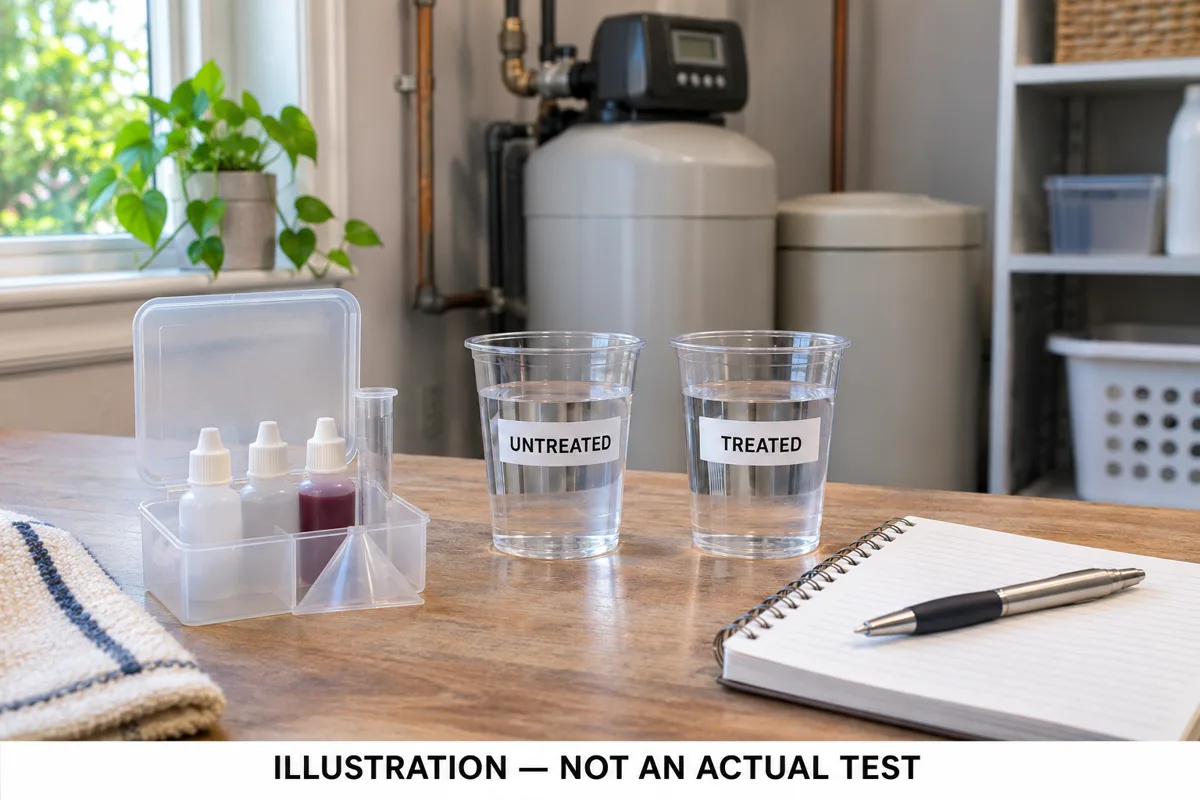
Sample results
| Sampling point | Assumed hardness | Converted hardness |
|---|---|---|
| Before the softener | 15 gpg | Approximately 257 mg/L as CaCO₃ |
| After the softener | 1 gpg | Approximately 17 mg/L as CaCO₃ |
The readings are inputs to the example. The conversions and reduction below are calculated from them.
Calculate the reduction
Multiply grains per US gallon by 17.1 to express hardness in mg/L as CaCO₃, using the conversion explained above:
- Untreated: 15 × 17.1 = 256.5 mg/L.
- Treated: 1 × 17.1 = 17.1 mg/L.
Percentage reduction = (untreated hardness − treated hardness) ÷ untreated hardness × 100.
For these inputs: (15 − 1) ÷ 15 × 100 ≈ 93%.
What would these results tell us?
These readings would indicate substantially lower hardness at the treated outlet: approximately 93% reduction under the sampled conditions. That percentage alone would not establish that the softener meets its specification. Compare the remaining hardness with the equipment’s performance target and the test method’s resolution.
For example, Hach lists a one-drop increment of 1 gpg for its standard Model 5-B procedure. Converting a reading into different units does not make the measurement more precise. A hardness result also does not measure all dissolved solids or establish drinking-water safety.
If the comparison looks different: equal readings before and after treatment show no reduction resolved by that method; repeat the tests and confirm sampling routes and service position before diagnosing a fault. If both readings fall in the lowest strip category, the chart cannot establish a smaller difference within that category. Choose a suitable lower-range method if that difference matters.
What should you check next?
Repeat the comparison at the same sampling points before the next automatic regeneration, using the same method. This helps distinguish an initially low treated-water reading from performance maintained throughout the operating interval.
If treated hardness rises unexpectedly, confirm the sampling route, bypass position, hardness programming and completed regeneration before attributing the result to worn resin.
Conclusion
A change from 15 gpg to 1 gpg translates into approximately 93% hardness reduction. A useful assessment combines that calculation with the remaining hardness, equipment specification and repeat observations across the regeneration interval.
If you rent and the readings confirm hard water at the outlets you use, our hard-water guide for apartment renters explains what to document and discuss with the property manager.
Common testing mistakes
- Using a TDS meter as a hardness test. Hach explains that TDS may not change significantly across a softener because hardness ions are exchanged for sodium ions. That reading does not show that the softener failed. [7]
- Comparing different units. Convert hardness values to the same basis before comparing them.
- Sampling the wrong outlet. Confirm whether it receives treated water.
- Changing the test procedure. Sample size, read time, and reagent sequence affect how a result should be interpreted.
- Confusing hardness with alkalinity or calcium-only hardness. Select a total-hardness test for the comparison described here.
Frequently asked questions
Can I test hardness with soap and a bottle?
Lather behavior can provide a rough observation, but it does not give the calibrated total-hardness value needed for unit conversions or programming a softener. Use a dedicated test for those decisions.
How often should I test?
Create a baseline, then retest when diagnosing a change or checking the result of maintenance. Follow any monitoring interval specified for your system. This guide does not impose one schedule on every home.
Can I use my water supplier’s report?
A supplier’s report is a useful starting point for understanding the public supply. EPA provides a Consumer Confidence Report lookup. If hardness is not listed, ask the supplier for its available hardness data. A supply report is not a measurement of water after your own softener. [8]
Does soft water mean safe drinking water?
No. A total-hardness test is not a test for all contaminants. For concerns beyond hardness, ask a drinking-water laboratory or your water authority which analyses are appropriate. EPA provides contacts for certified laboratories and guidance for private-well owners. [4]
Keep these checks in your regular water softener maintenance routine.
Sources and testing instructions
Sources checked September 24, 2026. Follow the instructions supplied with your particular test and water-treatment equipment.
- USGS: Hardness of Water
- Hach: Total-hardness test strips
- Hach: Model 5-B total-hardness test kit
- EPA: Certified drinking-water laboratories
- Hach: Grains-per-gallon conversion
- Rheem: Checking softener operation
- Hach: Water analysis manual, TDS section (PDF)
- EPA: Consumer Confidence Reports
Editorial review November 7, 2026: clarified paired hardness results and test resolution. Documentation-based guidance; no hands-on test is claimed.
Updated October 27, 2026: added a fill-in water hardness sample record with a downloadable text copy. Manufacturer-based guidance is not a report of hands-on testing.