
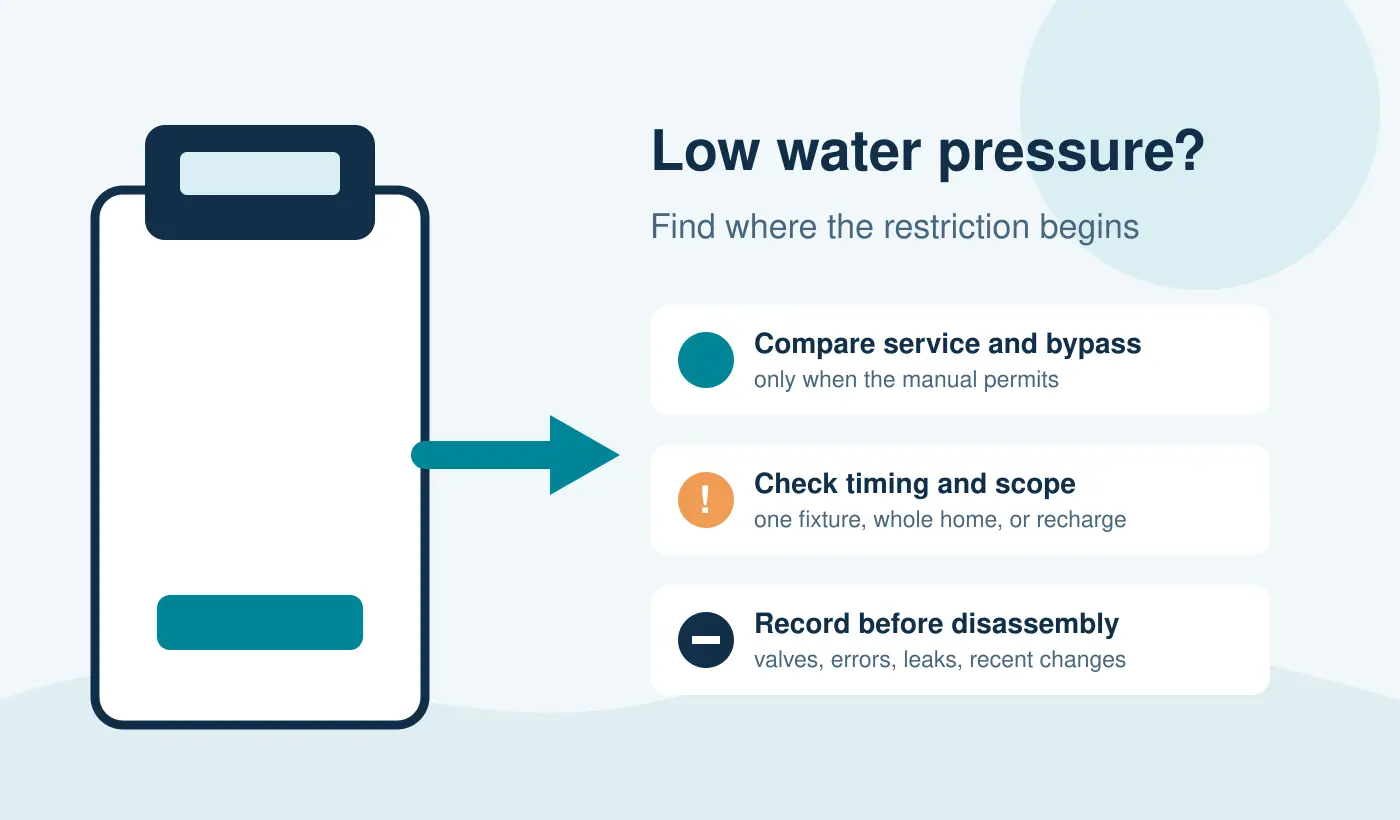
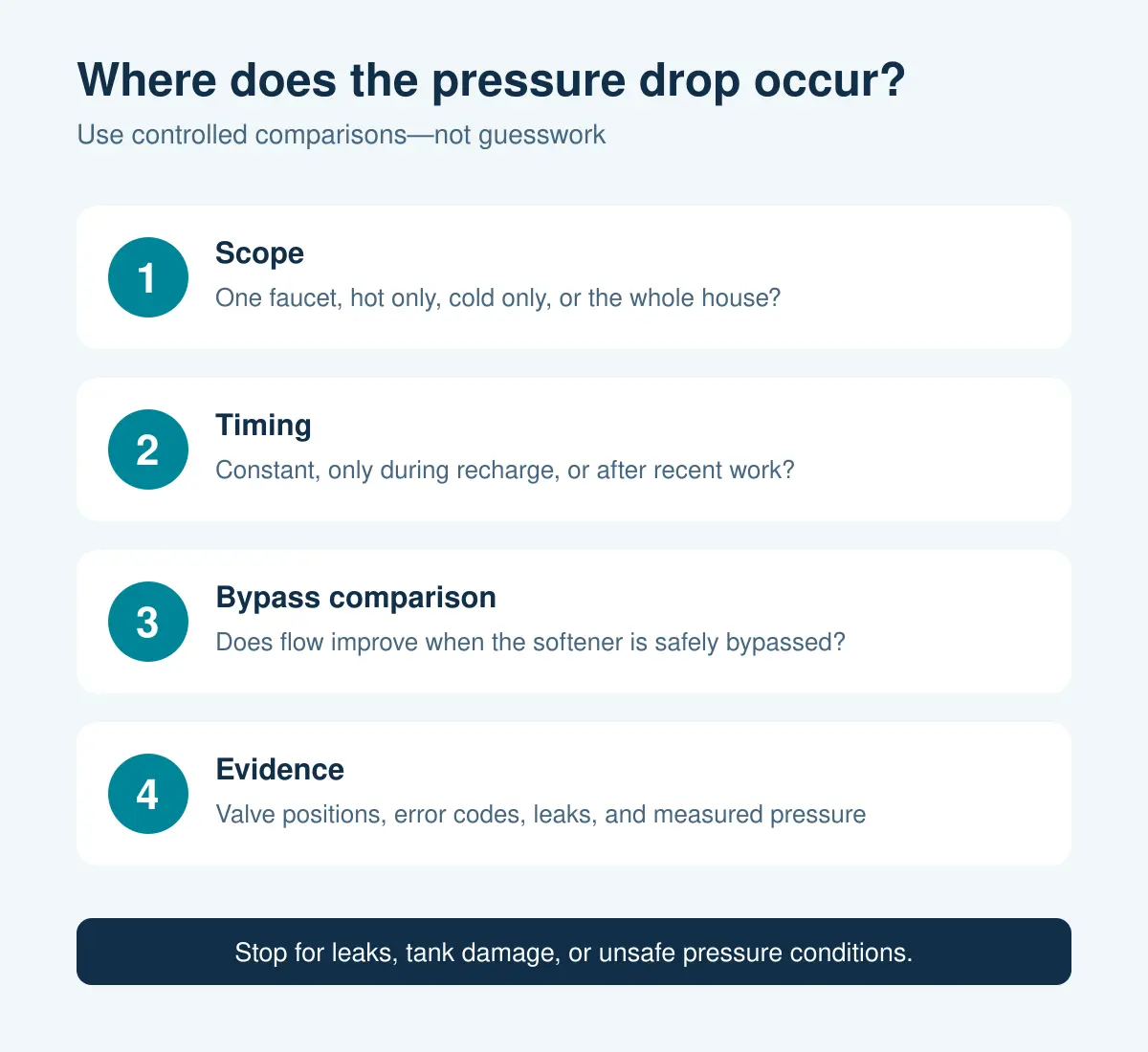
A water softener can cause low water pressure when flow is restricted inside the unit, but it is not the only possible source. First determine whether the problem affects one fixture or the whole home, whether it happens only during regeneration, and whether flow improves when the softener is placed in bypass according to its manual. That comparison helps separate the softener from the incoming supply and household plumbing. [1] [2]
Do not open a pressurized valve or resin tank to investigate. Record the evidence, use only model-approved homeowner checks, and involve a plumber or water-treatment professional when the test points to an internal restriction.
Start by defining the pressure problem
Homeowners often use “pressure” and “flow” interchangeably. Static pressure is the force in the plumbing when water is not moving; available flow is what reaches a fixture while water is being used. A clogged aerator can reduce flow at one faucet even when whole-house pressure is normal. A restriction at the softener can affect multiple downstream fixtures, especially when demand rises.
| Observation | Likely area to investigate first | Useful comparison |
|---|---|---|
| One faucet or shower is weak | Fixture aerator, cartridge, local shutoff, or branch line | Other hot and cold fixtures |
| Hot water only is weak | Water heater and hot-water plumbing | Cold flow at the same fixture |
| Whole home is weak | Supply, main valve, pressure system, whole-house treatment, or softener | Several fixtures and the softener bypass test |
| Flow falls only during regeneration | Model’s regeneration and bypass behavior | Normal service before and after the cycle |
| Flow improves in softener bypass | Restriction in or immediately around the softener | Same fixtures under similar demand |
| Flow stays low in bypass | Problem outside the softener or incomplete bypass opening | Supply, main valves, filters, pump, and household plumbing |
Use the bypass comparison carefully
Rheem and Whirlpool both use a bypass comparison in their model-specific low-pressure guidance. On the units they cover, if pressure remains low in bypass, the softener is not identified as the source; if flow improves, their troubleshooting continues with checks for buildup or blockage. They also warn that a three-valve bypass that does not open fully can itself restrict flow. [1] [2]
- Choose repeatable fixtures. Use two or three downstream faucets or showers and note whether hot, cold, or both are affected.
- Turn off large competing uses. Avoid comparing one test while a washer, irrigation system, or another shower is running.
- Record the current operating state. Note whether the softener shows service, regeneration, or an error.
- Move to bypass only as your manual instructs. Our bypass valve guide helps you identify the arrangement. Bypass designs and valve directions differ. Never force a stuck control.
- Repeat the same fixture checks. Compare flow rather than relying on a vague impression from a different faucet.
- Return the system to the documented service position. Confirm valve positions before ending the test.
Water in bypass is generally untreated, so the comparison is a diagnostic step rather than a long-term fix. Do not initiate repeated regeneration cycles while trying to identify a pressure restriction.
If pressure stays low in bypass
Look beyond the softener. Confirm that the main shutoff and any accessible isolation valves are fully open and that no recent plumbing work changed their position. Check whether neighbors or the water utility report a supply issue. Homes on a well may require evaluation of the pump, pressure switch, pressure tank, or well yield by a qualified professional.
Whole-house filters installed before or after the softener can also restrict flow when loaded. Use their pressure indicators or replacement instructions if provided. Do not remove a filter cartridge and leave an unapproved empty housing in service.
If only one outlet is affected, clean or inspect the fixture as its manufacturer directs. If both hot and cold flow are low throughout the house, or measured pressure is outside the limits specified for installed equipment, call a plumber. Do not adjust a pressure-reducing valve or well controls without the appropriate procedure and experience.
If pressure improves in bypass
The comparison points toward the softener or its immediate connections, but several causes remain possible. Pentair’s whole-house softener manual lists mineral or iron buildup in the resin tank, obstructed distributors, damaged distributors, and a plugged riser among model-specific causes of pressure loss. Those internal diagnoses and repairs require the applicable manual and often professional service. [3]
Mineral, iron, or sediment buildup
Deposits can restrict paths through the valve or media bed. Pentair’s IntelliWater manual also lists iron buildup and foreign material released by recent plumbing work among possible causes for the covered system. That guidance should not be converted into a universal instruction to add cleaner or disassemble a valve. [4]
Record the source water, any known iron or sediment, the date the pressure changed, and recent plumbing work. Use only cleaners explicitly approved for your model and water condition. Some procedures require cycling the unit and may carry additional risks on older equipment.
A blocked screen, distributor, valve, or riser
Some models include an accessible sediment screen; others do not. Internal distributors and risers are pressure-containing components inside the treatment path. Do not assume a screen exists, remove the control head, or probe the resin tank based on a generic guide.
Ask the service provider which pressure or flow comparison supports the diagnosis, where the restriction was found, and whether the proposed part is compatible with the full model number.
Resin-bed restriction
Rheem and Whirlpool describe media condition as one possible source of a pressure drop on their covered systems. Resin age alone is not proof: incoming water, fouling, distributor condition, and valve restrictions can produce similar symptoms. [5]
Before agreeing to water softener resin replacement, request evidence that the media bed—not the valve, plumbing, or supply—is the restriction. Keep this scope separate from judging whether the entire softener has reached the end of its useful life.
Incorrect or partially open valve positions
A service or bypass valve left between positions can restrict flow. Compare every accessible handle with the installation diagram. Do not force a seized valve; a damaged bypass can leak or fail to isolate the equipment.
Does regeneration temporarily affect pressure?
It can, depending on the system design and household demand. Some single-tank softeners pass untreated water while regenerating, and the drain flow needed for backwash or rinse can add demand to the supply. Other systems use different arrangements. Check the manual rather than assuming every softener behaves the same.
Confirm that the cycle ends and normal service returns within the model’s expected process. Our guide to water softener regeneration duration explains how to distinguish the scheduled start, active stages, and return to service. Pressure that remains low after the unit returns to service needs a separate investigation.
Safe checks before calling for service
- Confirm whether one, several, or all fixtures are affected.
- Compare hot and cold flow.
- Note whether the problem is constant or tied to regeneration.
- Record model, serial number, display messages, and valve positions.
- Look for visible leaks, kinked exposed hoses, or recent plumbing changes without disconnecting anything.
- Use the documented bypass comparison if the valve operates normally.
- Check your maintenance record for changes in salt use, cleaning, or service.
- If softening performance is also in doubt, test untreated and softened water hardness separately from the pressure diagnosis.
When to stop troubleshooting
Stop and get help for an active leak, a cracked tank or fitting, resin particles at fixtures, sudden severe pressure loss, unusual pipe movement, or wet electrical equipment. Use the documented isolation procedure only if you can identify the correct valves safely.
Contact a plumber when pressure remains low with the softener correctly bypassed or when the wider supply system is suspect. Contact the manufacturer, installer, or water-treatment technician when the restriction is localized to the softener, an error is displayed, or internal service is required.
Sources and model-specific guidance
Manufacturer documentation reviewed September 26, 2026. Follow the manual for your exact model before operating valves or performing maintenance.
- Rheem: Low water pressure troubleshooting
- Whirlpool: Low water pressure in water softeners
- Pentair: Whole House Water Softening System manual
- Pentair: IntelliWater Connected Water Softener manual
- Rheem: Old or expired resin
Updated October 16, 2026: added a working calculation or simplified overlapping explanations. Examples and records are not field-test results.