
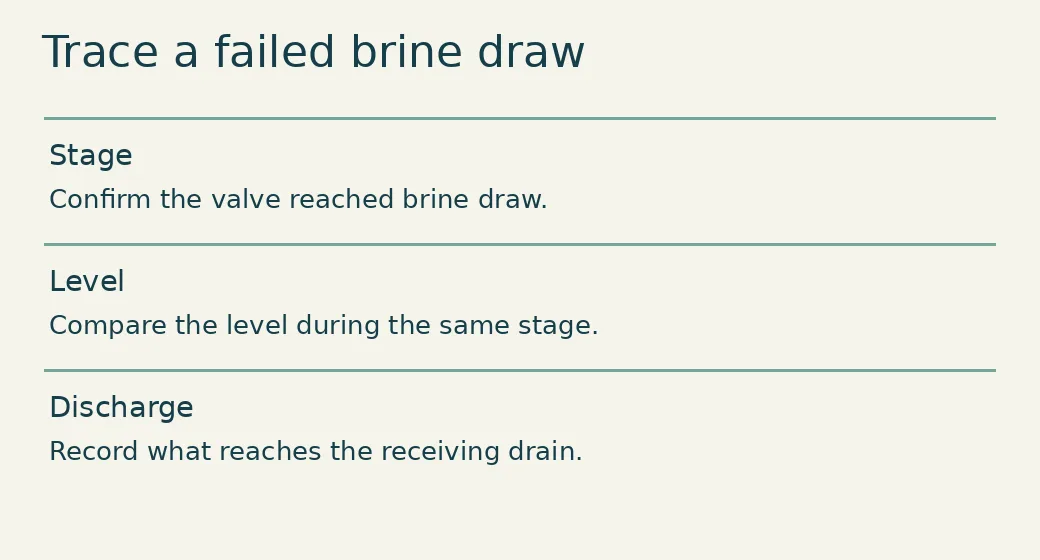
If the brine level stays high after regeneration, the injector is one possible cause. The most useful observation is whether the level drops during the documented brine-draw stage. A tank that refills later can look just as full after a successful cycle as it did before. Watching the right stage gives a technician much better evidence than a single photo of a full tank.
Establish whether the softener actually attempted a draw
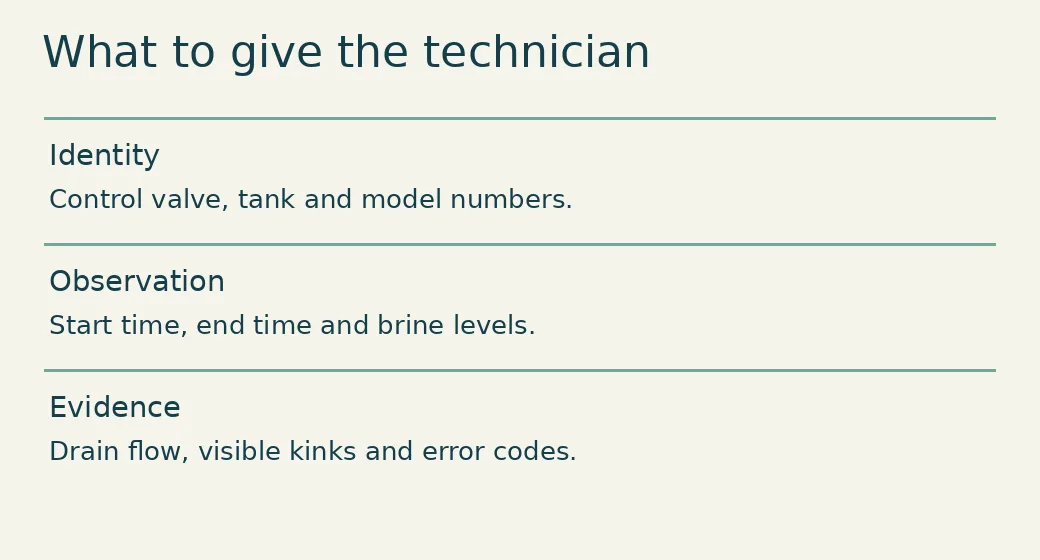
- Record the control-valve model and the regeneration sequence from its manual. Use the valve identification label as well as any label on the tank. A controller faceplate alone may cover more than one configuration.
- Find a repeatable way to see the liquid level without disconnecting the brine line or moving the float. If salt hides the level, record it as unknown. The brine well diagram may help you identify the observation point.
- During a normal cycle, note the time and level as brine draw begins and again later in the same stage. From a safe distance, record whether discharge reaches the drain and whether the drain backs up. Leave the line secured.
Some controls combine brine draw and slow rinse in one timed stage. Once the available brine has been drawn, the liquid level need not keep falling for the rest of the timer. Compare your observation with the sequence for your valve before diagnosing an interruption.
Interpret the observation before choosing a part
| Observation | Next check |
|---|---|
| No draw stage observed | Confirm the cycle ran and the valve advanced. Start with the regeneration checks. |
| Level falls during draw and rises later | Identify the refill stage. If treated water still tests hard, record the hardness and review salt and regeneration history. |
| Level stays high during confirmed draw; drain flow looks weak | Inspect the exposed hose route for restrictions. Use the drain flow checks before assuming the injector is plugged. |
| Level stays high, with discharge visible | Record the visible condition of the brine line, valve model and any error. Visible discharge alone does not establish adequate flow or suction. |
What the Fleck 5600SXT manual actually identifies
For its downflow 5600SXT, Pentair lists a plugged drain flow control, injector or injector screen among the possible causes of failed draw. Its troubleshooting table also identifies low line pressure, an internal control leak and failure to cycle. Those causes lead to different service decisions. Seeing water in the salt tank cannot tell you which component needs replacement. See the Fleck 5600SXT Downflow Service Manual, troubleshooting table.
For example, a homeowner who notices a crushed drain hose immediately after moving a cabinet has a visible restriction to document first. A homeowner who sees an unobstructed external route and repeated failure at the same stage has a different service call. Neither observation determines the correct injector size or color.
Cleaning an injector or replacing the assembly
Use the service instructions and parts list for the exact valve, flow direction and tank configuration. Ask the service provider to confirm whether the screen, injector, seals or complete assembly is involved. A listing that fits the brand can still be the wrong configuration. Do not change injector size to compensate for an unresolved draw problem.
Opening a valve body requires the specified isolation and depressurization procedure. Leave internal work to a qualified service provider if you cannot match the assembly or confirm pressure relief. In a cabinet softener whose manual calls the assembly a nozzle and venturi, follow the nozzle and venturi identification guide and that model’s illustrated maintenance procedure instead of copying Fleck disassembly steps.
If your main complaint is salty water at the tap, use the salty-water troubleshooting guide to organize the cycle and rinse information. That symptom alone does not identify a failed injector.
Confirm the result during the next documented check
Record whether the level falls during draw, whether refill occurs at the expected stage and whether there is leakage at any serviced connection. Compare treated-water hardness with your earlier reading at the same tap. If the tank overflows or water escapes outside the appliance, stop the test and follow the equipment’s safe isolation instructions. For a persistently high level across cycles, use the brine tank water-level record to keep the observations together.