
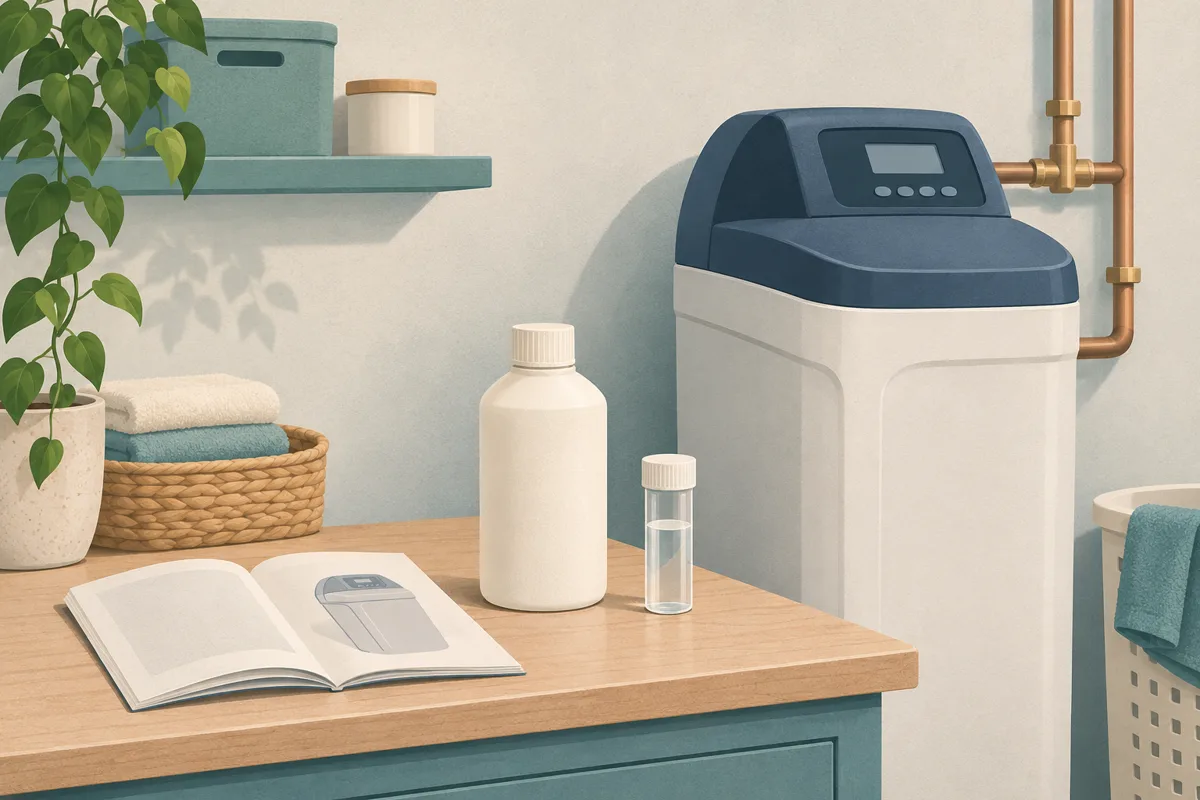
A water softener cleaner is a product used to address specified deposits inside a compatible softener. Choose it by your equipment instructions and the buildup it is intended to treat—not simply because the water feels hard. It does not replace regeneration salt, physical tank cleaning, or repair of a failed valve.
This guide helps you decide whether a cleaner fits the problem, compare product instructions, and prepare a cleaning record. Product examples below come from manufacturer documentation, not our own performance tests.
Do you need a water softener cleaner?
Start with two questions: does the owner’s manual specify a cleaning product or schedule, and is the softener operating normally? A scheduled treatment on a working unit is different from trying to restore a unit that will not draw brine or complete regeneration.
| What you observe | Next step |
|---|---|
| Manual calls for periodic cleanser | Identify the exact product, application point, dose, and rinse procedure. |
| Loose dirt or sludge in the salt tank | Check the tank-cleaning procedure; a bottle does not physically remove debris. |
| Hard water with an unchanged salt level | Investigate salt supply, regeneration, and brine flow before treating deposits. |
| Leak, error, or continuous drainage | Follow fault instructions or arrange service before adding chemicals. |
If you have not measured performance, compare untreated and treated water hardness. Record the sampling points and units. Hardness alone cannot identify iron fouling or establish that cleaning is the remedy.
Resin cleaner, brine-tank cleaning, and sanitizing are different jobs
The resin is the treatment medium; the brine tank stores regeneration salt. Washing the accessible salt tank is not the same operation as passing an approved cleaner through internal components. Use our brine-tank cleaning guide when physical residue is the issue.
Sanitizing is another separate procedure. A cleaner marketed for mineral or iron deposits should not be assumed to disinfect a system. If contamination is suspected, contact the equipment manufacturer or water-treatment professional for a procedure suited to the situation. Do not substitute a household disinfectant or surface descaler.
How to compare water softener cleaners
Read both the equipment manual and the current product label. A product’s broad compatibility claim is not permission to ignore a restriction in your manual. Keep the full product name and formulation: two bottles from one brand may have different purposes.
- Intended deposit: Does the label address the condition you are investigating?
- Equipment approval: Is it suitable for your softener and any combined filtration media?
- Dose basis: Is the amount per treatment, per resin volume, or supplied through a feeder?
- Application: Which opening is used, and what operating position is required?
- Aftercare: What regeneration, water-use restriction, and final flushing are specified?
For example, Whirlpool describes its cleanser as a diluted phosphoric-acid solution for internal buildup. Its support instructions recommend treatment every four months for the equipment covered, direct users to model-specific application details, and require recharge followed by flushing. That schedule and chemistry are not universal specifications for all softeners. [1]
Pro Products describes Res Care as a resin-cleaning product for contaminants that salt alone may not remove and offers a feeder-based maintenance approach. This illustrates why a manually dosed bottle and a continuous feeder should not share an improvised dosing schedule. It is a manufacturer description, not evidence that this product is the best choice for your system. [2]
Before using a cleaner: a practical checklist
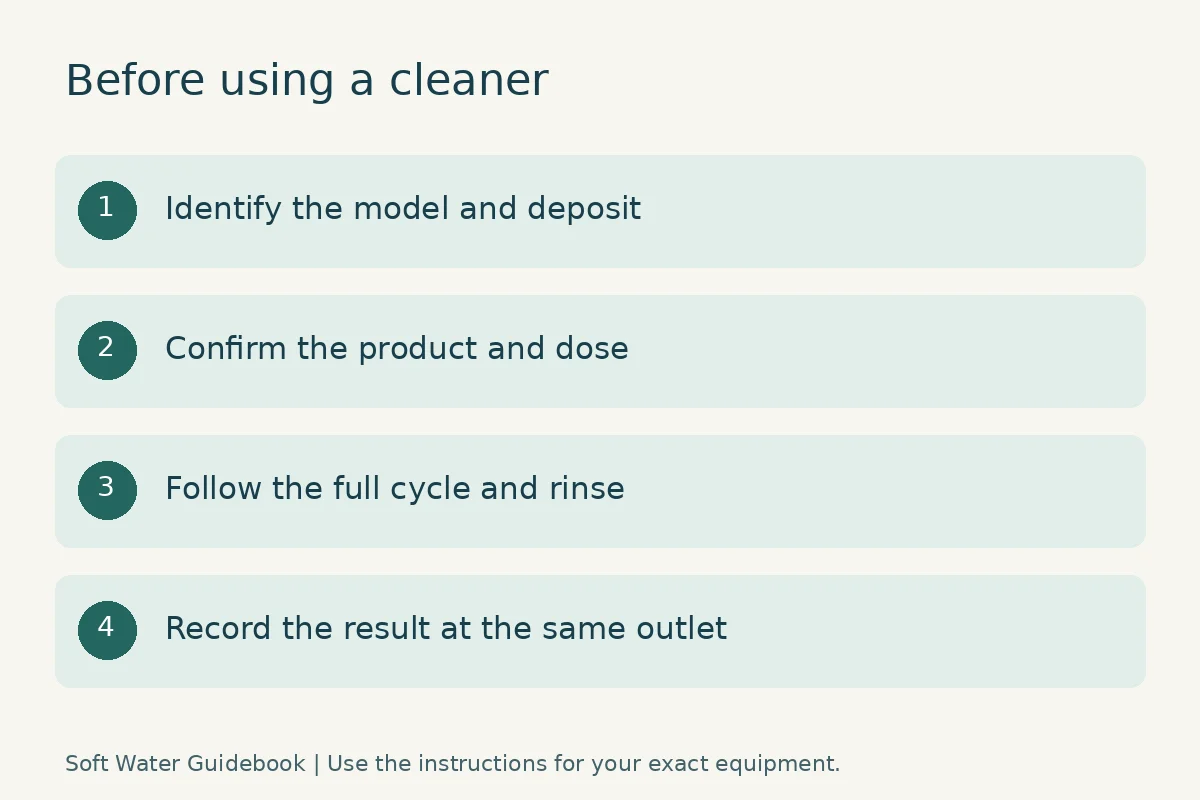
- Find the procedure first. Have the model, current product label, and owner’s guide together before opening the bottle.
- Check for an unresolved fault. A unit that cannot complete its required cycle may not clear the treatment as intended.
- Plan the treatment window. Follow any instruction to avoid household water use. Tell other people in the home when that restriction applies.
- Confirm the application point. A brinewell is not a drinking-water faucet or an arbitrary plumbing opening. If the illustrated parts do not match your unit, stop and ask support.
- Use only the specified quantity. Do not combine cleaners or add extra product to compensate for uncertain results. Follow the label’s handling precautions.
- Complete the specified cycle and flush. Do not return to normal use just because the controller has stopped making noise.
Whirlpool’s linked instructions, for example, call for avoiding water use during recharge and running cold faucets afterward. Follow the exact branch for your model rather than applying its bypass-handle position to another brand. [1]
Keep a record that makes the result useful
Copy these fields into your maintenance record: model; reason for treatment; product and label version; dose; application point; cycle start and finish; flushing completed; hardness before and after at the same outlet; any error or unusual observation.
A lower hardness result afterward is useful evidence of current performance, but it does not isolate the cleaner’s effect from the regeneration that accompanied it. If performance remains poor, share the record with support instead of repeating stronger treatments. Our resin replacement guide explains why hard water alone does not prove the resin is worn out.
Common questions
Can I use vinegar instead of water softener cleaner?
Not as a general substitution. Use vinegar only if your equipment manufacturer supplies a compatible procedure for that purpose. An ingredient that removes deposits from one household surface is not automatically suitable for resin, seals, or a combined treatment system.
Does cleaner replace salt?
No. Keep the required regeneration salt supply and treat cleaning as a separate task. If the tank ran empty, follow the out-of-salt recovery steps for your model.
Should I clean every softener every four months?
No. That interval is a Whirlpool example, not an industry-wide rule. Use your model’s schedule and any water-specific guidance from its manufacturer.
Sources and review
Reviewed November 4, 2026. Manufacturer instructions inform this guide; no hands-on product comparison is claimed.