
If your water softener appears to have no water in the brine tank, first check whether the water is hidden beneath the salt and whether the current level matches your model’s cycle. An apparently dry surface is not enough to diagnose a filling failure.
Rheem starts its no-water troubleshooting by looking into the brinewell, the narrow tube that houses the brine valve. Water may be present at the bottom even when it is not visible across the salt surface. [1] Start with observation before adding anything.
Do not force covers, push tools into valve parts, or copy a universal water-depth target. Even Rheem’s guidance describes a level that changes through recharge; one snapshot needs to be interpreted in context. [2]
Is it hidden water, the wrong stage, or a refill problem?
- Water is visible at the approved inspection point: record its level and the current stage. The tank is not completely dry. If treatment is satisfactory and the level matches the manual, that observation alone does not call for a manual top-up. If the level is high, use the high-water guide.
- No water is visible, but the cycle stage is unknown: identify the model’s refill timing below. Do not diagnose a failed fill from a view of the salt surface or from the first sound of water at the drain.
- The supply route is in bypass: establish why it was bypassed before changing it. Compare the actual assembly with the bypass identification guide; do not copy a push-pull motion onto paired knobs. A valve position can explain an interrupted supply without identifying a blocked component.
- The correct fill stage has occurred, but no refill was established: record that result and use the exact model’s filling diagnostic or service support. State whether treated water is also hard. Neither an empty-looking tank nor hard water on its own identifies the failed part.
No salt and no refill are different findings. Record each separately. Adding salt does not demonstrate that the water path works, and adding water repeatedly does not demonstrate that automatic refill has recovered.
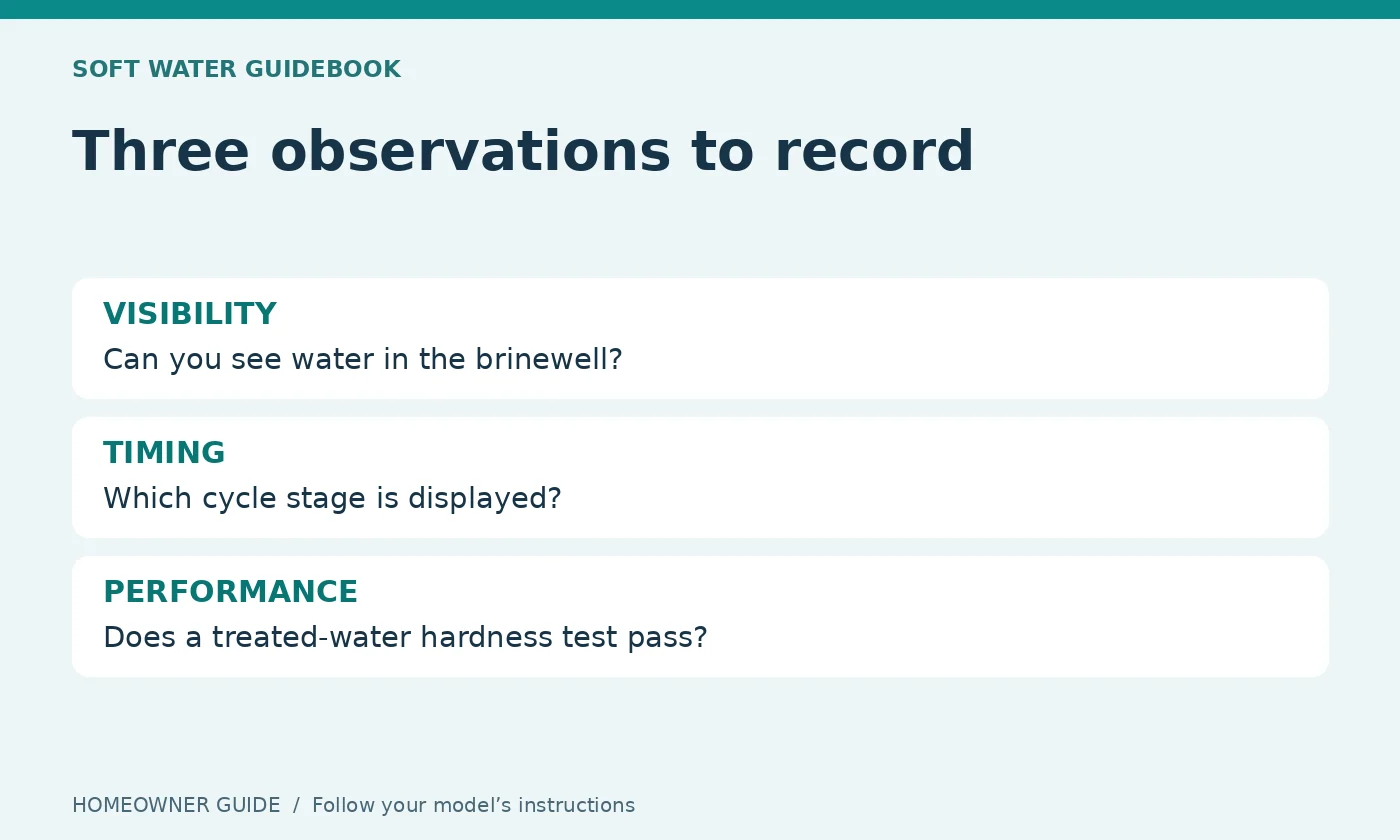
Compare refill timing before diagnosing an empty tank
| Documented equipment | Where refill occurs | Useful observation |
|---|---|---|
| Whirlpool WHES40 / WHES44 | The manual’s diagnostic starts with fill. Manual, p. 21 | Check the brinewell during the documented fill check; the salt surface can hide water. |
| Pentair 5600SXT VT softener systems | The system manual places brine refill last, supplying the next regeneration. Manual, pp. 3 and 9 | A low level before refill does not show whether the final refill succeeded. Record the displayed stage. |
These examples explain different observation times; they do not prescribe a common water depth. Use the matching manual edition and approved diagnostic. Do not advance stages merely to copy this comparison.
When an initial drain flow is not a failed fill
Rheem’s filling guide describes a possible Clean stage with extra backwash before fill. For the equipment covered there, hearing drain flow immediately after recharge starts does not by itself establish that refill has failed. Identify the displayed stage and use the matching sequence. This is a reason to interpret timing, not an instruction to skip stages. [3]
When a filling problem becomes more likely
A useful combination of evidence is a tank that remains dry when the manual says it should fill, plus treated water that is no longer soft. Rheem explains that a blocked filling route can prevent the system from preparing the brine needed to regenerate its media. [3]
That still does not identify the failed component. Supply configuration, flow through the fill path, and the brine-valve assembly are separate checks. Rheem’s diagnostic distinguishes them with a model-specific flow test. Because that procedure disconnects tubing and operates the valve, use the official instructions or have a technician perform it. [3]
For a homeowner’s record, photograph visible tubing without disconnecting it, note the controller message, and record any recent cleaning or installation work. Do not blow into tubing, defeat a float, or repeatedly advance cycles based on instructions for an unidentified model.
Should you pour water into the brine tank?
Only when your model’s startup, cleaning, or recovery instructions specifically require it. An initial fill is different from correcting an ongoing failure to refill automatically. Repeated manual top-ups can hide the symptom without resolving the cause.
If you recently cleaned the tank, revisit the manufacturer’s reassembly and refill steps alongside our brine-tank cleaning guide. If the tank still contains salt but the level never changes, also review why a softener may stop using salt.
How to confirm the softener is working afterward
After the prescribed recovery and a completed cycle, use a hardness test at a treated cold-water faucet. Record the sample location and compare it with untreated water. Checking only the tank level does not confirm that softening has resumed.
Refill observation record
Use the permitted inspection point for your model. Record uncertainty instead of pouring in water or advancing stages to make the tank look normal.
Open the fill-in record and download a copy
Use “unknown” for details you cannot confirm. Entries stay in this page and are not submitted by this tool. Download a text copy before leaving; reloading clears the record.
No record prepared yet.
JavaScript is off. Copy the field labels into your own notes and keep your record there. The download buttons require JavaScript.
Keep a photograph of the display and the permitted inspection point with the downloaded record. Do not send personal details or files through this worksheet; contact your equipment support separately.
Sources and review notes
New comparison and decision-route sources reviewed October 17, 2026. This guide compares manufacturer guidance; it does not report hands-on testing. Your model’s manual controls service procedures.
- Rheem: No Water in Tank
- Rheem: How Much Water Should Be in the Salt Tank?
- Rheem: Is My Softener Filling?
Updated October 27, 2026: added a fill-in refill observation record with a downloadable text copy. Manufacturer-based guidance is not a report of hands-on testing.