
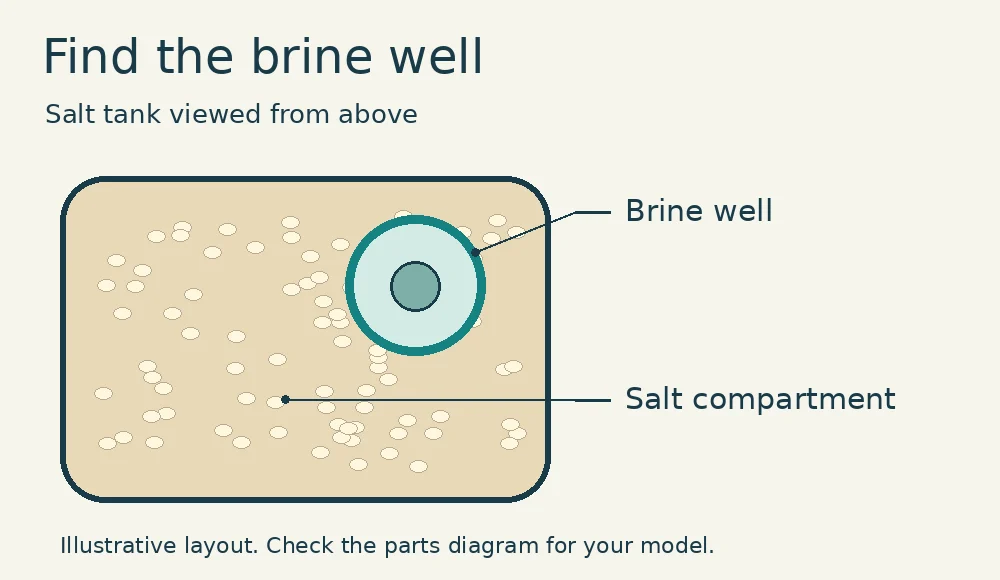
The brine well is the narrow upright tube inside a water softener’s salt tank. It houses the brine valve and float assembly. Open the lid you normally lift to add salt: the large compartment that holds the pellets is the salt tank, and the smaller tube within it is the part to look for. Some manuals spell it brinewell.
How to find the brine well in your water softener
- Start at the salt opening. On a two-tank system, look in the tank you refill with salt. On a cabinet-style unit, open the salt lid. You can identify the part without removing the control head or disconnecting a hose.
- Look for the rim of a narrow tube. It may have its own cap. The useful clue is its position inside the salt compartment. Color, diameter, and location around the edge can vary.
- Match it to your model’s parts drawing. Find the model number on the unit and look for “brinewell,” “brine well,” or “brine valve assembly” in the manual. The well is the outer tube. The valve assembly fits inside it. If the drawing and the tank look different, check the model number before lifting any parts.
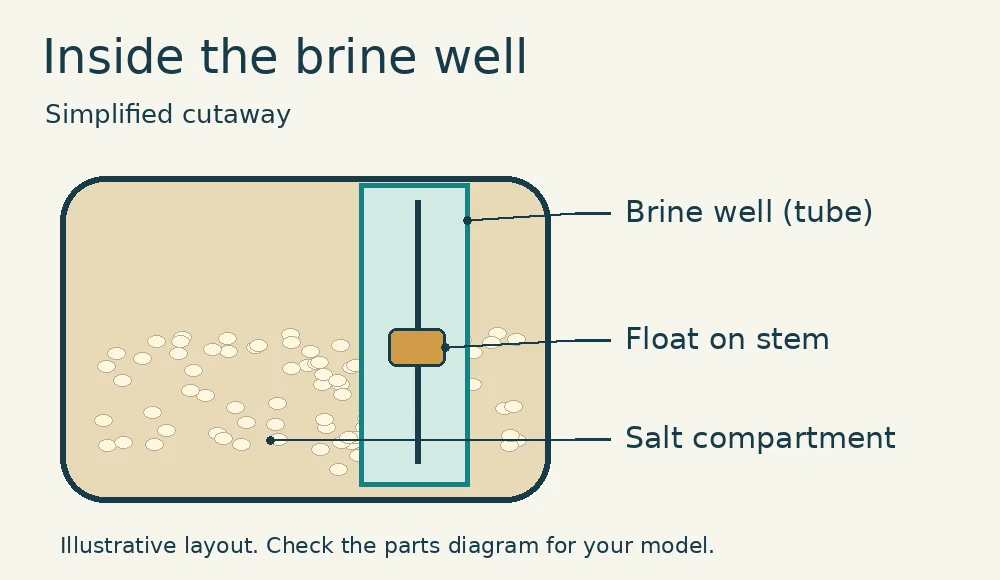
What does the tube do?
Think of the well as a housing. It gives the brine valve and float a space inside the tank while the surrounding compartment holds the salt supply. On the Rheem units covered by its support guide, the foam float provides backup protection if water rises too high. The stops on its stem are preset. A float that sits at a different height from the one in an illustration is not, by itself, a reason to move those stops. See Rheem’s float explanation and photo.
Where does the salt go?
Add softener salt to the large compartment around the well. Keep pellets and crystals out of the narrow tube. Whirlpool explains that accumulated salt inside the well can interfere with the float. If salt has already fallen in, its instructions distinguish a few stray pellets from a larger deposit. Check the instructions for your own unit before adding water or taking it apart. See Whirlpool’s illustrated salt placement guide.
If your question is how high to fill the surrounding compartment, use the salt level guide. If you have a bottle of resin cleaner, read its label alongside the softener manual. The instructions for adding pellets do not tell you where a liquid treatment belongs. Our guide to water softener cleaners explains what to check.
What if the well is the only place you can see water?
The top of the salt can look dry even when there is water lower in the tank. For the units covered by its fill guide, Whirlpool suggests shining a flashlight down the well to see the bottom. That observation answers one question: whether water is visible at that moment. Interpreting it requires the model and the stage of regeneration. See Whirlpool’s fill check.
If the unit seems dry, record when you looked relative to the last recharge and follow the checks for a brine tank with no visible water. If your purpose is to remove sludge or clean the tube, go to the brine tank cleaning guide for model-specific examples. For a simple salt refill, identifying the large compartment is all you need.