
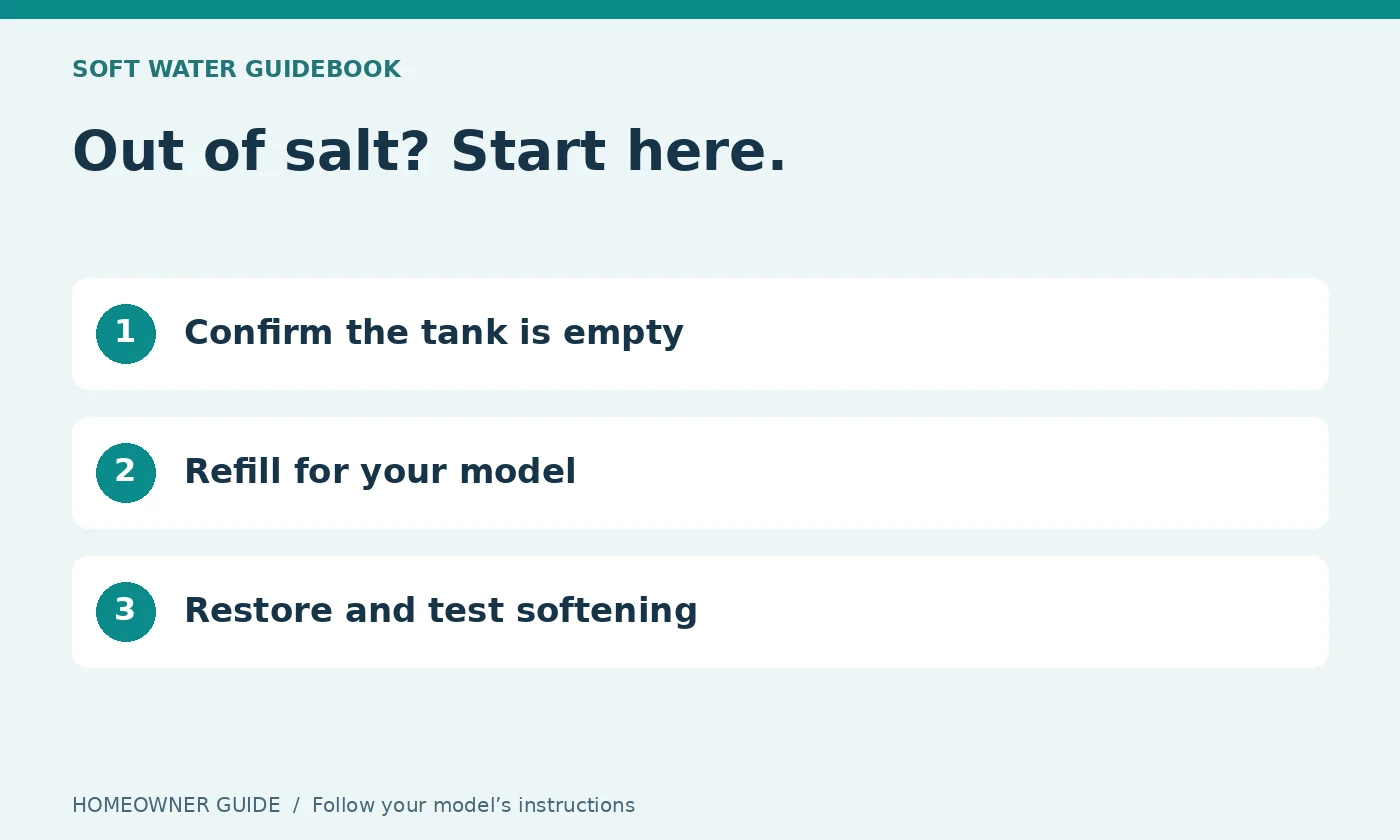
If your water softener is out of salt, refill it with a manufacturer-approved product and follow your model’s instructions for restoring softening. A manual recharge may be needed; adding salt does not itself complete regeneration. GE lists running out of salt as a reason to initiate a manual recharge. [1]
Do not assume the unit needs replacement. Whirlpool says that running out of salt should not damage the systems covered by its guidance, although it recommends adding salt promptly. [2] The next task is to restore operation and check the result.
1. Confirm that the usable salt is actually gone
Look inside the brine tank and compare what you see with the manual. An empty tank and a crust of salt suspended above the water call for different next steps. If you still see salt but suspect a gap underneath, use the salt-bridge guide before assuming the tank is empty.
Record when you found the problem and any hardness changes you noticed. “Empty since at least Monday” is more useful for later troubleshooting than assuming the last recharge worked normally.
2. Refill to your model’s recommended range
Use the salt type specified for the softener. Whirlpool’s salt guidance, for example, distinguishes approved water-softener products from unsuitable substitutes such as table salt and deicing salt. Product suitability can differ by equipment, so check your own manual. [3]
Follow the unit’s fill range rather than emptying every spare bag into it. Our salt-fill guide covers the storage-level question. For this recovery, note the product and weight added so you can track what happens next.
3. Use the prescribed recovery or recharge procedure
Find the instructions for “out of salt,” “manual regeneration,” or “recharge now.” Check whether the manufacturer specifies a wait after refilling so brine can form. Do not borrow a waiting period or button sequence from another brand.
On the GE systems described in its manual-recharge guidance, you can request an immediate cycle or one at the scheduled time. Hard water can be supplied during the cycle. The right command and operating behavior still depend on your model. [1]
Once started, let the prescribed cycle finish. See how long regeneration can take for the factors that affect completion; the article is not a substitute for your controller’s cycle indication.
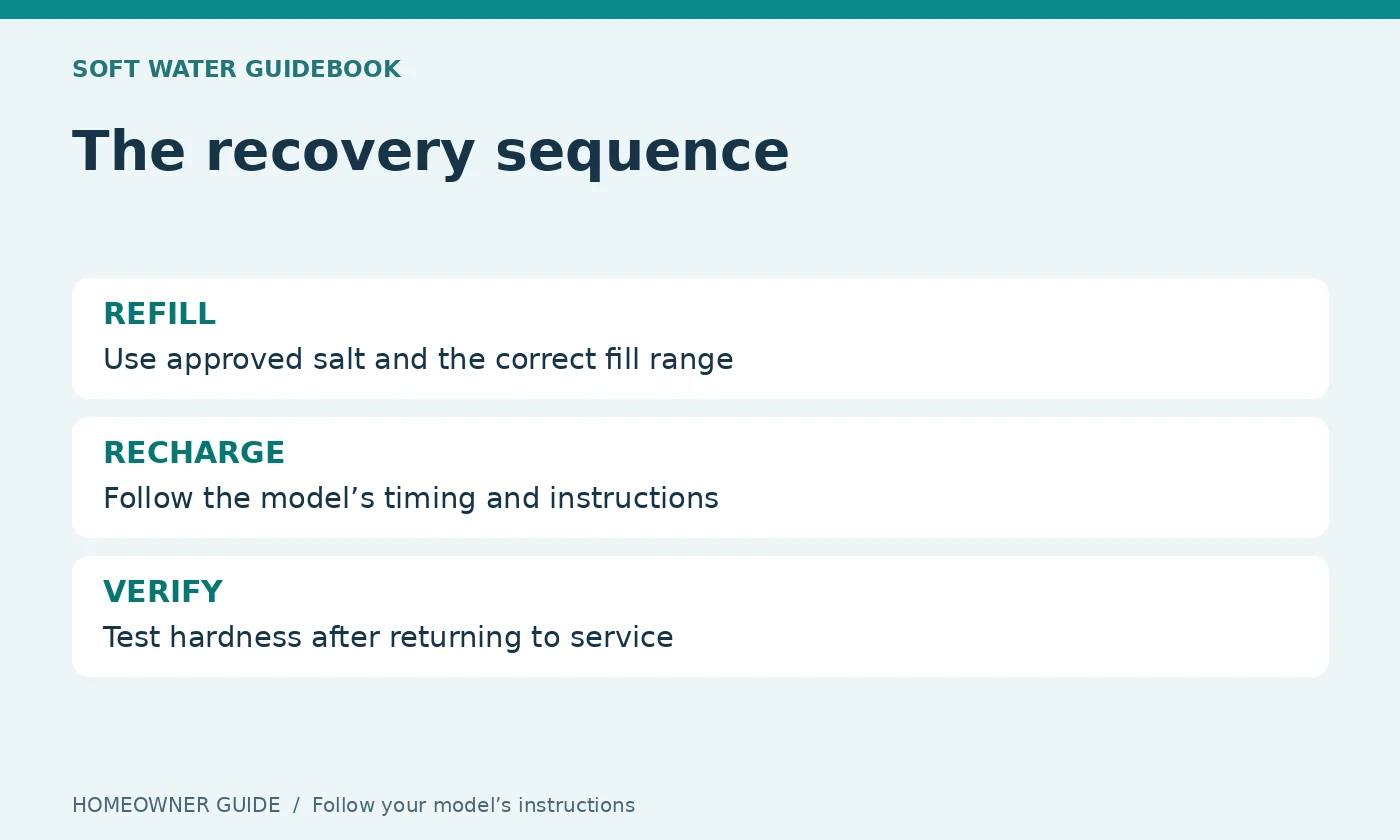
Recovery card: Whirlpool WHES40 / WHES44
The WHES40/WHES44 manual (pp. 14, 17 and 19) gives this model-specific path for “no salt in the storage tank”:
- Refill with the permitted salt. Its refill section says to add salt when the tank is less than one-quarter full; potassium chloride has a separate level-4 limit.
- Use RECHARGE NOW: hold RECHARGE until the recharge, service and fill indicators flash.
- Let the cycle finish. This troubleshooting entry does not prescribe an additional fixed waiting period after refilling.
- Record the treated cold-water hardness afterward using the sampling checks below.
This card applies to the cited manual, not every Whirlpool controller. If your manual or supplier prescribes a brine-making wait, follow that instruction.
4. Check the result at a treated cold-water faucet
After the unit has returned to service, use an appropriate hardness test at a faucet you know receives softened water. Follow the test kit’s sample instructions and compare with your incoming water. Our home water-hardness testing guide walks through that comparison.
Do not rely only on how soap feels. Keep the test date, sample location, and result. A hot-water sample may include water already stored in the water heater, so it is a less direct check of what the softener is delivering now.
If the water is still hard after recovery
| What you find | Next useful check |
|---|---|
| The recharge never started or did not finish | Record the display or error code and follow the model’s troubleshooting instructions |
| The tested faucet may be untreated | Confirm the plumbing route before judging the softener |
| Salt remains above a suspected hollow space | Investigate a salt bridge |
| A completed recovery still produces hard water | Contact service with the model, refill details, cycle status, and test results |
Avoid repeated forced recharges without a reason. They are not a substitute for identifying an incomplete cycle or another fault.
Do you need to reset the whole softener?
Do not perform a factory reset just because the salt ran out. If your unit has a salt-level counter, follow its refill-update instructions; updating that reminder is a different task from restoring all controller settings.
Prevent another empty-tank surprise
Add a visual salt check to your maintenance checklist and set the interval from your own consumption. Check sooner after guests or other changes in household water use. A simple refill note with the date and pounds added will help you choose a practical reminder.
For product selection, compare water softener pellets and crystals. To plan the next refill, track your monthly salt consumption.
Sources and review notes
Reviewed September 28, 2026. This guide compares manufacturer guidance; it does not report hands-on testing. Your model’s manual controls service procedures.
- GE Appliances: Water Softener — Manual Recharge
- Whirlpool: What happens if I run out of salt?
- Whirlpool: Salt Types
Updated October 6, 2026: Added a WHES40/WHES44 out-of-salt recovery example with the manual identified.