
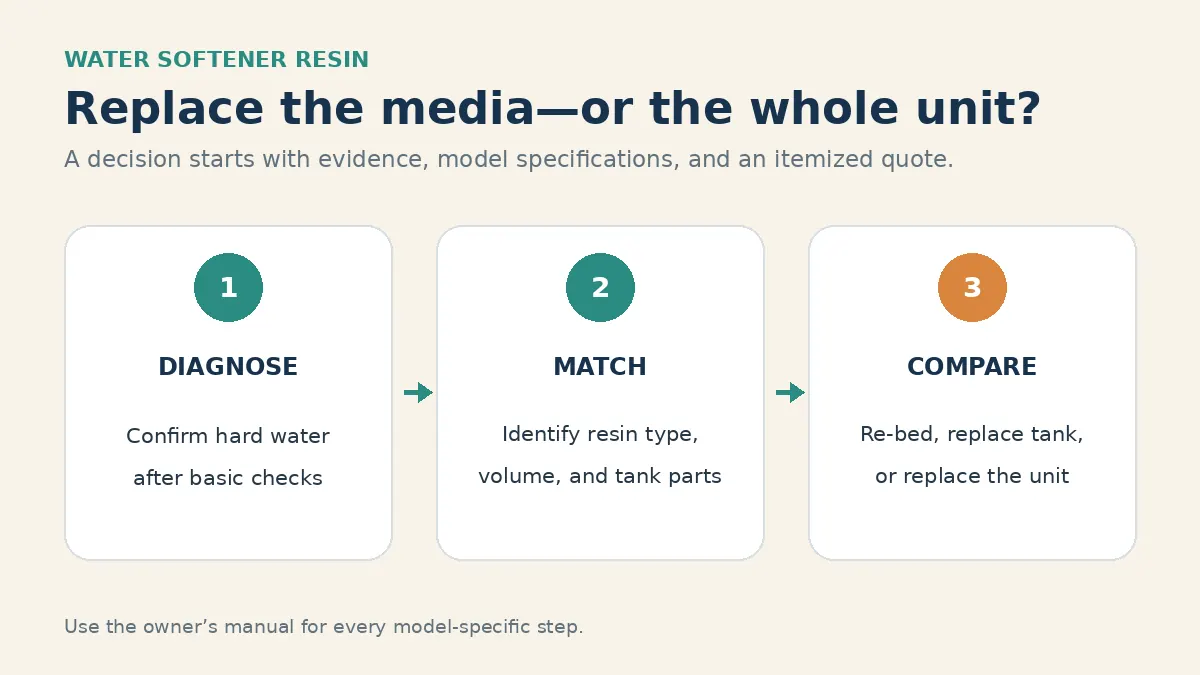
Water softener resin replacement may make sense when the media can no longer deliver soft water after the system’s basic settings, salt supply, regeneration, and brine flow have been checked. Hard water alone does not prove the resin has failed. A bypass left open, an incorrect hardness setting, a salt bridge, a valve problem, or a failed regeneration can produce the same result.
Start with measured performance and the owner’s manual. If the diagnosis points to the media, compare three distinct options: replacing only the resin, replacing the resin tank as an assembly, or replacing the complete softener. The right choice depends on model compatibility, the condition of the valve and tank, warranty coverage, labor, and the quality of the incoming water.
What the resin does—and what “replacement” means
In a salt-based ion-exchange softener, water passes through a bed of resin beads. The resin exchanges hardness minerals such as calcium and magnesium for sodium or potassium ions. Regeneration does not install new resin; it uses brine to restore the media’s exchange capacity for another service cycle. [1]
Re-bedding means removing the old media and filling the existing tank with the model-specified replacement media. A resin-tank replacement changes the pressure vessel and may include new media, while a complete-system replacement also changes the valve, controller, and other major components. Quotes that use the word “replacement” should identify which of these is included.
Signs that the resin deserves investigation
No single household symptom confirms exhausted or damaged resin. Treat these observations as reasons to test and diagnose:
- Hardness remains elevated after a confirmed regeneration. Test a cold-water outlet known to receive softened water and record the result and units.
- Softening capacity appears to have fallen. The unit completes cycles, but measured hardness returns sooner than expected under comparable water use and settings.
- Small bead-like particles appear at softened-water fixtures. GE notes that actual resin particles may enter the supply in certain fault conditions, although white or gray particles can come from plumbing or a water heater instead. Identification matters before blaming the resin. [2]
- Flow through the softener is restricted. Media fouling, internal component damage, or another restriction may be involved, but low water pressure alone does not identify the resin as the cause.
- The resin has known exposure to damaging conditions. GE states that chlorine above 2 ppm can begin degrading resin in its softeners and that heat can shorten resin life in outdoor installations. That threshold is manufacturer guidance for the equipment it covers, not a universal cutoff for every resin. [3] [4]
Water feel, spots on dishes, or the age of the softener are not enough on their own. If you have not measured the water, begin with a repeatable hardness test.
Rule out these problems before replacing resin
First record untreated and treated hardness, confirm the bypass position and hardness setting, and verify that regeneration completes. If pressure is the main symptom, use the pressure diagnostic; if salt remains unchanged, use the salt-use guide.
Ask the technician to distinguish media damage from a valve or distributor fault and compare incoming-water analysis with the media’s requirements. Correct an operational fault, follow its recovery instructions, and retest before ordering resin.
Can the resin be cleaned instead of replaced?
Cleaning and replacement solve different problems. A compatible resin-bed cleaner may help with specified deposits or fouling, but it cannot rebuild resin beads that have physically degraded. GE provides separate guidance for cleaning its resin bed and for resin deterioration, illustrating why “dirty resin” and “failed resin” should not be treated as the same diagnosis. [4] [5]
Use only a cleaner and procedure approved for the model and water condition. More chemical is not a substitute for identifying iron, chlorine, sediment, or another continuing cause. If the media is replaced without addressing the cause, the same problem may return.
Choose the correct resin and quantity
Replacement media is not universal. Confirm the model, resin chemistry, crosslink specification, volume, tank size, distributor arrangement, and whether the unit contains more than one type of media. Whirlpool states that its softeners use 8% crosslinked polystyrene resin; that specification should not be copied to a different brand without checking its documentation. [6]
The tank also needs freeboard—the open space that allows the bed to expand during backwash. Rheem says the resin tanks in the equipment covered by its guidance are typically about two-thirds to three-quarters full and directs owners to the model’s specification table for the actual amount. Do not fill a tank to the top or estimate quantity by appearance. [7]
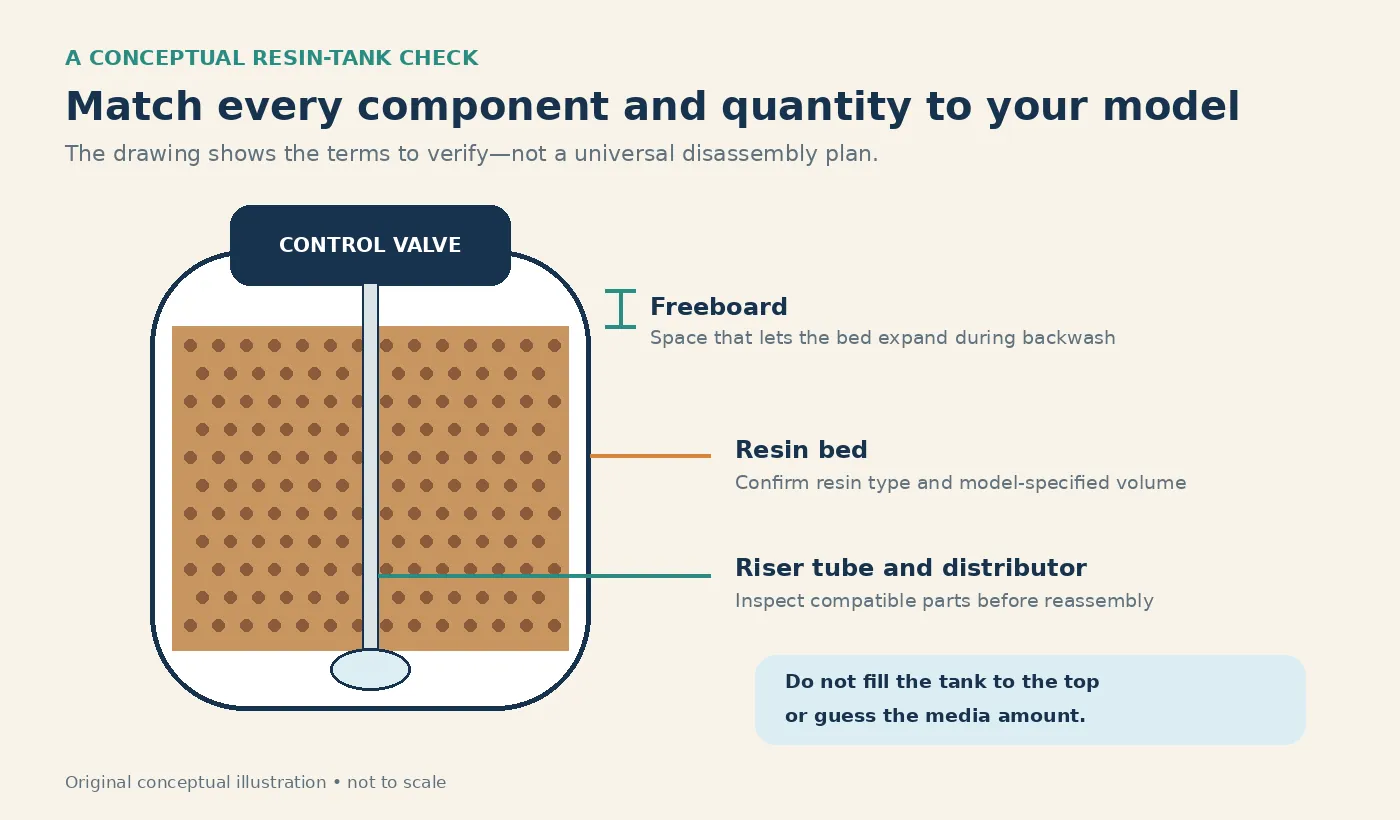
Hybrid equipment may contain resin, gravel, carbon, or other layers in a defined order. Re-bedding it as though it were a single-media tank can change its function. Ask the manufacturer or service provider for the exact bill of materials.
Water softener resin replacement options
| Option | May fit when | Confirm first |
|---|---|---|
| Clean or restore the existing bed | The manufacturer identifies removable fouling and the media is otherwise serviceable | Approved product, cause, procedure, and follow-up test |
| Replace resin only | The tank and valve are serviceable and compatible media is available | Resin specification, quantity, distributors, seals, labor, and commissioning |
| Replace tank and media | The vessel, tank neck, distributor, or assembly is damaged or a complete assembly is the supported repair | Tank rating, valve compatibility, included media, fittings, and warranty |
| Replace the complete softener | Several major components are worn, parts are unavailable, or the repair does not make economic sense | Sizing, measured water conditions, installation scope, operating settings, and disposal |
Do not compare the price of a bag of resin with a complete installed-system quote. They cover different scopes, risks, parts, and warranties.
What affects water softener resin replacement cost?
Compare itemized local quotes for the same scope. Media specification and quantity, access to the tank, related valve or distributor repairs, labor, commissioning and disposal change the total. Use the comparison sheet below to expose exclusions.
Request separate totals for resin-only, tank-and-media and complete-system work when each is technically suitable. Include correcting the original cause of performance loss. Whirlpool’s replacement instructions also cover safe handling and disposal of loose beads. [8]
DIY resin replacement or professional service?
Whirlpool publishes a model-specific replacement procedure covering isolation, pressure relief, dismantling, media handling, reassembly and commissioning. [8] That does not authorize the same procedure for another system.
Use professional service when the manual does not provide an owner procedure, the vessel or valve may be damaged, the wet tank cannot be handled safely, plumbing changes are needed, or the required media and startup steps are uncertain. Never loosen a pressurized valve head or work on wet electrical equipment.
How to compare a resin replacement quote
| Item | Quote A | Quote B |
|---|---|---|
| Diagnosis and supporting hardness/inspection results | ____ | ____ |
| Resin product, specification and quantity | ____ | ____ |
| Required freeboard and compatibility confirmation | ____ | ____ |
| Distributor, riser, seals and valve work included | ____ | ____ |
| Labor, disposal, taxes and total | ____ | ____ |
| Cause of damage and additional treatment | ____ | ____ |
| Startup, leak checks and treated-hardness test | ____ | ____ |
| Parts/labor warranty and exclusions | ____ | ____ |
Ask each provider to identify omitted work. A media-only price and an installed repair including damaged distributors are different scopes. Compare with the whole-system repair-or-replace assessment if other components also need work.
What to verify after new resin is installed
Follow the manufacturer’s return-to-service instructions. Whirlpool’s covered models require a backwash and rinse after new media, a leak check, and flushing cold-water faucets to remove small fines. The correct cycle and button sequence depend on the equipment. [8]
- Confirm that the valve and plumbing connections remain dry.
- Record the restored settings rather than relying on memory.
- Let the prescribed startup cycle finish.
- Test treated-water hardness at the same sampling point used before service.
- Record the result, units, date, and any follow-up recommended by the installer.
A successful repair is not simply a tank that contains new beads. It is a correctly configured system that completes its cycle, does not leak, and produces a documented treated-water result.
Can new resin be added on top of old resin?
Do not top up by guesswork. The specified media quantity, freeboard, distributor condition and startup procedure work together. Follow the model’s re-bedding instructions or ask a qualified provider to confirm the complete scope.
Sources and model-specific instructions
Manufacturer documentation reviewed September 28, 2026. This article covers household salt-based softeners. The manual and support information for your exact model take priority.
- Rheem: How a water softener works
- GE Appliances: Particles or resin beads in the water supply
- GE Appliances: Resin life and replacement
- GE Appliances: Chlorine and resin
- GE Appliances: Cleaning the resin bed
- Whirlpool: Resin type used in its softeners
- Rheem: Resin quantity and freeboard
- Whirlpool: Replacing resin beads
Updated October 6, 2026: Added a two-quote comparison sheet and linked the separate operational diagnostics.