
Water softener salt and pool salt may both contain sodium chloride, but that does not make every bag interchangeable. Check the equipment manual, purity, additives, and product form. Approval for a salt-water chlorinator does not establish approval for a household softener—or the reverse.
The most useful distinction is the direction of the swap. Rheem advises against pool salt in its softeners. A Pentair IntelliChlor manual, by contrast, permits certain water-conditioning salt pellets that meet its specifications, while warning about slow dissolution and surface damage. Both instructions can be correct for their respective equipment. [1] [2]
Water softener salt vs. pool salt: the practical differences
| Question | Household softener | Salt-water pool |
|---|---|---|
| What is the salt used for? | Regenerating the ion-exchange softening system | Supplying a compatible chlorine generator |
| What must the label establish? | Approved chemistry, purity, form, and additives for the softener | Approved sodium chloride specification for the chlorinator |
| Are additives relevant? | Some softener products contain cleaning or iron-control ingredients | The chlorinator may prohibit additives accepted in another application |
| Does crystal shape prove compatibility? | No | No |
| What decides a substitution? | The receiving softener’s instructions | The receiving chlorinator and pool-surface instructions |
Morton explains that a functioning salt-water generator is needed for its pool-salt application; adding salt alone does not provide the generator’s sanitizing action. Its pool-salt FAQ also states that its pool salt contains neither iodine nor anti-caking agents. Those are statements about that product, not a guarantee covering every salt sold for pools. [3]
Can you use pool salt in a water softener?
Do not assume so. Rheem’s salt guidance recommends products labeled for water softeners with at least 99% purity and low impurities, and explicitly lists pool salt among products it does not recommend. For a Rheem unit covered by that guidance, use an approved softener salt rather than treating a pool-salt purity claim as an exception. [1]
For another brand, read that model’s requirements. If pool salt is not addressed, send the manufacturer the complete bag label and product specification and ask whether that exact product is acceptable. “It is sodium chloride” does not answer questions about additives, insoluble material, or the equipment’s approved use.
If you simply need to choose between approved shapes, use the separate pellets-versus-crystals guide. This article addresses cross-use between equipment, not which approved softener shape you should buy.
Can you use water softener salt in a salt-water pool?
Sometimes a particular chlorinator permits a suitable product, but do not generalize across models. The cited Pentair IntelliChlor IC15/IC20/IC40/IC60 guide specifies at least 99.8% pure sodium chloride, favors evaporated granulated non-iodized salt without additives, and permits water-conditioning pellets while noting slower dissolution and possible surface damage. It excludes potassium chloride and calcium chloride as substitutes. [2]
Consequently, an iron-control softener salt is not automatically acceptable just because plain pellets are mentioned. Check the full formulation and current manual revision. Follow the pool-surface requirements and the model’s addition procedure; do not copy a generic internet dose or pour a bag into the skimmer.
A bag labeled as a potassium chloride alternative for a softener is a particularly important distinction. “Salt alternative” in the softener aisle does not mean an alternative for a sodium-chloride pool generator.
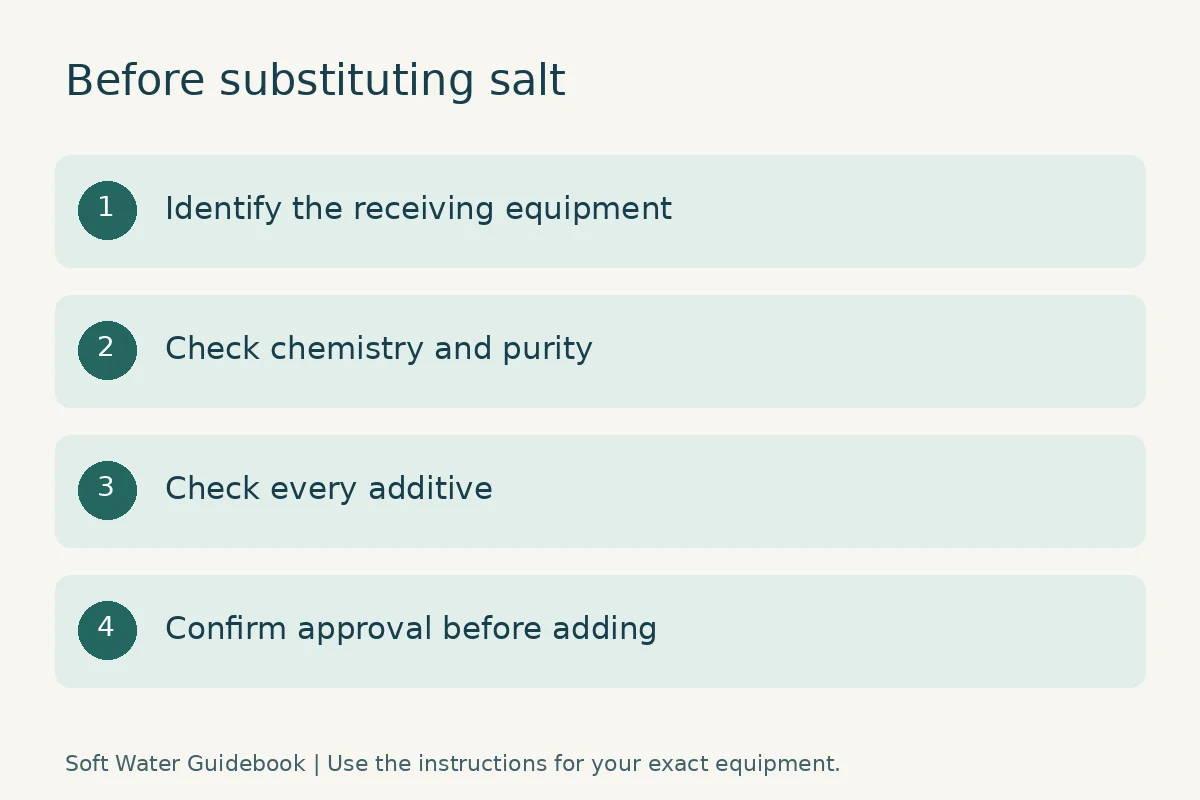
A five-point bag check before you buy
- Receiving equipment: Write down the exact softener or chlorinator model.
- Chemical: Identify sodium chloride versus potassium chloride or another compound.
- Purity: Compare the stated specification with the manual’s requirement.
- Additives: Look for rust-control, resin-cleaning, anti-caking, fragrance, or other added ingredients.
- Explicit compatibility: Confirm that the manual and product information support the intended application. Resolve gaps with the manufacturer.
Photograph both sides of the bag, not only the front branding. Keep the product code with the manual reference. If a specification is missing, mark it “unknown”; do not turn missing information into “additive-free.”
Is the cheaper bag actually a saving?
Compare price only after compatibility. For approved products, divide the bag price by its net weight using the same units. For illustration only, a $10 bag weighing 40 lb costs $0.25/lb; a $9 bag weighing 25 lb costs $0.36/lb. These are invented arithmetic examples, not current retail prices.
That calculation cannot price the risk of an unapproved substitution. Nor does a lower price justify overfilling a salt tank. Follow the model’s refill level and keep the bag identification in your maintenance notes.
What if you already added the wrong salt?
Keep the packaging and record the amount, when it was added, and whether the equipment has operated since. Contact the receiving equipment manufacturer with those facts before choosing a removal or recovery procedure. There is no single remedy for every additive, amount, or installation.
Do not add another chemical to “neutralize” an unknown product or repeatedly force cycles to clear it. If support directs you to remove salt and clean the tank, use its isolation and refill instructions; the tank-cleaning preparation guide can help organize the task.
Common questions
Is all pool salt purer than softener salt?
No universal ranking follows from the product name. Compare the actual specifications and additives, then check the receiving equipment’s requirements.
Can I use either product as dishwasher salt?
Do not assume either is suitable. An appliance with an integrated softener has its own salt requirements and designated reservoir. Check its manual rather than transferring approval from a whole-house softener.
Sources and review
Reviewed November 4, 2026. Compatibility examples are model-specific; this is not a report of substitution testing.