
Choose dishwasher detergent for hard water by the appliance’s instructions, the product’s dosing guidance, and the problem you are trying to solve. A suitable detergent can improve washing, but it will not repair etched glass or replace descaling an appliance with existing mineral buildup.
For a practical starting point, use an automatic-dishwasher product recommended for your model, check the hardness of its water supply, and use rinse aid as directed. Then assess a comparable load before changing another variable. This is a selection guide based on manufacturer information, not a ranking from laboratory or hands-on testing.
Which dishwasher detergent should you try in hard water?
A good first candidate is the format your appliance manufacturer recommends. Whirlpool’s support guidance favors quality premeasured tablets or packs for the machines it covers. Cascade says its ActionPacs contain water-softening ingredients intended to help prevent deposits. These recommendations support trying a compatible product; they do not prove one brand wins in every dishwasher. [1] [2]
| Format | Practical advantage | Check before use |
|---|---|---|
| Tablet or pod | A defined dose with little measuring | Correct placement, compatible cycle, and the label’s dose instructions |
| Powder | A measured quantity can follow a model’s hardness-based dispenser guidance | Keep dry; use the amount specified for the product and machine |
| Gel | Allows measured dosing where the appliance permits it | Check formula and dosing guidance rather than assuming equivalence to powder |
Format alone is not a performance test. Do not cut pods or combine an extra pod with powder to invent a hard-water dose. With loose detergent, use the dispenser markings and instructions that actually apply to your machine. Avoid filling every compartment merely because another model’s guide says to do so.
Measure the water the dishwasher actually receives
A utility hardness figure describes the supply, but a household softener may change the water arriving at the appliance. Use a hardness test from a confirmed relevant outlet, or ask the installer which line feeds the dishwasher. Record units as well as the number.
Do not treat a hardness setting on a household softener as a measurement of the treated water. If you have a softener and the appliance supply is unexpectedly hard, investigate its operation before buying a succession of detergents.
How much detergent should you use?
There is no universal tablespoon dose for hard water. The American Cleaning Institute explains that water hardness affects the quantity needed and directs owners to both the detergent package and dishwasher manual. Too little and too much can impair washing. [3]
- Identify the exact product. Record its name and whether it is a pod, powder, or gel.
- Find the relevant dose. Match the label and manual to hardness and soil conditions; do not substitute the instructions for another formulation.
- Check dispensing. Keep dishes from blocking the dispenser and confirm that spray arms can move as instructed.
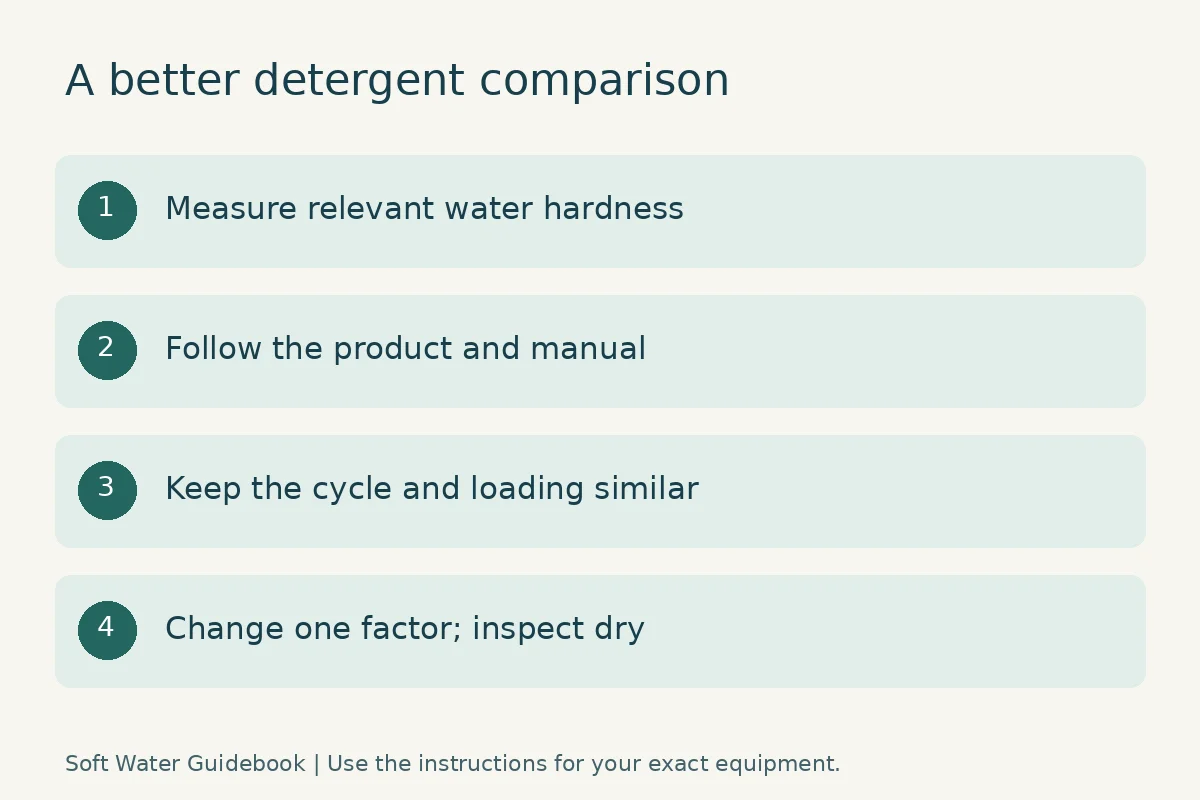
- Use the intended cycle. A detergent change and a shorter cycle made together are difficult to evaluate.
- Inspect a dry result. Compare food removal, spots, film, and any undissolved product separately.
Whirlpool recommends fresh automatic-dishwasher detergent stored closed in a cool, dry place. A damp, clumped product introduces another variable before you even start the wash. [1]
Detergent, rinse aid, salt, and descaler have different jobs
| Product | Purpose |
|---|---|
| Automatic-dishwasher detergent | Wash food and soils from dishwasher-safe items |
| Rinse aid | Help water sheet off items, reducing droplets and spotting |
| Dishwasher salt | Serve an integrated softener, only where the machine has one and specifies it |
| Compatible descaler | Address existing mineral deposits through a separate care procedure |
ACI describes rinse aid’s sheeting action; it is not a substitute for treating the incoming hardness. Bosch distinguishes mineral descaling from cleaning food-related residue and tells owners to check whether their model has a salt reservoir. Follow those appliance instructions even when a detergent is labeled “all in one.” [3] [4]
For an already chalky machine interior, use the dishwasher buildup guide. Keep a separate descaling treatment out of your normal detergent experiment unless the product and appliance directions explicitly call for it.
Use a simple comparison before buying a larger pack
For your next comparable loads, keep loading pattern, cycle, and rinse-aid setting consistent. Change only the detergent product or its permitted dose. This is a household troubleshooting exercise, not a controlled performance study.
- Record the product and measured dose or pod count.
- Photograph the same type of glass after it dries.
- Note food left behind separately from white film.
- Record whether detergent remains in the dispenser.
- Keep the hardness result and any softener changes alongside the notes.
If washing improves but one glass remains cloudy, check for removable film versus permanent etching. More detergent will not reconstruct a damaged glass surface.
When detergent changes are not enough
Stop treating a leak, drainage error, or blocked spray system as a detergent-selection issue. Follow the appliance’s fault instructions. For persistent mineral deposits, discuss the measured hardness and water-treatment options with the manufacturer or installer. Whirlpool specifically flags very hard water at 15 grains per gallon or above in its guidance; that is not a universal dosing threshold. [1]
Common questions
Can I use regular dish soap?
No. Use detergent labeled for automatic dishwashers. Hand-dishwashing liquid is not a substitute for the appliance’s detergent.
Will a hard-water detergent remove every cloudy mark?
No. Distinguish food residue, mineral film, and etching first. The glassware guide addresses that separate diagnosis.
Should I turn up the water heater?
Do not change a whole-home water-heater setting solely on generic detergent advice. Check the dishwasher’s required inlet conditions and discuss an unsuitable supply with the installer.
Sources and review
Reviewed November 4, 2026. Named products are manufacturer examples, not independently tested winners.