
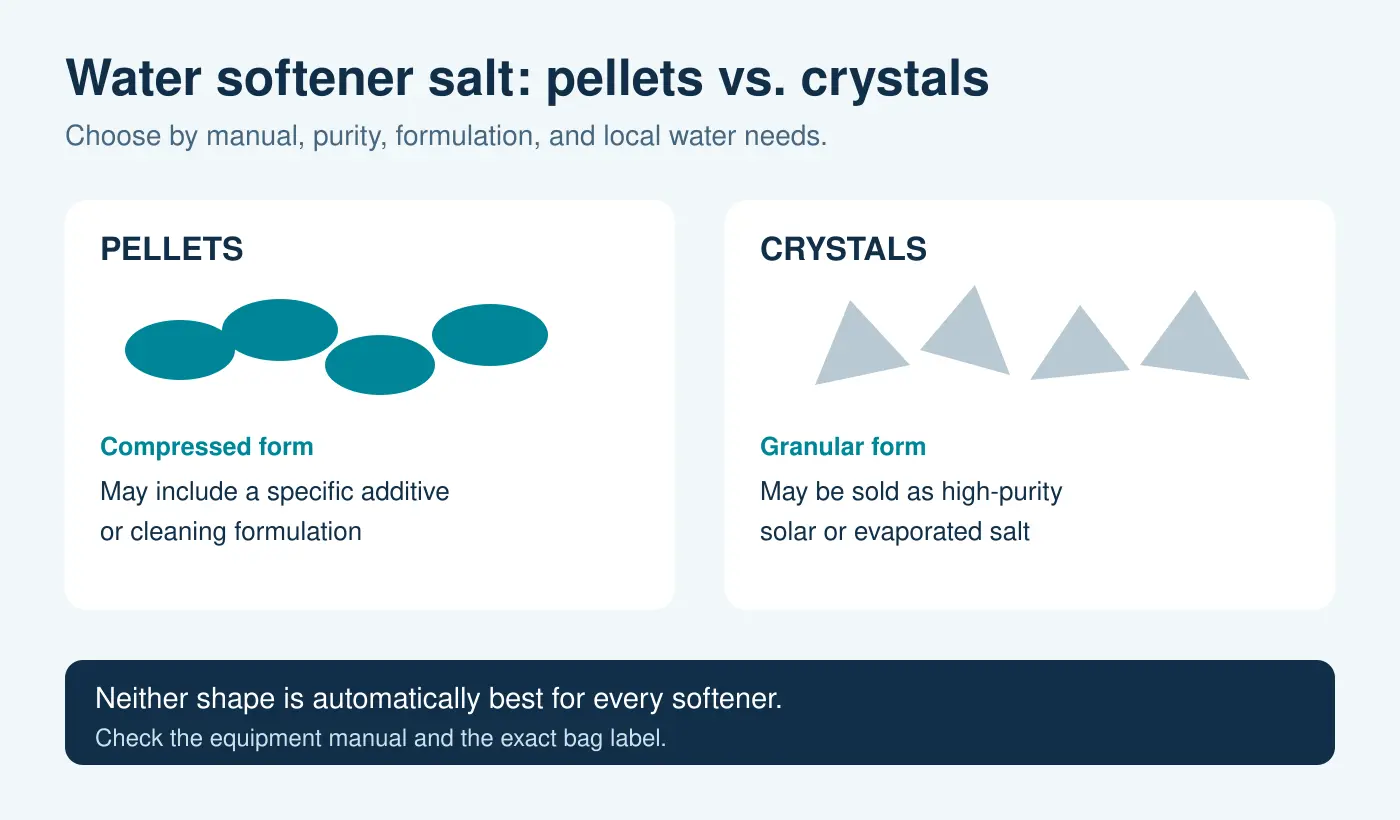
Water softener pellets and crystals can both work well, but the best choice is the product your equipment permits with the purity and formulation your water needs. Pellets are compressed salt and may contain cleaning or iron-control additives. Crystals are granular and often sold as solar or evaporated salt. Shape alone does not determine performance.
For example, Whirlpool recommends either evaporated salt pellets or solar salt crystals with less than 1% impurities for several current models. Rheem likewise accepts several high-purity forms, while advising owners to use salt labeled for water softeners. Always let your own manual override general comparisons. [1] [2]
Considering a spare bag intended for a pool? Read the water softener salt versus pool salt comparison before substituting: compatibility depends on which equipment will receive it.
Water softener pellets vs. crystals: quick comparison
| Factor | Pellets | Crystals |
|---|---|---|
| Physical form | Small particles compressed into a pellet or cube | Granular salt produced in crystal form |
| Formulations | Plain and additive-containing products are available | Plain high-purity products are common; check each label |
| Compatibility | Accepted by many softeners, subject to the manual | Accepted by many softeners, subject to the manual |
| What matters most | Manufacturer approval, sodium or potassium chloride, purity, additives, and the specific water problem | |
| Mixing | Advice differs by manufacturer; follow the instructions for your equipment and product | |
This comparison concerns salt-based ion-exchange softeners. It does not apply to salt-free conditioners, and it does not replace instructions for a system that uses a proprietary product.
What are water softener salt pellets?
Salt pellets are made by compressing smaller salt particles. The finished shape can be convenient to handle, but two bags of pellets may have different purity levels and additives. Read the ingredient and product information rather than assuming that every pellet is equivalent.
Rheem describes pellet salt as a clean source of salt and says pellets can help reduce bridging in the systems covered by its guidance. Morton sells Clean and Protect pellets and a separate Plus Rust Defense formulation. Do not interpret a cleaning-formula product as plain, additive-free salt just because both products are pellet-shaped. [2] [3]
What are water softener salt crystals?
Salt crystals are loose granules. Solar salt is produced by evaporating salt water, while evaporated salt is a processing description that can also appear in product specifications. “Crystal” describes the physical form; it does not by itself confirm purity or suitability.
Whirlpool lists solar salt crystals with less than 1% impurities alongside evaporated pellets for current high-efficiency models. Diamond Crystal also markets solar salt crystals for water softeners. These examples show why the exact product specification is more useful than a blanket rule that crystals are better or worse. [1] [4]
Which is the best salt for your water softener: pellets or crystals?
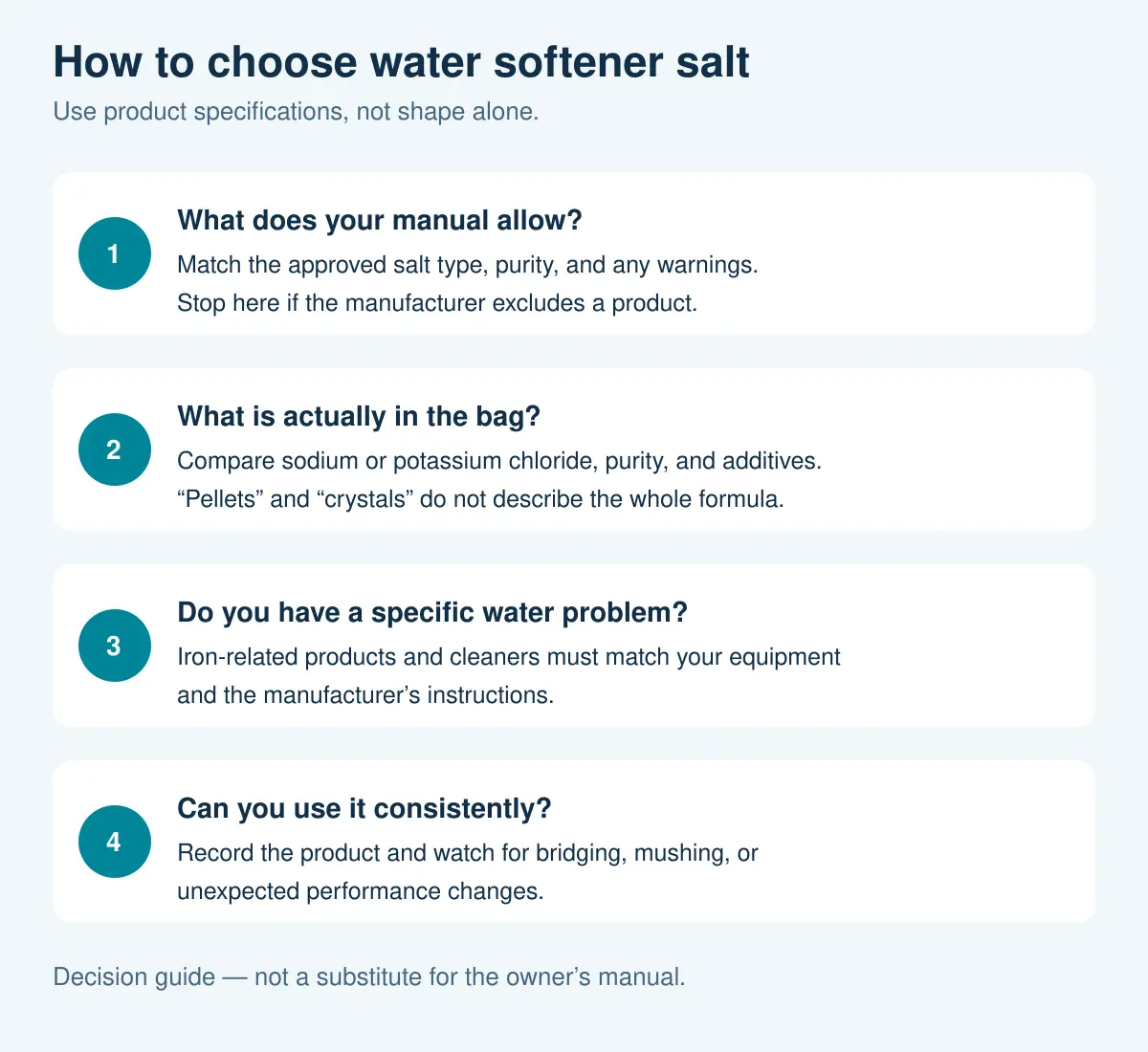
Choose in this order: manual compatibility, chemical type, purity, formulation, and then practical preference. A high-purity approved product is a safer default than choosing solely by shape, price, color, or marketing language.
1. Check your owner’s manual
Find the section covering salt type, purity, prohibited products, and any controller setting for sodium chloride or potassium chloride. Some manufacturers warn against block, rock, pool, or table salt even when those products contain sodium chloride, because impurity levels and physical behavior differ. Rheem’s general guidance, for example, recommends salt designed for softeners with 99% or greater purity and less than 1% contaminants. [2]
2. Read the bag beyond “pellets” or “crystals”
- Chemical: sodium chloride and potassium chloride are not interchangeable without checking the controller and manual.
- Purity: compare the stated percentage or impurity limit.
- Additives: identify resin cleaners, rust-control ingredients, or other formulations.
- Equipment claim: confirm that the product is labeled for water-softener use.
Do not confuse a “salt alternative” with a different shape. Rheem requires model-specific programming when potassium chloride is selected on the systems it covers. [5]
3. Match specialty products to an actual need
An iron-control or cleaning formulation is not automatically preferable for every household. Confirm the incoming water condition and whether your manufacturer permits that additive. Some instructions also contain placement or maintenance warnings for specialty salts.
If performance has changed, test the water hardness rather than switching products based only on staining, taste, or feel. A test result does not select a salt by itself, but it helps separate a treatment problem from a shopping decision.
4. Choose a product you can identify and use consistently
Keep a photo of the bag label and record the date and amount added. That record makes it easier to relate a change in residue, bridging, or softening performance to a product change. Follow your model’s fill range; the choice between pellets and crystals does not change how much salt the tank should hold.
Do pellets prevent salt bridges better than crystals?
Rheem says pellets can help reduce bridging, but bridging is not controlled by shape alone. Humidity, overfilling, long periods without use, impurity content, and product mixing can also matter. Treat a “bridge-resistant” claim as a product-specific feature, not a guarantee. [2]
If the tank looks full but salt is not reaching the water below, use the salt-bridge checks. Do not keep adding bags on top of a hardened layer.
Can you mix salt pellets and crystals?
Manufacturer advice is not uniform. Morton says its own water-softening products are compatible and can be mixed. Rheem tells owners of its systems to stick with one shape because mixing pellets and crystals can increase the risk of bridging and blockage. [6] [7]
The practical answer is therefore to follow the equipment manual first and the exact product manufacturer second. A product maker’s compatibility statement does not override a softener manufacturer’s warning. If you change products, wait until the level is low when practical, record the change, and watch the salt condition and treated-water hardness.
What if the tank becomes dirty, mushy, or hard?
Loose pellets or crystals are different from a solid crust or sludge. A crust may be a salt bridge; wet, broken-down salt and sediment may require tank cleaning. Identify the condition before choosing a remedy.
For residue or sludge, follow the model-specific brine-tank cleaning procedure. If the salt level stays unchanged and the water is hard, use the not-using-salt troubleshooting guide rather than assuming the product shape caused the problem.
Editorial review November 7, 2026: clarified product formulation versus plain salt.
Sources and product guidance
Sources checked September 26, 2026. Product formulas and model requirements can change; verify the current bag label and manual before use.
- Whirlpool WHES40 product guidance, including its recommended pellets, crystals, and impurity limit.
- Rheem: Salt Types
- Morton: Clean and Protect Plus Rust Defense pellets
- Diamond Crystal: Solar Naturals water softener salt crystals
- Rheem: Potassium chloride salt alternative
- Morton Salt FAQ, including its product-mixing guidance.
- Rheem: Adding Salt to the Tank, including its guidance not to mix shapes.
Updated October 16, 2026: added a working calculation or simplified overlapping explanations. Examples and records are not field-test results.