
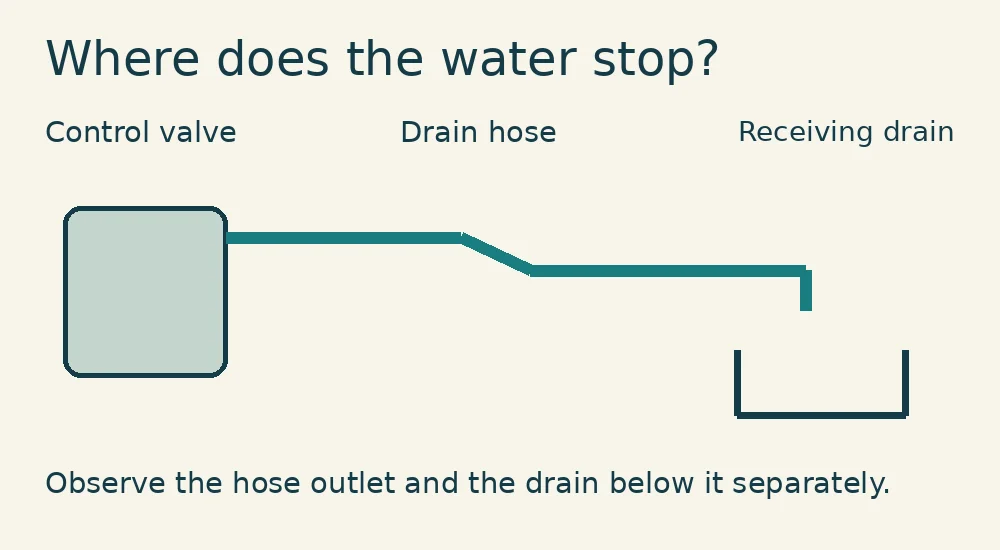
If you suspect a clogged water softener drain line, watch two places during a regeneration stage when your manual says the valve should discharge: the open end of the hose and the drain beneath it. Little or no water leaving the hose points you toward the appliance or its hose route. Water leaving the hose while the laundry tub or standpipe fills points you toward the receiving drain. That first distinction can save you from taking apart the wrong component.
If water is already spilling onto the floor, skip the observation test. Follow the softener’s documented bypass or isolation procedure if you can reach it safely, keep away from wet electrical equipment, and arrange service. Leave the hose outlet open. Starting another recharge can repeat the spill.
First, identify the outlet and cycle stage
Trace the visible hose back to its source without disconnecting it. The valve drain starts at the control valve. A separate overflow hose, if fitted, starts on the salt tank. If you see water only at the overflow, use the high brine tank water level checks. A dry overflow hose during normal operation tells you little about flow through the valve drain.
Note the stage shown on the display. If the display shows only “recharge,” write down the elapsed time and check the cycle sequence in the manual. Discharge changes during regeneration, so comparing a trickle during one stage with a stronger stream during another can give a misleading impression. When the stage is unknown, record that detail rather than calling the hose clogged.
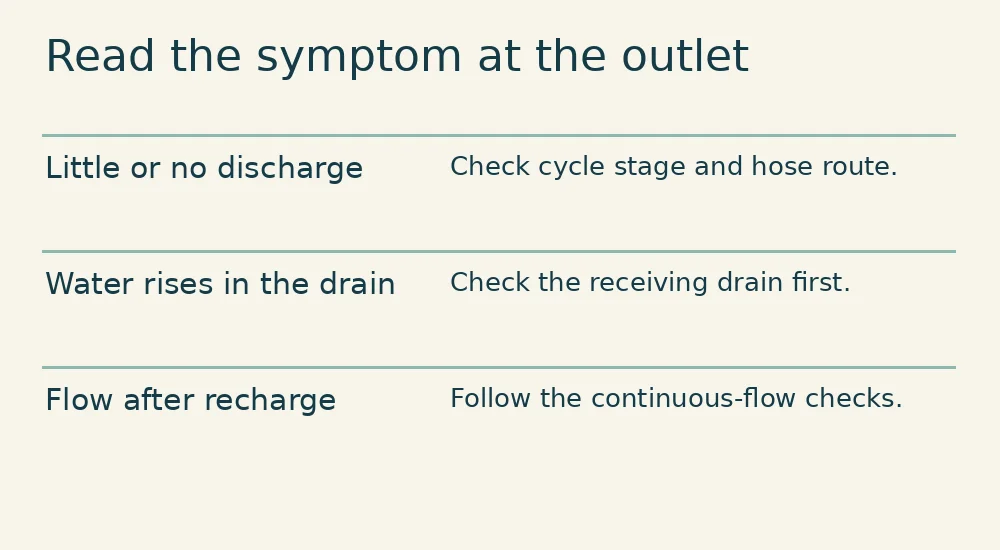
Use the first visible symptom to narrow the problem
| What you see | What to check next |
|---|---|
| Little discharge during a stage that should drain | Follow the exposed hose from valve to outlet. Look for a flattened section behind the cabinet, a tight bend at a support, or a kink where the hose turns down. If the route looks clear, an internal restriction or valve problem still needs model-specific diagnosis. |
| The hose discharges, but water rises around the standpipe or in the tub | Stop the check before water spills. Record whether another appliance was draining at the same time. A plumber can evaluate the shared drain and its capacity. Cleaning the softener hose would not explain why water already delivered to the fixture stays there. |
| Water drips from the outside of a fitting | Locate the first wet point. A puddle below a hose can come from a connection higher up. See the external leak checks if the first wet point is at the valve head. |
| Water keeps leaving the hose in normal service | Confirm that the recharge has ended. Then follow the continuous draining guide; the timing matters more than the size of the stream. |
Inspect the hose before attempting to clean it
Look along the full accessible route, including the last bend at the drain. Did the problem begin after the softener was moved, shelving was added, or the discharge point changed? A photo of the new route can be more useful than a close-up of the outlet. If the hose is pinched, damaged, submerged, or joined to the overflow, document what you find before deciding on a repair. Compare the installation with the drain routing and air gap guide and your unit’s manual. Whirlpool’s illustrated routing requirements show examples of restrictions and separate hose connections.
When does cleaning the hose or adapter make sense?
Look for the drain-hose procedure for your exact softener. For its covered units, Whirlpool’s cleaning instructions distinguish equipment styles and cover the hose adapter and drain port as well as the hose. Match the model and fitting shown before loosening anything. Use the manufacturer’s isolation and pressure-relief instructions. If you cannot identify the fitting or safely isolate the equipment, leave it assembled for service.
Keep household drain opener out of the softener and its tubing. If the receiving plumbing needs clearing, tell the plumber where the softener discharges and whether other fixtures also drain slowly. If the receiving drain stays clear but the appliance repeatedly delivers little water during the same expected discharge stage, contact the softener service provider with your observations.
What to record for a service call
Record the model, displayed cycle stage, which outlet you watched, what the water did at the hose end, and what happened at the receiving drain. For example: “During backwash, water came out of the valve hose into the laundry tub. The tub level rose until I stopped the check. The washer was off.” That gives a plumber a different starting point from “During backwash the tub stayed empty, the valve hose barely dripped, and there was a sharp bend behind the salt tank.”
After the documented repair, verify both observations during the manufacturer’s return-to-service check: discharge reaches the receptor during the expected stage, and the receptor carries it away without backing up. Note any leak at a refitted connection. If the symptom returns, keep the stage and timing for the technician rather than running repeated test cycles.