
How much salt should you put in a water softener? Add enough to reach your model’s recommended refill level, without exceeding its limit. There is no universal number of bags: the tank size, existing salt, and manufacturer’s instructions determine how much will fit appropriately. Check the salt already in the tank before opening another bag.
This guide covers salt-based residential softeners. It separates the amount stored in the brine tank from the amount consumed during regeneration.
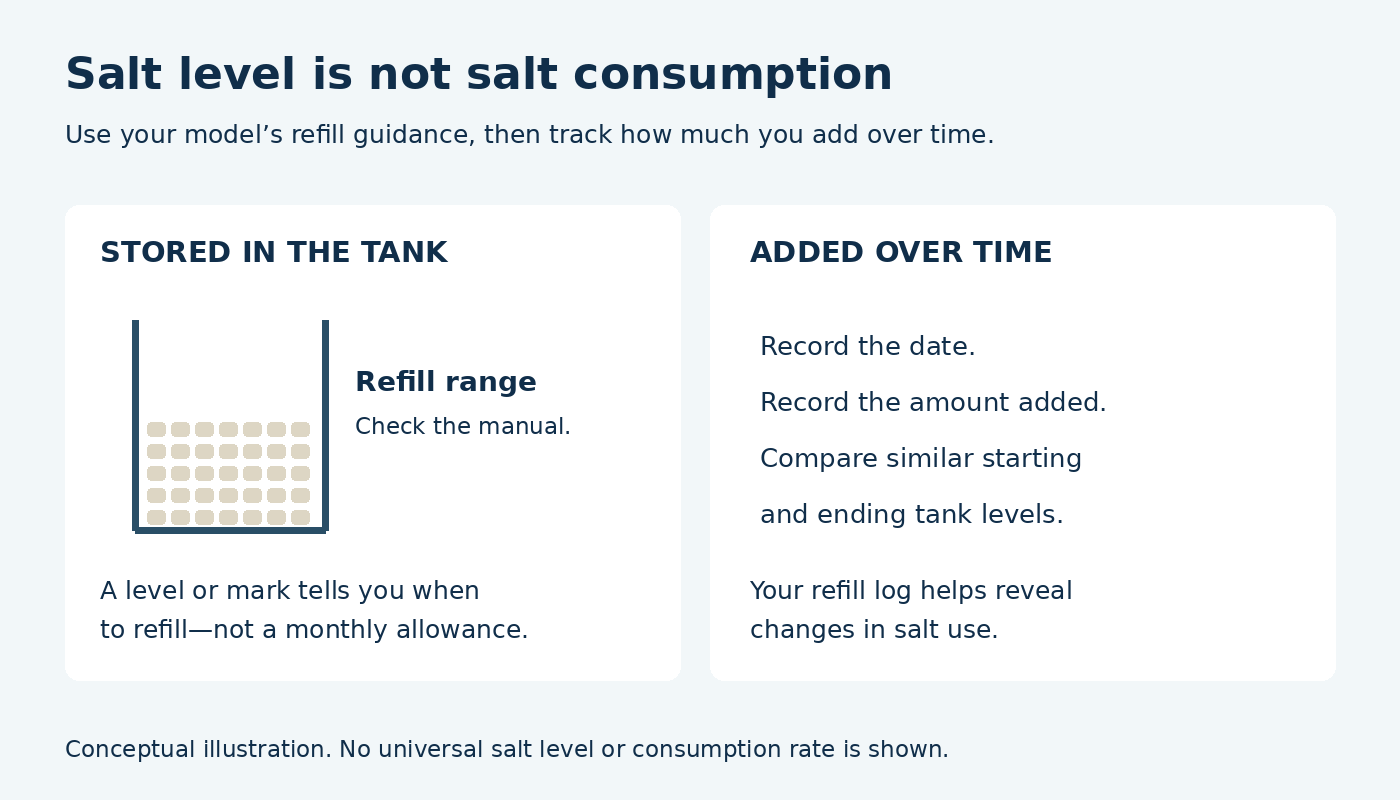
Diagram above: The recommended storage level and the amount used over time are different measurements. This illustration does not specify a universal fill level.
Check your model’s recommended salt level
Look for the salt-level section in your owner’s manual. It may refer to a marked scale, a depth, or a refill range. For example, Rheem’s support instructions specify levels 2–5 on the brinewell scale for the equipment covered by that guide. Those numbers are not a standard shared by all softeners. [1]
Use the instructions that match the model number on your unit. If its tank has no matching scale, do not draw an equivalent line based on a photograph of another system. Ask the manufacturer or installer which refill level applies.
| Check | Why it matters |
|---|---|
| The approved refill range | Sets the target for your particular equipment |
| Salt already in the tank | A partly filled tank needs less than an empty one |
| Whether salt is loose or hardened | A full-looking tank may conceal a blockage |
| The bag’s stated weight | Lets you record how much you actually added |
| Humid conditions or recurring bridges | May call for smaller, more frequent refills within model guidance |
Two manual-specific refill examples
| Models and source | When to refill | Important limit |
|---|---|---|
| Whirlpool WHES40 / WHES44 | Below one-quarter full. Manual, p. 17 | For potassium chloride, no higher than brinewell level 4. |
| GE GXSH40V / GXSH45V | Below one-quarter full in the Adding Salt section. Manual 49-6000299 Rev. 1, p. 23 | Potassium chloride also has a level-4 limit. |
Use the salt type and storage limits for your exact equipment. These thresholds are not a bag count or pounds used per cycle.
| Date / model | Before level | Salt type / weight added | After level / monitor reset |
|---|---|---|---|
| ____ | ____ | ____ | ____ |
When should you add more salt?
Refill as the salt approaches your model’s minimum, rather than waiting for the tank to run empty. Use any low-salt alert together with a physical inspection. Rheem instructs owners to update the salt-level setting after adding salt so the reminder reflects the new level. Check whether your controller requires that step. [1]
Make a note of the date and take a quick photograph before refilling. Over several checks, that gives you a practical record of how fast the stored supply changes. An alert, a tank mark, and the bag weight describe different things; none should be mistaken for a fixed monthly requirement.
How to refill the salt tank
1. Check the existing salt
Open the salt-storage lid and inspect the contents using the method in your manual. Rheem recommends periodic checks for hardened salt and directs owners to its bridge-removal procedure if the salt is no longer movable. Do not bury an unresolved salt bridge under another refill. [1]
2. Choose an approved product
Match the bag to the salt type specified for your softener. Culligan notes that higher-purity products generally leave less insoluble residue, while rock salt may require more cleaning and is not suitable for every system. Products sold for other purposes, such as sidewalk deicing, should not replace approved softener salt. [2]
Check compatibility before switching between salt types or using potassium chloride. Culligan explains that potassium chloride can require different quantities for comparable performance. A change of product is a reason to review the manual, not simply assume the old settings still apply. [2]
Compare pellets versus crystals before changing the form of salt you buy. If you are considering a bag labeled for a pool, check the pool salt versus water softener salt comparison against your equipment requirements.
3. Add salt to the specified level
Pour into the designated salt-storage area, stopping at the model’s refill target. Keep packaging and debris out of the tank. Handle the bag in manageable amounts if needed; finishing an opened bag is not a reason to exceed the recommended level.
Close the lid and update any required salt-level reminder. Record the amount added, including whether you used a full bag or only part of one.
Can you put too much salt in a water softener?
More stored salt is not automatically better. GE advises using less salt per refill and replenishing more frequently in humid conditions to help prevent bridging. Its guidance also recommends checking for leaks or rain exposure that could contribute unwanted moisture. [3]
Stay within your own model’s range when adapting refill habits. If a crust keeps returning, investigate the conditions rather than repeatedly adding more salt. A bridge separates salt from the water below, so a tank that looks full may still fail to make brine properly. [2]
Salt level vs. salt consumption
Stored salt is the current supply; consumption is what the system uses over time. Record the weight added and compare periods with similar starting and ending levels. For the calculation and worked example, use the salt-consumption guide.
What if the salt level never drops?
Check whether the system is registering water use and regenerating. Whirlpool’s low-salt-use troubleshooting then checks for a salt blockage and, if one is absent, directs owners toward the filling cycle. An unchanged salt level alone does not identify which part is faulty. [5]
Collect observations before changing settings: the last refill, recent water use, recharge activity, and any hardened salt. If the manual’s checks do not explain the condition, contact support with that record.
Do you add water with a routine salt refill?
Do not repeat an installation water charge unless your model directs it. Initial setup, cleaning and recovery can require a separate water addition; an ordinary salt refill is not automatically one of those tasks. [4]
Sources and model-specific guidance
Manufacturer documentation checked September 24, 2026. Always match refill instructions to your equipment.
- Rheem: Adding Salt to the Tank
- Culligan: Choosing water softener salt
- GE Appliances: Preventing a salt bridge
- Whirlpool: Water levels in the salt tank
- Whirlpool: Little/No Salt Use
Updated October 6, 2026: Added two manual-specific refill examples and a refill record.
Updated October 16, 2026: added a working calculation or simplified overlapping explanations. Examples and records are not field-test results.