
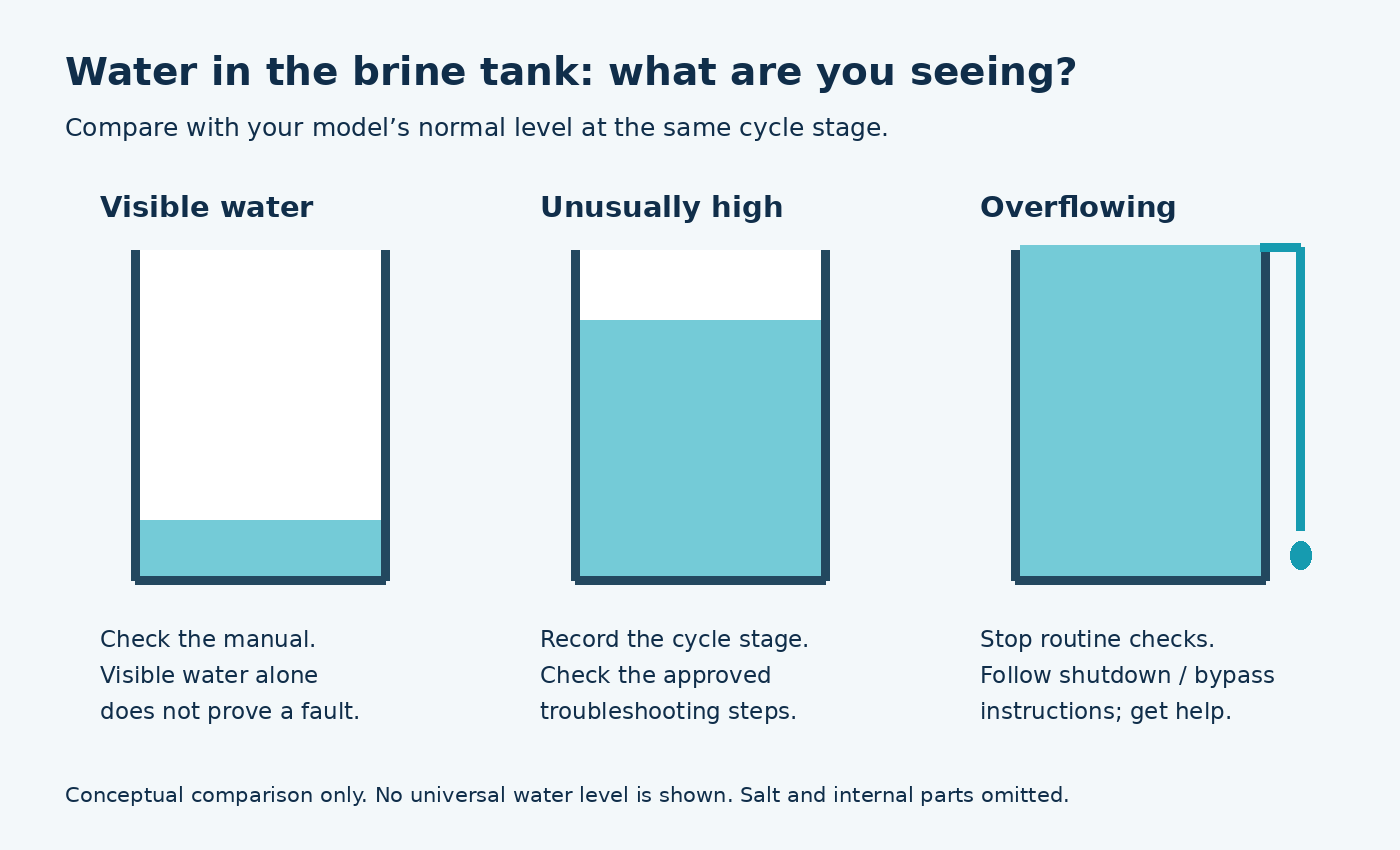
A water softener full of water is not always overflowing or faulty. Some water in the salt tank is expected, and the level changes during regeneration. First compare what you see with the instructions for your model and its current cycle stage. Water that stays unusually high needs investigation; water escaping the tank needs prompt attention. [1]
This guide concerns the brine tank—the container where you add salt—not the sealed resin vessel. Start with observations and external checks. Use your model’s instructions for any repair.
Diagram above: Conceptual comparison, not a water-level specification. Salt and internal components are omitted.
How much water in the brine tank is normal?
There is no single depth that applies to every softener. For example, Whirlpool describes a low residual level for its equipment and explains that the tank fills and draws down during recharge. Treat that as guidance for the covered models, not a fill line for a different brand. [1]
Find the owner’s manual and record whether the unit is in normal service, filling, or drawing brine. Compare levels at the same stage. “I saw water halfway through a cycle” and “the level stayed high after the cycle finished” are different observations.
Also note the salt level: visible water may be easier to see when salt is low. Culligan cautions that seeing water alone does not establish that more salt is needed. [2]
Compare the level at the same cycle stage
| Equipment / guidance | What the document describes | What to record |
|---|---|---|
| Whirlpool WHES40 / WHES44 | Fill followed by brine draw in the diagnostic sequence. Manual, p. 21 [6] | Level before fill, during fill and after the completed cycle; no universal depth inferred. |
| Pentair 5600SXT VT softener systems | Brine refill is last. System manual, pp. 3 and 9 [7] | A post-refill level is not directly comparable with a mid-draw level. |
| Rheem support family; verify model coverage | Support describes 0–4 inches of residual water. | Use only for equipment covered by that guidance; do not transfer this depth to another design. |
High-water observation record
Use a consistent accessible reference and record the actual stage. An overflow takes priority over completing this form; do not run another cycle to collect data.
Open the fill-in record and download a copy
Use “unknown” for details you cannot confirm. Entries stay in this page and are not submitted by this tool. Download a text copy before leaving; reloading clears the record.
No record prepared yet.
JavaScript is off. Copy the field labels into your own notes and keep your record there. The download buttons require JavaScript.
An overflow requires the isolation steps below, not another cycle for the sake of filling out the sheet. Keep the measurement reference consistent and keep tools out of moving components.
Is the water unusually high—or overflowing?
If water is escaping the tank, stop routine troubleshooting. Follow the manufacturer’s shutdown or bypass procedure to stop the supply to the softener where you can do so safely. Get service help if you cannot identify the correct valves or the overflow continues. Keep clear of wet electrical equipment.
If the level is high but stable, take a photograph and note the time and cycle stage before changing anything. Do not start repeated regenerations to see whether the problem clears: some sequences add water before drawing it out. Whirlpool’s excess-water procedure explicitly distinguishes the fill stage from the brine-draw stage. [3]
Choose the next check from the level trend
Use this observation route before choosing a part. It separates an unsafe overflow, a timing mismatch, and a possible withdrawal problem; it does not identify an internal failure.
- Is water escaping, or is electrical equipment wet? If yes, stop here and use the isolation guidance above. Do not start a regeneration to gather more observations. If the water is contained, continue.
- Can you identify both the model and the displayed stage? If not, photograph the label and display and find the matching cycle description. A stable level with an unknown stage is an incomplete observation, not a confirmed drainage fault.
- Was the level recorded during a documented fill or after a final refill? Use the comparison above to choose a like-for-like observation point. In the cited Pentair sequence, the last refill prepares the next cycle; in the cited Whirlpool diagnostic, fill precedes brine withdrawal. Do not compare those two snapshots as if they were the same point. [6] [7]
- Does the level fall during the actual brine-withdrawal stage? Observe only as your manual permits. A recorded fall is different evidence from a level that stays unchanged. If withdrawal cannot be established, record that uncertainty and follow the model’s excess-water diagnostic rather than repeatedly adding another cycle. [3]
- After the completed cycle, is the level still outside your model’s expected condition? If yes, give support the stage-by-stage record and visible hose photographs. If the level behaves as documented but the water remains hard, move to the hardness and programming checks; a normal-looking tank alone does not establish successful treatment.
Keep two observations separate: tank level and water treatment. For example, “water stayed high, stage unknown” is not equivalent to “the level did not fall during confirmed brine draw.” These are illustrative descriptions of evidence, not reports of a tested installation.
For external checks, compare visible drain routing with your installation manual, note any kink or leak, and copy the exact display error before a reset. If you suspect a blockage, compare flow at the hose outlet with the water level in the receiving drain. If the level stays high during a confirmed draw stage, use the brine draw and injector checks. Do not disconnect a hose or adopt another model’s drain dimensions. [3]
Why the brine tank may not drain properly
The system is not drawing brine as intended
During regeneration, the softener must move brine from the salt tank through the treatment system. Culligan identifies an obstructed injector, a problem with the brine connection, and inadequate supply pressure as possible causes of poor operation. These are possibilities to test—not a reason to buy an injector immediately. [2]
A line, valve, or float needs attention
Culligan’s troubleshooting guidance lists restricted drain or brine lines, injector blockage, control-valve faults, and safety-float problems among explanations for excess water. An external inspection can reveal obvious damage, but it cannot confirm the condition of internal parts. If the water stays unusually high, arrange a system inspection. [4]
Do not force the float, remove pressurized fittings, or dismantle the control valve as a generic fix. The right procedure depends on the equipment and on whether it must be isolated or depressurized first.
Salt buildup may be part of the problem
A hardened bridge can separate salt from water, while sludge at the bottom can interfere with brine formation or withdrawal. Check for these only as your manual permits. A crust is not proof that it explains every water-level problem, and clearing visible salt buildup does not establish that the drain and valves work. [4]
What to check after the recommended repair
For help identifying cycle stages and completion, see our guide to regeneration duration.
Complete the manufacturer’s recovery sequence. Observe the tank at the stage specified in the instructions, then compare it with your earlier photograph. A useful record includes the start time, cycle stage, water level, and whether any leak or alert returned.
Verify water treatment too. Rheem recommends checking bypass and programming and testing hardness after its prescribed recharge procedure, rather than relying on how the water feels. Use a faucet supplied by the softener and follow the hardness-test instructions. Record the result and units so a follow-up reading is comparable. [5]
If the tank behaves normally but the hardness result remains unexpected, continue the model’s performance checks. If the water rises abnormally again, stop repeating the same remedy and give your observations to service support.
When to call for service
Get help for an active overflow, recurring high water, an unresolved control fault, or a procedure that requires work beyond your experience. Before calling, gather:
- The brand, model, and serial number.
- Photographs of the tank level and visible hose routing.
- The last known completed regeneration and current display status.
- Recent maintenance, salt additions, or plumbing changes.
- The checks already completed and any hardness-test results.
Ask which finding supports the recommended repair. A water-filled tank alone is not enough information to decide that the entire softener needs replacement.
If the tank appears dry, use the no-water and fill-stage guide to check visibility and timing.
Sources and model-specific instructions
Documentation for the additions below checked October 17, 2026. Consult your own model’s manual before maintenance.
- Whirlpool: Water levels in the salt tank
- Culligan: Water softener full of water
- Whirlpool: Excess Water in Tank
- Culligan: Water softener troubleshooting
- Rheem: Checking softener operation
- Whirlpool WHES40 / WHES44 manual, document 7392319, printed p. 21: fill and brine-withdrawal check
- Pentair 5600SXT Softener System manual, printed pp. 3 and 9: refill and cycle sequence
Updated October 27, 2026: added a fill-in high-water observation record with a downloadable text copy. Manufacturer-based guidance is not a report of hands-on testing.