
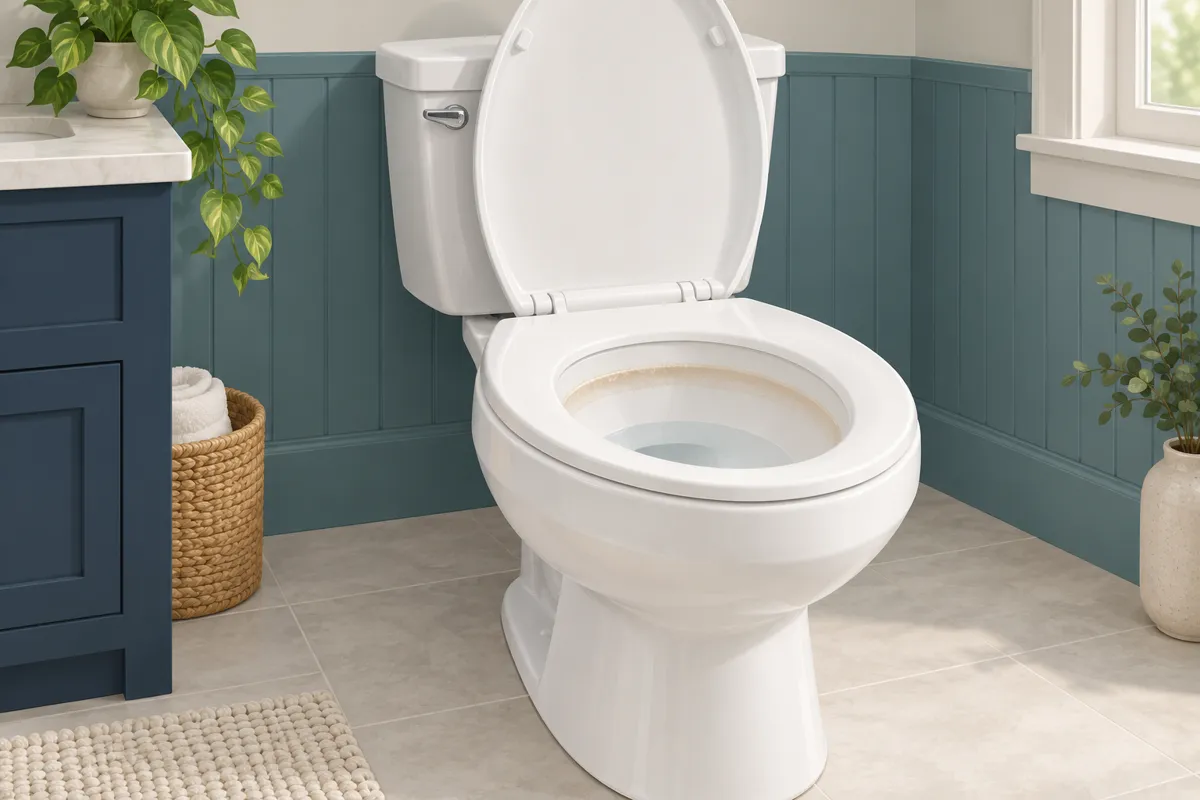
Hard water stains in a toilet should be treated with a mineral-deposit cleaner approved for the bowl’s surface. Read the toilet maker’s care guide and the cleaner’s label, use the specified contact time, then brush and rinse as directed. Do not mix products or assume that a stronger acid is safer for stubborn marks.
Start by locating the problem: inside the bowl, around the rim, on the seat, or inside the tank. This article covers bowl deposits. Different parts can be made from different materials and may not tolerate the same product.
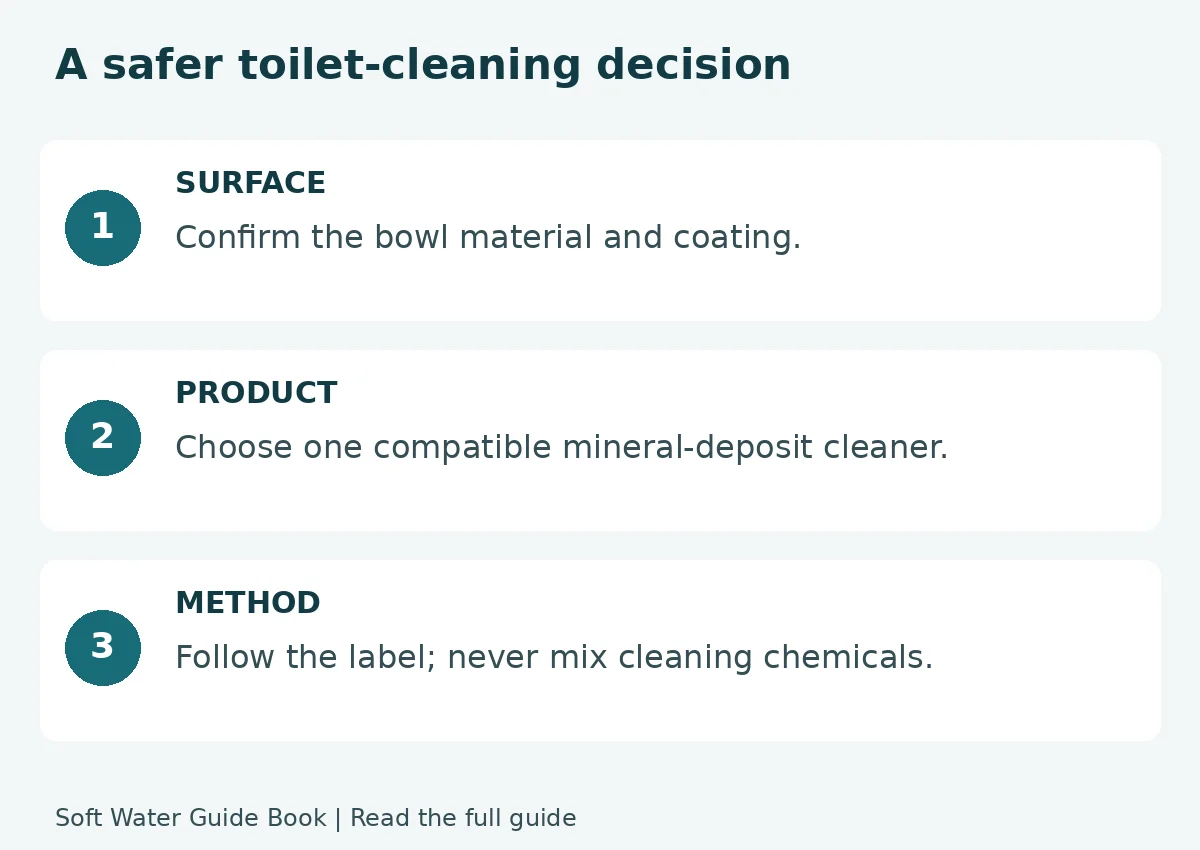
Are the hard water stains in your toilet really mineral deposits?
A waterline ring is a reason to inspect, not a complete diagnosis. Note its texture, color, location, and whether it returns after cleaning. Photograph the dry-looking exposed area before treatment, and compare it under similar lighting afterward.
| Location or observation | What to check | Do not assume |
|---|---|---|
| A deposit inside the bowl | Bowl material and approved mineral cleaner | Every discoloration has the same cause |
| Marks on the seat or lid | Seat-specific care instructions | Bowl cleaner is suitable for plastic |
| Deposits with weak rim wash | Manufacturer’s rim-hole troubleshooting | Cleaning the visible ring fixes the flush |
| Water or leakage outside the toilet | Plumbing or seal condition | It is only a stain-removal task |
Sterling notes that hard-water deposits can obstruct rim holes and trapways and directs owners to a compatible commercial deposit remover. Its care guide also separates bowl products from products for other surfaces. [1]
How to clean hard water stains in a toilet
1. Identify what is already in the bowl or tank
Before adding anything, check whether a cleaning tablet, bleach product, or another cleaner is in use. If you do not know what is present, stop and get product-specific advice. Do not try to neutralize an unknown cleaner with another chemical.
Poison Control warns that mixing an acid toilet cleaner with bleach can produce chlorine fumes. Use one product according to its label, with its required ventilation and protective equipment. [2]
2. Confirm compatibility
Check the toilet model and any special coating. Choose a cleaner explicitly intended for the bowl and mineral deposits. A product described as a general bathroom cleaner may serve a different purpose. Read restrictions, contact time, and rinsing instructions before starting.
3. Apply and brush as directed
Follow the label’s directions for the water level and application area. Use the brush or cleaning tool allowed by the toilet maker. Keep bowl cleaner off the seat, hinges, plated trim, and surrounding surfaces. Do not increase the contact time just because the mark has been present for months.
4. Rinse and assess the result
Complete the instructed rinse or flush, then check the same area. If the label permits another application, follow its limits. If the deposit remains unchanged, contact the toilet or cleaner manufacturer instead of switching to an abrasive or stronger chemical on speculation.
Avoid turning a stain into surface damage
Do not assume that pumice, wire brushes, or abrasive pads are safe for an unidentified bowl or coating. A method suitable for one surface can be wrong for another. Ask for model-specific confirmation before using a tool that removes material mechanically.
Sterling advises against in-tank cleaners because they can damage flush components. It also warns against using its bowl cleaner on seats and other household surfaces. These examples show why “toilet-safe” should not be read as “safe on every toilet part.” [1]
What if the rim wash is weak?
Visible cleaning and flush performance are separate checks. Kohler provides a distinct procedure for rim holes affected by hard-water deposits. Use the troubleshooting instructions for your model rather than pouring cleaner into the tank as an improvised shortcut. [3]
If the toilet leaks, flushes poorly after permitted checks, or has a damaged surface, ask a plumber or the manufacturer for the next step. Provide photos and the cleaner used so the advice can account for earlier treatment.
Reduce repeat staining by checking the supply
Keep a simple record of cleaning dates and how soon the ring returns. To investigate hardness, follow our water-hardness testing guide. A hardness result and a stain photograph answer different questions; keep both.
If your home has a softener, confirm whether this toilet actually receives treated water. Then check the bypass position and maintenance routine if treatment is expected. Do not infer whole-house softener failure from one toilet.
Check the product label before treating the bowl
| Label or equipment detail | Your record |
|---|---|
| Toilet model, bowl material and any coating | ________________ |
| Product explicitly covers hard-water or mineral deposits | ________________ |
| Permitted bowl surface, dose and contact time | ________________ |
| Brush, ventilation, protection and rinsing instructions | ________________ |
| Other cleaner or tank tablet already present | ________________ |
If an entry is unknown, resolve it before applying a second product. Sterling separates bowl cleaner from seat and exterior care and advises against in-tank cleaners; its general disinfecting instructions do not supply one universal descaling contact time. [1]
For deposits elsewhere in the bathroom, use the material-specific guides to shower doors and faucet finishes. Do not carry a bowl cleaner over to those surfaces.
Sources and care instructions
Sources reviewed September 30, 2026. Use the instructions for your exact product, material, and equipment.
- Sterling: Toilet care and cleaning
- Poison Control: Safe spring cleaning
- Kohler: Poor toilet rim wash
Manufacturer examples and task links checked October 16, 2026. The comparison is editorial guidance, not a report of hands-on cleaning tests.