
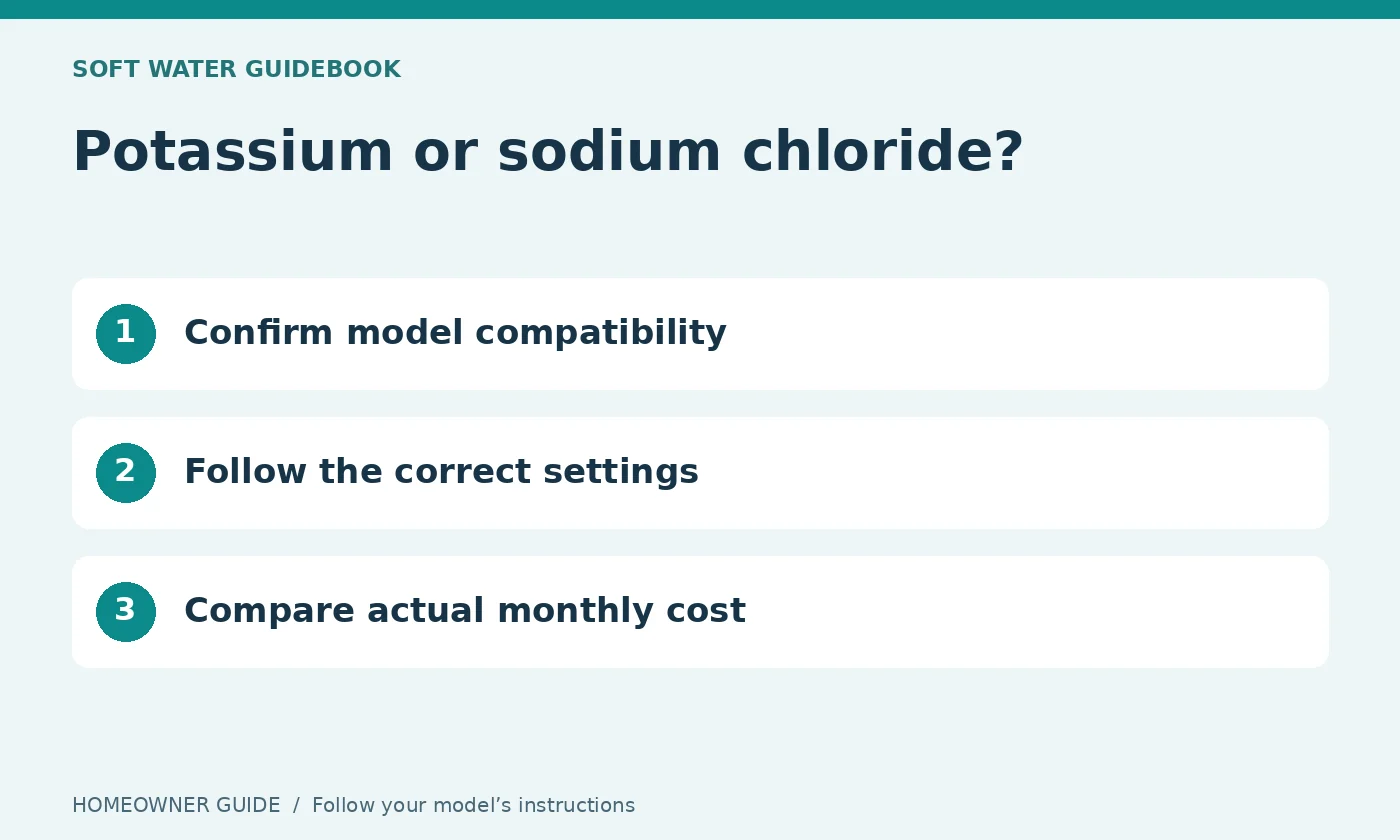
Potassium salt for a water softener usually means potassium chloride, or KCl, used in place of sodium chloride, or NaCl, for regeneration. It can be an option in compatible systems, but you should confirm the model’s instructions and required programming before switching.
The practical decision involves three questions: does your equipment allow it, which settings change, and what will it cost to maintain? A different bag label alone does not answer those questions.
Potassium salt for a water softener: what changes?
Both products are salts used to prepare the regeneration solution. KCl is an alternative to sodium chloride; it does not turn a regenerating softener into a salt-free conditioner. Water-Right describes softening as replacing hardness minerals with sodium or potassium. [1]
| Decision point | Sodium chloride — NaCl | Potassium chloride — KCl |
|---|---|---|
| Product to confirm | Approved sodium-chloride softener salt | Approved potassium-chloride softener product |
| Controller setup | Use the model’s NaCl instructions | Check for a salt-type option or another specified adjustment |
| Ongoing cost | Track price per pound and actual use | Compare price per pound and consumption after the change |
| Result to verify | Treated-water hardness | Treated-water hardness after correct setup |
If you are considering the switch because of a prescribed sodium or potassium restriction, discuss your drinking-water arrangement with your clinician. Do not treat KCl as automatically appropriate for every diet. This comparison is about equipment and running costs, not a medical recommendation.
Check the exact model before changing settings
Manufacturer instructions differ. Rheem’s KCl guide tells owners to use the salt-type menu when available; for covered models without that option, it specifies a 25% hardness-setting adjustment. GE’s guidance specifies a 20% increase for its covered softeners. [2] [3]
Those examples show why you should not copy a percentage from another brand. Start with the correct incoming-water hardness setting, then apply only your model’s KCl procedure. Keep a photo of the previous configuration so the service provider can see what changed.
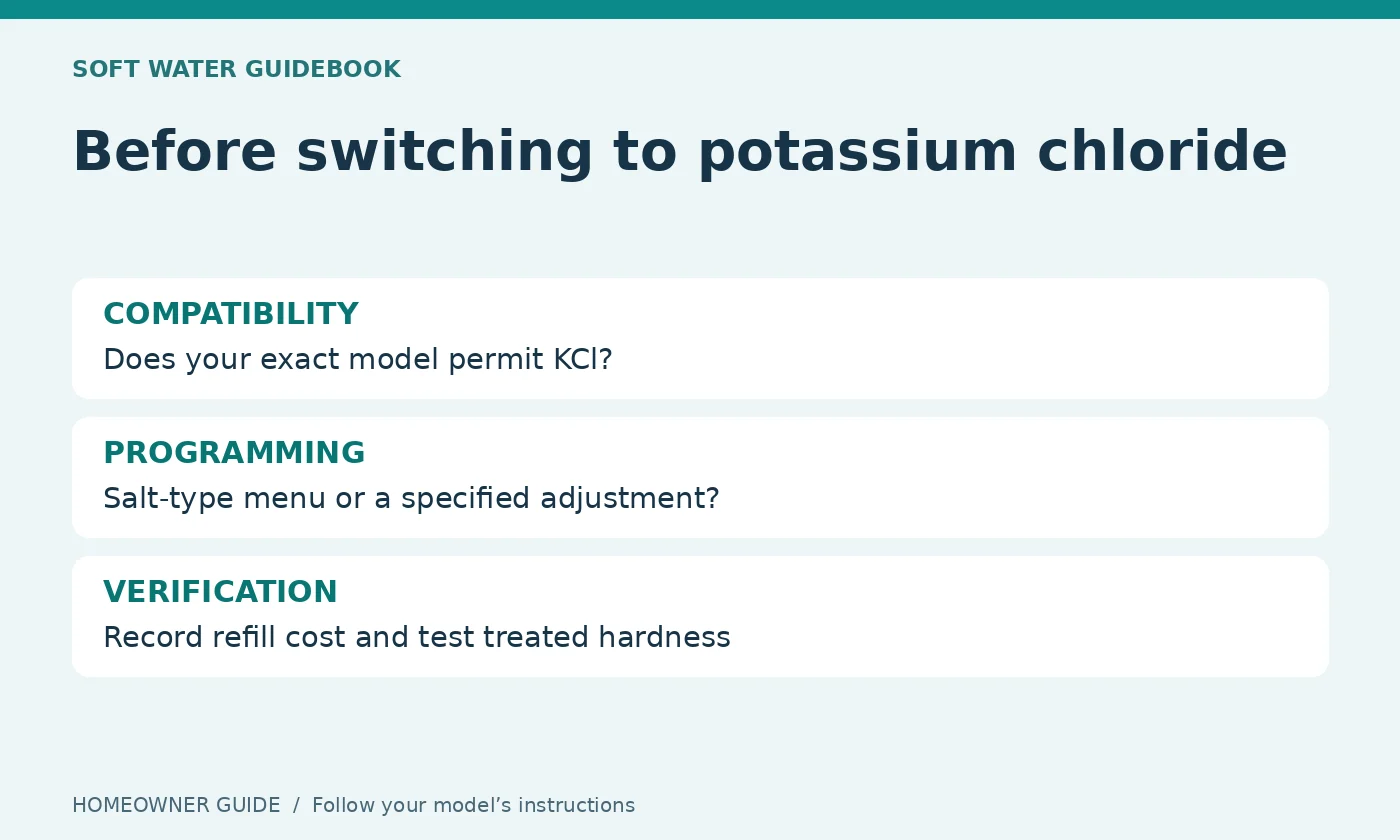
Compare monthly cost, not just bag price
GE explains that KCl is less efficient than sodium chloride for its regeneration process and that operating behavior can change. [3] A like-for-like bag comparison therefore may not predict your actual monthly expense.
Use this simple calculation for either product:
Monthly regenerant cost = pounds used during the month × purchase price per pound.
Hypothetical example: a 40 lb bag priced at $12 costs $0.30 per pound. A different 40 lb bag priced at $28 costs $0.70 per pound. At an assumed 40 lb monthly use for each, the material cost would be $12 versus $28. These are invented arithmetic examples, not current prices or a prediction that both products will have equal consumption.
For a useful household comparison, keep receipts, refill weights, and dates. Record any extra regeneration and changes in occupancy. Compare periods that begin and end with a similar amount stored in the tank, rather than assuming every purchased bag was used immediately.
A practical switching checklist
- Confirm approval. Find the model’s KCl instructions or ask the manufacturer.
- Check the product. Use a water-softener regenerant, not an unrelated potassium product.
- Follow the changeover method. Ask whether to use up the existing salt first and whether any cleaning is required.
- Apply the specified programming. Do not combine a salt-type selection with an extra adjustment unless instructed.
- Verify the result. After the prescribed recovery, compare treated and untreated water with a hardness test.
Keep the tank within its recommended fill range; our guide to how much salt to add covers that separate question. If consumption or recharge frequency changes, review regeneration frequency against the new setup.
Questions homeowners ask
Can potassium chloride and sodium chloride be mixed?
GE says accidental mixing does not harm the softeners covered by its guidance. [3] That does not establish a universal changeover procedure or the correct settings for every mixed tank. Follow your equipment instructions.
Does KCl eliminate brine-tank maintenance?
No. Keep the manufacturer’s inspection and cleaning schedule. Changing regenerant is not a reason to skip the maintenance checklist.
Which one should I choose?
Choose an approved product that meets your household requirements and that you can supply consistently. If NaCl is working well and there is no specific reason to change, first establish what benefit you expect from KCl and compare the full operating cost.
Use our monthly salt-consumption calculation to compare equivalent periods. The separate pellets-versus-crystals comparison addresses physical form rather than the NaCl-versus-KCl decision.
Sources and review notes
Reviewed September 28, 2026. This guide compares manufacturer guidance; it does not report hands-on testing. Your model’s manual controls service procedures.