
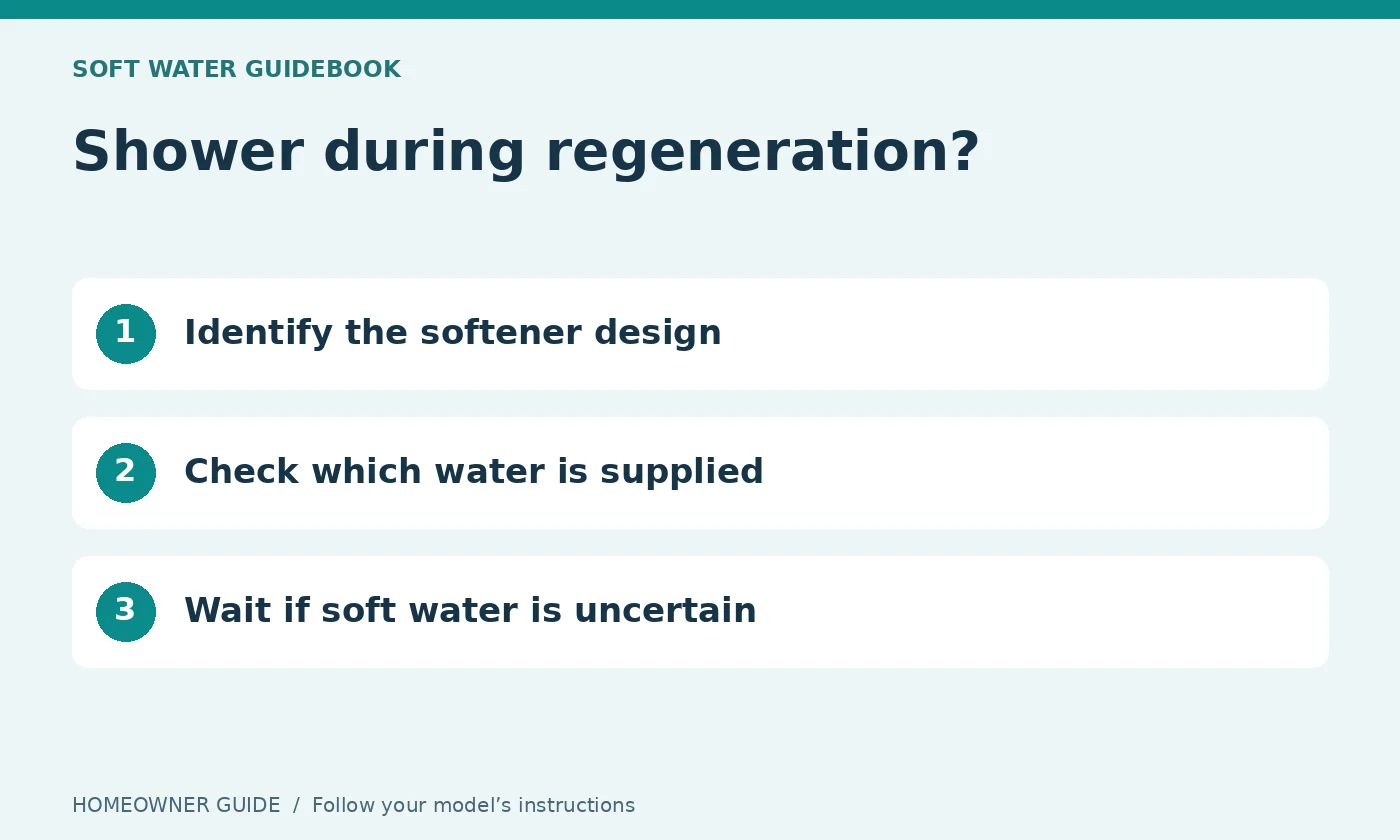
You can shower during regeneration only if your model permits household water use at that stage. Whether the shower receives softened water is a separate question. Some single-tank units provide untreated water through an automatic bypass during recharge. Alternating twin-tank softeners can keep one softening tank in service while the other regenerates.
If you want a reliably soft-water shower and have not confirmed your model’s behavior, wait until it returns to service. The key is the equipment design, rather than a universal rule that nobody may use water during regeneration.
Single-tank and twin-tank systems behave differently
| System | What may reach the shower during regeneration | Practical choice |
|---|---|---|
| Single softening tank with automatic bypass during recharge | Untreated water while the tank regenerates | Wait if softened water is important for the shower |
| Alternating twin softening tanks | Softened water from the tank still in service | Check the model’s operating and flow limits |
| Unknown design or configuration | Cannot be determined from the number of visible containers alone | Identify the model before relying on uninterrupted soft water |
GE states that the systems covered by its guidance automatically bypass during recharge and supply hard water if a faucet is opened. It recommends avoiding hot-water use because the water heater can refill with hard water. [1]
Kinetico’s Signature Series provides a different example: its twin softening tanks alternate so one remains available while the other regenerates. [2] That example should not be applied to every product described casually as having “two tanks.”
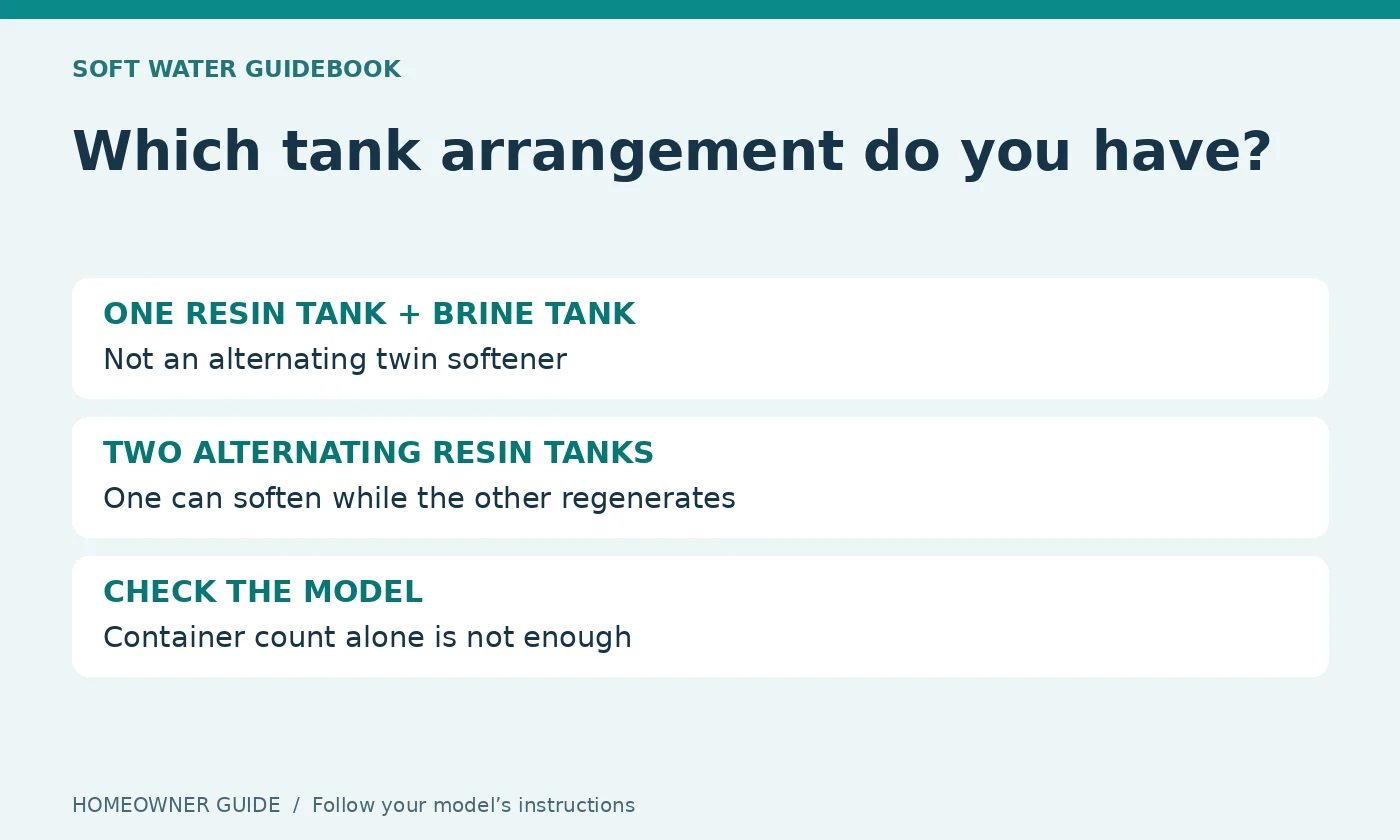
Two containers do not necessarily mean twin-tank softening
A conventional installation may have one resin tank and one separate salt or brine tank. The brine tank stores the regeneration supply; it is not a second softening tank. Whirlpool explains the distinct jobs of the resin and salt in its system guidance. [3]
Look up the model, rather than counting containers in the garage. Useful manual terms include “water available during regeneration,” “automatic bypass,” and “alternating twin tank.” An automatic bypass function is also different from manually placing the unit in bypass.
What happens to a hot shower?
With a storage water heater, the water already in the tank and the replacement water entering it are not necessarily the same. GE’s warning about hot-water use matters because a shower can cause the heater to take in untreated replacement water during recharge. [1]
For that reason, the initial feel of the shower does not establish that the softener is actively supplying soft water throughout it. Do not use that impression to identify the system type or decide that regeneration has ended.
What about toilets, laundry, and dishes?
First confirm that your model permits household water use during regeneration. If it supplies untreated water through an automatic bypass, choose based on whether that task needs softened water.
- Showering: postpone it if the goal is a soft-water shower.
- Laundry or dishwasher cycles: schedule them outside regeneration when you want their water supply softened.
- Flushing a toilet: this does not require a soft-water result, but water availability still follows the system’s design.
These are scheduling choices, not a diagnosis of unusual pressure, noise, or taste. Investigate those symptoms separately rather than assuming every change is normal during recharge.
Move regeneration away from your shower time
Check the controller clock first, especially after a power interruption. If your model offers a preferred recharge time, set it for a period when the household usually needs less water. Keep the expected regeneration duration in mind so the cycle can finish before your morning routine.
Changing the preferred start time is different from forcing more frequent cycles. Use the regeneration-frequency guide if you are trying to understand when the unit decides to recharge. Do not change the hardness setting simply to move a cycle away from a shower.
Should you stop the cycle to take a shower?
Do not interrupt a regeneration sequence unless your model’s instructions explain how and why to do so. When the system type is uncertain, waiting for the normal service indication is the clearest way to avoid guessing. If softened water does not return afterward, confirm it with a hardness test and troubleshoot that result separately.
If the clock changed after an outage, follow the guide to restoring water softener settings after a power interruption before moving the recharge time.
Shower-time plan
Confirm what the manual says about water availability and treatment during regeneration. Do not interrupt the cycle just to complete this record.
Open the fill-in record and download a copy
Use “unknown” for details you cannot confirm. Entries stay in this page and are not submitted by this tool. Download a text copy before leaving; reloading clears the record.
No record prepared yet.
JavaScript is off. Copy the field labels into your own notes and keep your record there. The download buttons require JavaScript.
Sources and review notes
Reviewed September 28, 2026. This guide compares manufacturer guidance; it does not report hands-on testing. Your model’s manual controls service procedures.
- GE Appliances: Water Softener — Water Usage During Regeneration
- Kinetico: Signature Series Water Softeners
- Whirlpool: Hard Water and Water Softening Systems FAQ
Updated October 27, 2026: added a fill-in shower-time plan with a downloadable text copy. Manufacturer-based guidance is not a report of hands-on testing.