
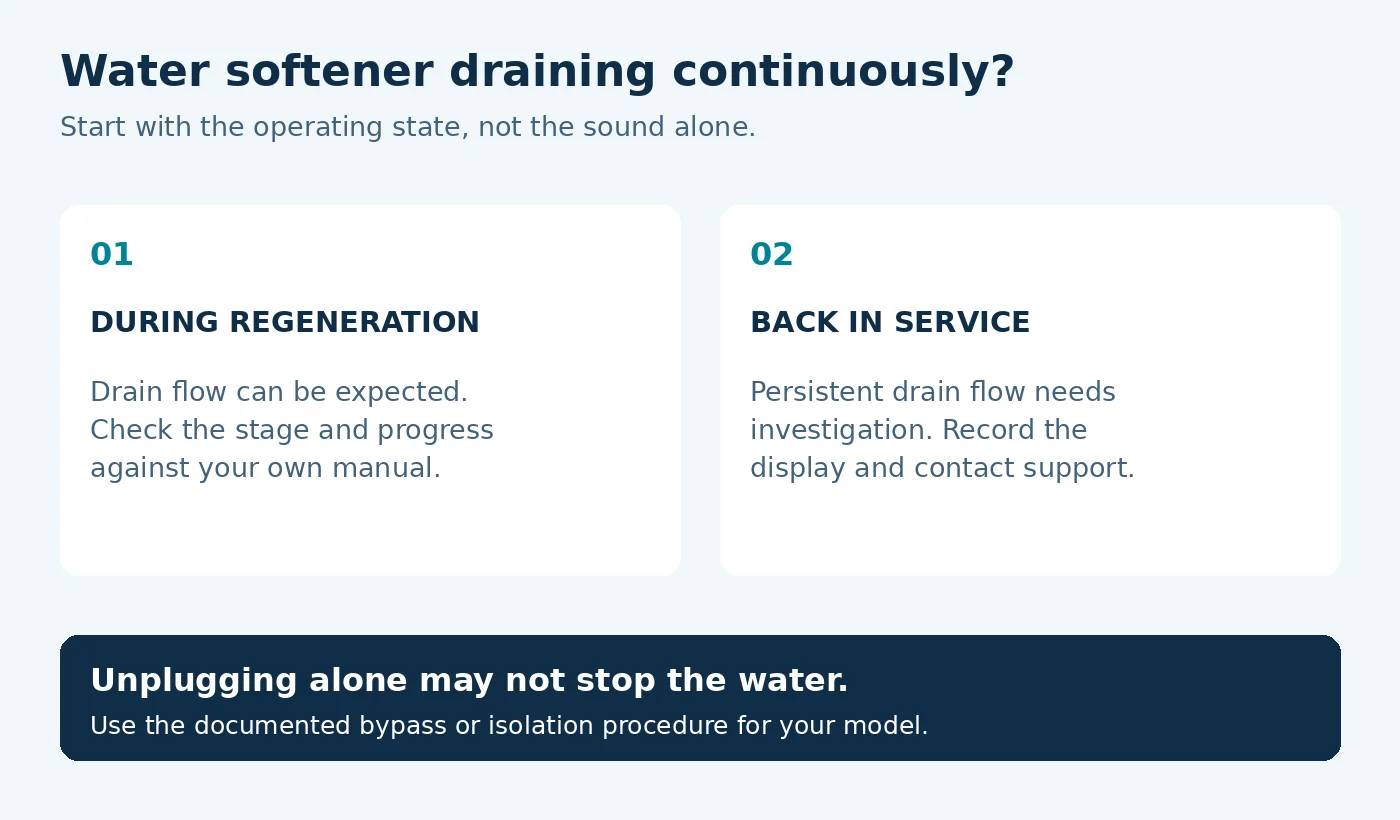
A water softener draining continuously needs attention if water keeps leaving the valve drain after the unit should be back in normal service. First check whether regeneration is actually underway, identify which hose is flowing, and record any error message. A valve that has not returned to its operating position, a control fault, or excessive incoming pressure may be involved; the symptom alone does not identify a failed part.
If water is escaping onto the floor or the drain is backing up, follow your model’s documented bypass or water-isolation procedure if you can do so safely, and get help promptly. Do not cap the drain hose or handle wet electrical equipment.
Is the water softener draining continuously or finishing a normal cycle?
Water going to the drain during regeneration can be normal. Whirlpool’s recharge guide describes a slow discharge during brining and faster flow during backwash and rinse. It also describes an optional cleaning stage on some units. The sound and flow can therefore change during a single cycle. [1]
Check the actual operating state rather than timing from when you first noticed the sound. Record the start time if known, the displayed stage, and whether the indicator progresses. Compare these with your exact model’s instructions. Our guide to how long regeneration takes explains why one brand’s cycle duration is not a deadline for every softener.
A useful distinction is one cycle that never finishes versus separate cycles that finish and restart. Tell support which pattern you see. A quiet motor or a normal-looking clock is not, by itself, proof that the water valve has returned to service.
Identify the valve drain and the tank overflow
Trace the visible hose back to its connection without disconnecting it. The regeneration drain comes from the control valve; an overflow hose, where fitted, connects to the salt tank. Whirlpool’s WHES30/WHES33 installation diagram shows these as separate lines and explicitly says not to connect them together. Use your own installation diagram to identify yours. [2] For a visual comparison, see how the valve drain and tank overflow are routed.
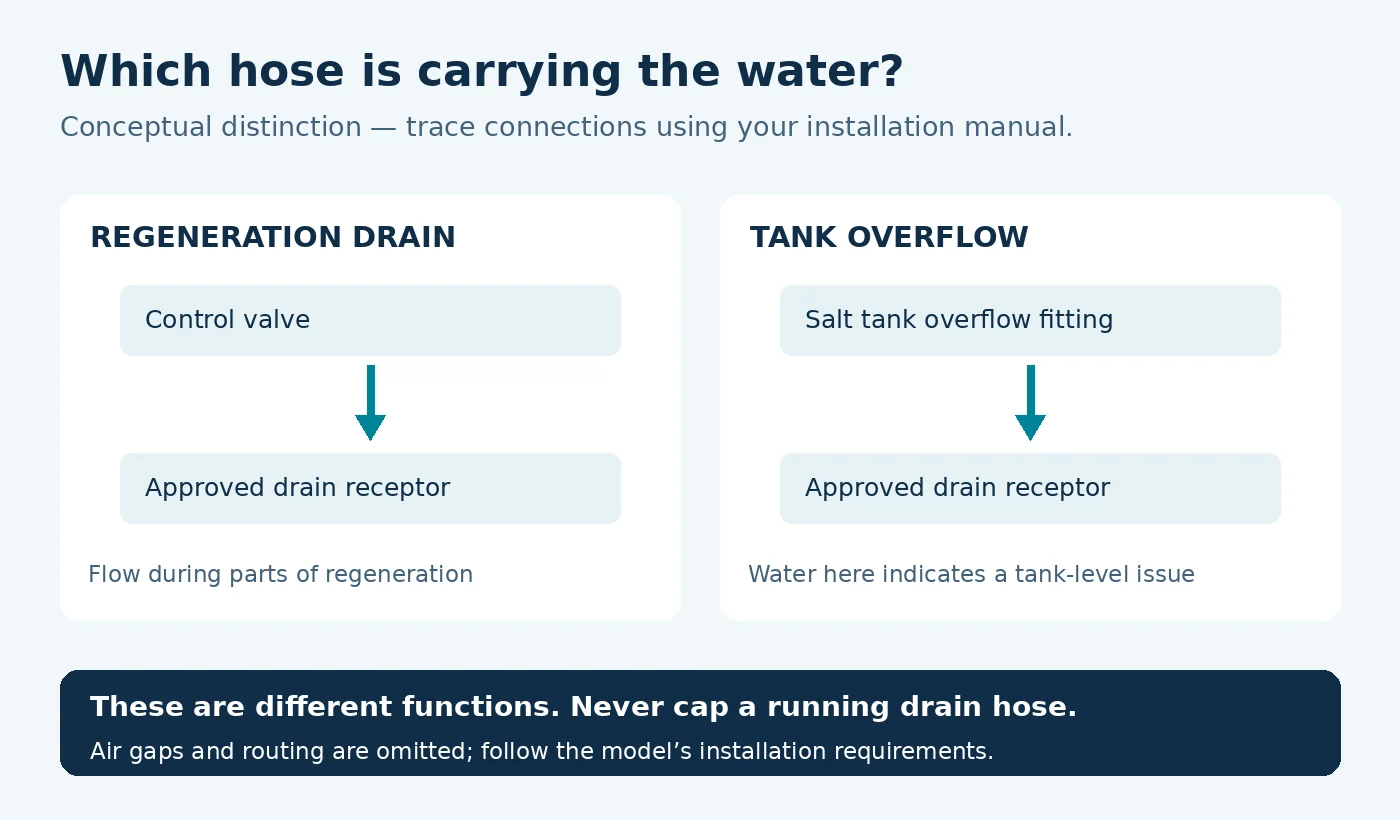
If the problem is water rising in the salt tank or escaping from its overflow fitting, use the separate guide to a water softener full of water. A high brine-tank level and persistent valve-drain flow may occur together, but they are different observations.
What to check before changing settings
| What you observe | What to record | Next step |
|---|---|---|
| Drain flow during an active cycle | Stage, start time, and progress | Compare with the model’s normal sequence |
| The same stage stays on the display | Exact wording and any error code | Use the controller’s fault instructions |
| Flow continues after the expected return to service | Whether flow is steady or intermittent | Follow constant-draining diagnostics or contact support |
| Draining began after a power interruption | When power failed and the last known stage | Check the model’s recovery instructions |
| Water leaves the salt-tank overflow | Tank level and the hose connection | Investigate excess tank water |
| A floor drain backs up or water escapes | Location, if safe to observe | Isolate the supply as instructed and request help |
1. Photograph the display before resetting anything
Include the full message, not just “error.” Rheem’s error guide distinguishes possible motor, switch, wiring, valve, and control-board faults; some codes apply only to particular models. An error is a route into the correct diagnostic procedure, not an automatic instruction to replace the board. [3]
Keep the model and serial number with the photograph. If the screen is blank, note that too. Avoid a factory reset unless the manufacturer’s procedure specifically requires it: preserving the original settings and fault details makes the service conversation more useful.
2. Inspect the accessible hose route
Look for crushing, a sharp kink, displacement, or a drain receptor that cannot accept the discharge. Do not remove a pressurized connection or reposition a flowing hose to test it. The WHES30/WHES33 manual links drain restrictions to poor brine draw and requires a secured discharge with an air gap. A hose problem does not automatically explain why a valve keeps sending water to the drain. [2]
3. Note what changed before the symptom appeared
Write down any outage, service visit, plumbing work, or intentionally extended cycle. “It started immediately after the controller lost power” is more useful than “it has been running for ages.” If the problem followed an outage, check our guide to restoring operation after a power outage. If you do not know the start time, say so; do not estimate a cycle duration from an incomplete observation.
Why a water softener may keep draining
The valve has not returned to its normal position
Rheem identifies a valve stuck in a rinse position as a possible explanation for constant drainage. Its guidance uses a specific diagnostic sequence and considers rotor-disc and seal work if draining persists afterward. This applies to the equipment covered by that guide; other valve designs need their own parts and procedures. [4]
The controller or valve drive cannot complete the movement
A motor running does not establish that the valve mechanism is moving correctly. Rheem’s error procedure separately checks motor operation, the cam and gear, and position-switch behavior. Leave internal testing to a qualified service provider if it requires tools or access you are not comfortable using. [3]
Incoming water pressure needs checking
Excessive supply pressure is another possibility in Rheem’s constant-draining guidance. Its pressure-testing article recommends a gauge that records peak pressure, since pressure changes with household and neighborhood demand. Have the reading compared with the requirements for your exact softener; do not apply a generic pressure limit or adjust a regulator by guesswork. [4] [5]
If you already have a suitable gauge and know the approved test procedure, record the current and peak readings, the time, and the test location. Otherwise, ask the installer or plumber to check them. A single low reading while water is being used may miss higher pressure at other times. [5]
How to stop unwanted drain flow safely
Use the documented water-isolation procedure, not unplugging alone. Whirlpool’s extended-brine instructions show why this matters: on the covered equipment, disconnecting power during brining deliberately leaves the valve draining until power is restored. That is a troubleshooting procedure for a different symptom, not a general way to fix continuous discharge. [6]
- Identify the correct bypass or shutoff. Our water softener bypass valve guide explains the common arrangements. Use the labels and manual for your installation. Do not assume every handle moves in the same direction or force a stuck control.
- Follow the complete procedure. Include any model-specific power or blending-valve instructions. Do not improvise button presses to advance stages.
- Observe the result from a safe position. Record whether the sustained flow stops. If it continues, do not keep manipulating valves; contact support or a plumber for the appropriate isolation step.
- Keep the unit isolated until the fault is addressed. Arrange service rather than leaving it wasting water or repeatedly starting regeneration.
Rheem’s constant-draining procedure includes a dry recharge while bypassed. If you have a covered model, follow that manufacturer’s full instructions or ask support to guide you. It is not a universal reset sequence. [4]
If you also hear persistent running, vibration or a repeated mechanical sound, use the water softener noise guide to describe when it occurs alongside the drain flow.
What to tell the technician—and what to verify afterward
Prepare a short record: model and serial number; which hose flows; actual cycle start if known; display and errors; recent changes; and what happened after the documented isolation step. Add photographs of the accessible connections. Ask which test supports the proposed repair before ordering parts.
After repair, follow the manufacturer’s return-to-service procedure. Confirm that the prescribed cycle completes, abnormal drainage does not return, and the visible plumbing stays dry. Then test hardness at an outlet supplied by the softener according to the test kit and recovery instructions. Stopping a leak and confirming softening performance are separate checks.
Add the fault, repair, and follow-up observations to your water softener maintenance record. This makes a recurring problem easier to explain without guessing which part failed last time.
Frequently asked questions
Is a small trickle to the drain normal?
It can be normal during brine draw and rinsing. A persistent trickle after the unit should have returned to service warrants investigation. Check the operating stage rather than judging only by the amount of water. [1]
Why does the water keep running when the softener is unplugged?
On some equipment, removing power stops the valve drive without closing the current water path. Whirlpool documents this behavior during an extended brine cycle. Use the model’s bypass or isolation instructions when flow must stop. [6]
Will adding salt stop continuous drainage?
Adding salt does not diagnose a valve-position, control, or pressure problem. Record the operating state and follow the constant-draining procedure first. Treat salt replenishment as a separate maintenance task.
Can I clamp the drain hose shut?
No. Do not block the discharge as a workaround. Stop unwanted flow using the installation’s documented isolation controls and arrange the correct repair.
Does continuous draining mean I need a new softener?
Not by itself. The symptom needs diagnosis before comparing a targeted repair with replacement. Ask for the identified fault, applicable warranty coverage, and an itemized quote; this guide cannot determine the failed component from drain flow alone.
Sources and model-specific instructions
Manufacturer documentation reviewed September 28, 2026. This guide covers household salt-based water softeners; the manual for your exact model takes priority over general examples.