
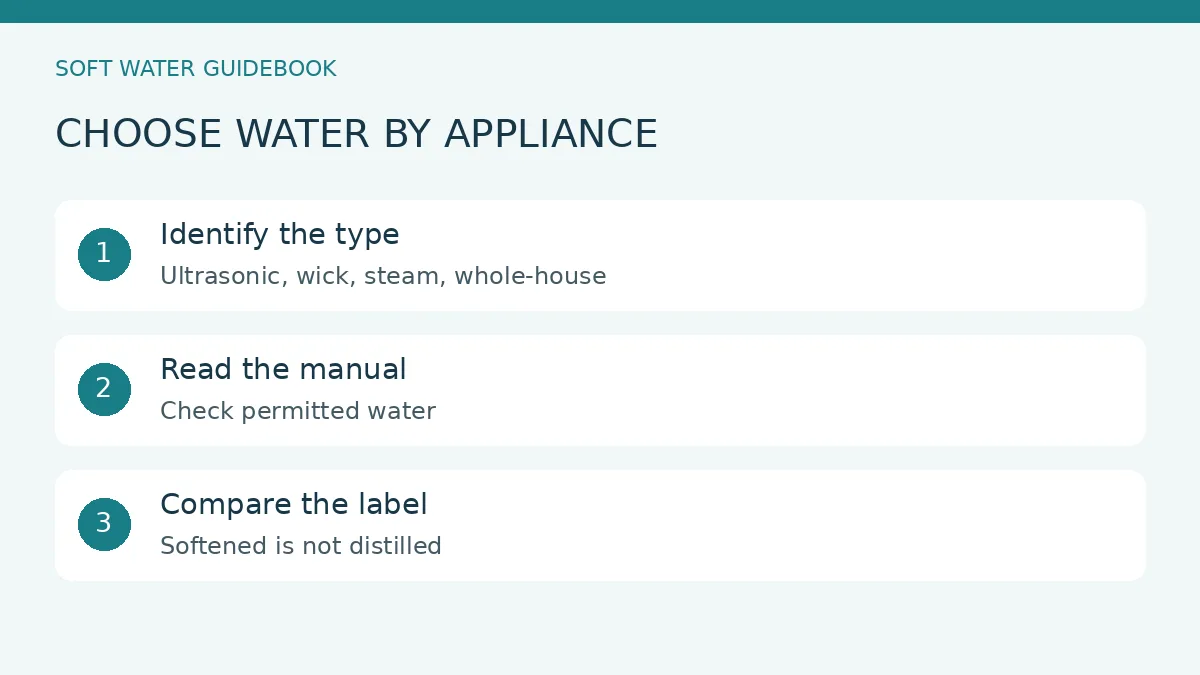
The right water for a humidifier depends on the appliance type and its manual. For ultrasonic or impeller units, EPA recommends low-mineral water, such as water labeled distilled, to reduce mineral dispersion and deposits. An evaporative unit or a plumbed-in system can have different requirements. [1]
Start with the model label, then check the water instructions. “Cool mist” alone may not tell you how the unit works. This guide compares water choices for household equipment; it does not assess drinking-water safety or recommend a humidifier to treat a medical condition.
Choosing water for a humidifier: identify the appliance first
| Type | What matters | First check |
|---|---|---|
| Ultrasonic or impeller | Minerals can be carried into the room with the mist. | Low-mineral water and any manufacturer-approved cartridge. |
| Evaporative, with a wick | Mineral accumulation can affect the wick and upkeep. | Permitted water and wick replacement instructions. |
| Steam or warm mist | The water requirements depend on the design. | Manual instructions for water and descaling. |
| Whole-house system | Supply water and treatment must suit the installed equipment. | Installer specifications rather than portable-unit advice. |
EPA distinguishes ultrasonic and impeller devices from evaporative and steam units, which generally disperse fewer minerals. AIRCARE also describes how minerals can accumulate in evaporative wicks. [1] [2]
Can you use tap water in a humidifier?
Some manufacturers permit it, but permission is model-specific. AIRCARE describes tap water as an option while explaining its mineral-related drawbacks. The relevant question is not simply whether water comes from a faucet: identify the appliance and what the water contains. [2]
If white dust appears, review the water choice and the device’s instructions. Do not respond by adding a household chemical to the operating tank. A cleaning product and a water additive serve different purposes.
Distilled, purified, and bottled water are not the same label
EPA identifies distillation, reverse osmosis, and deionization as mineral-removal processes. “Purified” does not identify just one process, while “spring” or “mineral” does not mean minerals have been removed. Read the treatment description rather than assuming any bottled drinking water is equivalent to distilled water. [1]
AIRCARE discourages spring water for its humidifiers because mineral content can contribute to deposits and wick deterioration. Its advice supports checking the water type instead of buying a bottle solely because it is sold for drinking. [2]
| Water choice | Decision |
|---|---|
| Distilled | A relevant low-mineral option when permitted by the manual. |
| Purified | Check the treatment process and the appliance requirements. |
| Spring or mineral | Do not assume it is a low-mineral replacement. |
| Softened | Reduced hardness is not the same as removal of dissolved solids. |
| Reverse osmosis | Check compatibility and the actual treatment arrangement. |
Can you use softened water in a humidifier?
A conventional ion-exchange softener does not make distilled water. Lancaster Water Group explains that softening exchanges hardness minerals for sodium rather than eliminating the total mineral content. It also distinguishes deposits in evaporative equipment from mineral dust produced by misting equipment. [3]
That distinction matters if you already have a whole-house softener. A low hardness result confirms one property of the water; it does not prove that the water is mineral-free or suitable for every humidifier. Use our water hardness testing guide to understand what that measurement establishes.
Do not raise the softener’s hardness setting as a substitute for choosing suitable humidifier water. Follow the humidifier’s requirements, even when the rest of the home benefits from softened water.
What about reverse osmosis water for a humidifier?
Reverse osmosis belongs in the comparison, but it is not a blanket approval for every appliance. Specialized humidification systems can use purpose-designed RO treatment: Condair describes equipment selected and integrated for that application. A whole-house installation therefore needs its own compatibility check. [4]
For a portable unit, compare the manual’s water specification with your RO system’s documentation. Record the treatment stages and maintenance status. If the manufacturer specifies a particular water type, do not replace that instruction with a generic claim that all filtered water is identical.
A practical water-choice record
Keep four details together: humidifier model and operating type; the manual’s water instruction; the exact bottle label or treatment system; and any observed deposits, dust, or wick changes. This makes a support request more useful than reporting only that the appliance uses “filtered water.”
Changing the water does not replace cleaning. EPA recommends daily emptying, drying, and refilling of portable tanks and cleaning every third day, with attention to the manufacturer’s cleaning instructions. [1] Check the manual before cleaning or replacing a wick; do not assume every filter is washable.
Common questions
Does filtered water mean distilled water?
No. “Filtered” is incomplete information. Identify the treatment process and compare it with the humidifier’s requirements.
Does zero hardness mean no white dust?
No. Hardness and total dissolved mineral content are different. Softening alone does not establish that all residue-forming material has been removed.
Should every water type have a separate buying decision?
Start with the appliance specification. Comparing labels against that requirement is more useful than choosing a water brand first.
Sources
Reviewed November 6, 2026. Follow the instructions for your exact appliance.