
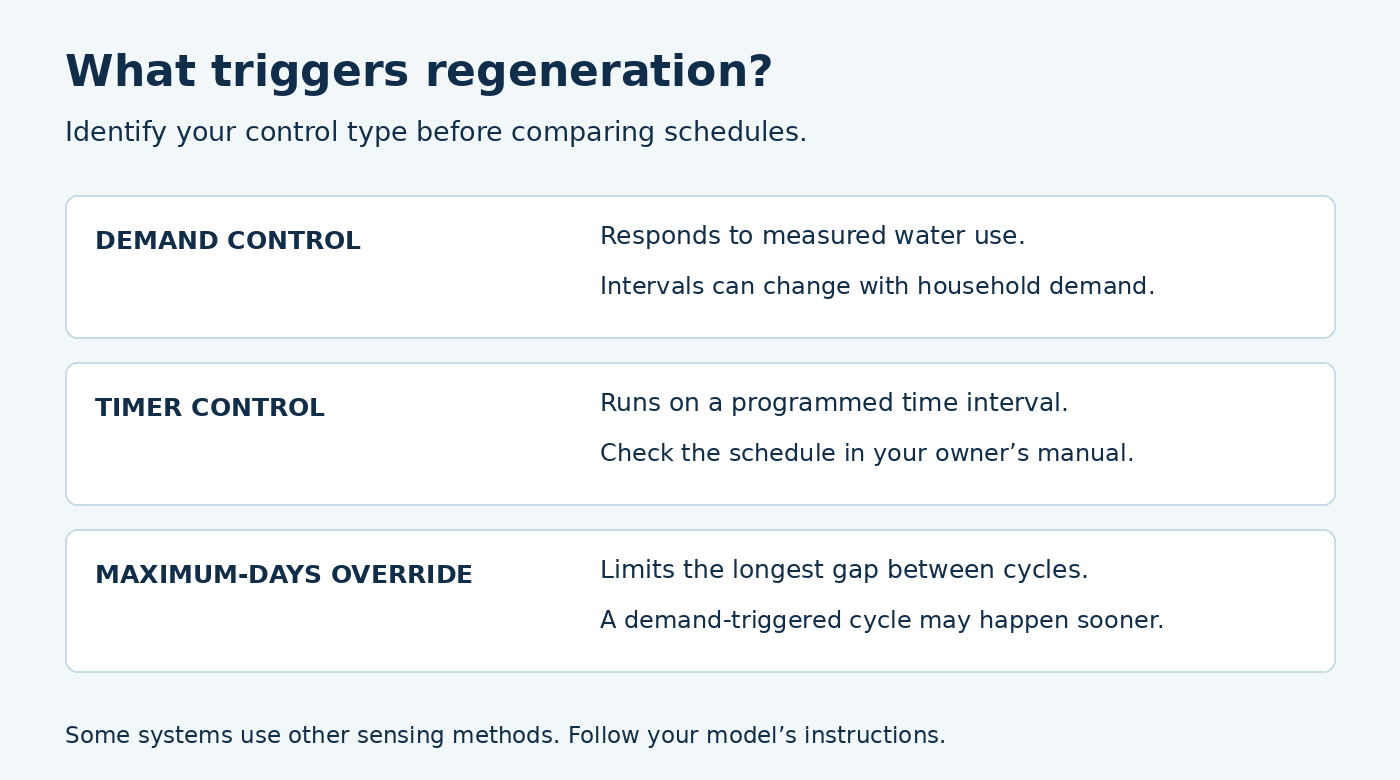
How often should a water softener regenerate? There is no single interval for every home. Frequency depends on incoming hardness, water use, usable treatment capacity, and the controller. As model-specific examples, Whirlpool describes automatic recharges usually occurring once or twice a week, while Rheem gives an average of 4–9 days for its new softeners. Neither is a universal setting. [1] [2]
The useful question is whether your system’s pattern matches its instructions and household demand while maintaining soft water. This guide concerns the interval between cycles, not how long an individual cycle lasts.
Diagram above: A maximum-days override can operate alongside demand control. Check which features your model actually has.
What determines regeneration frequency?
Regeneration restores the resin’s ability to remove hardness minerals. Harder incoming water places more mineral load on the resin for each gallon treated. Greater water use also uses available capacity sooner. The equipment’s resin capacity and control design help determine when another cycle is needed. [3]
These factors work together. Comparing two homes by household size alone ignores differences in hardness, equipment, and actual consumption. Likewise, a schedule that worked before a change in water use may deserve a review afterward.
Demand-initiated vs. timer-based regeneration
| Control approach | What triggers a cycle? | What to check |
|---|---|---|
| Demand-initiated | Water use and the controller’s capacity calculation | Flow registration, hardness programming, and household use |
| Timer-based | A programmed time interval | The configured schedule and its suitability for the installation |
| Maximum-days override | The maximum permitted gap is reached if an earlier cycle has not occurred | Whether this optional setting is enabled and why |
Culligan distinguishes usage-based and timed regeneration and also describes systems that sense resin condition. The table is a practical comparison, not an exhaustive list of technologies. [3]
A maximum-days setting is a limit, not a promise to wait that many days. Rheem explains that demand can trigger a recharge sooner. For example, a seven-day limit does not prevent a cycle on day four. The override can also increase salt and water use when it forces a cycle earlier than the normal algorithm would. Do not remove a deliberately configured limit without checking why it was set. [4]
When choosing the time of day for a cycle, check the guide to showering during water softener regeneration alongside your model’s instructions for water use during recharge.
How to check your softener’s regeneration pattern
Consult the controller and manual
Identify the exact model, then find its regeneration, recharge, or diagnostics section. Look for any available cycle counter, history, or status display. Whirlpool provides a model-specific method for checking recharge frequency; use instructions for your controller rather than copying a button sequence from another brand. [1]
Record completed cycles
Keep a simple log with the date, whether the cycle was automatic or manually started, and any displayed fault. Record completed events separately from a future recharge reminder. Note the observation period too: three cycles during one week is different from three since you installed the equipment.
For a basic comparison, calculate the gaps between consecutive recorded cycles. Avoid treating a long-term controller average as a description of the last few days if household conditions recently changed. To connect your cycle log with consumption, see how to estimate water used during regeneration.
Compare changes in water use
Add notes about guests, absences, or unusual water use. Rheem explains that its automatic cycle frequency adapts to household use and incoming water quality. A varying interval can therefore be consistent with demand operation, rather than evidence that the timer is unreliable. [2]
Keep a cycle-interval log
| Cycle start | Automatic / manual | Previous automatic start | Interval | Water use / hardness / changes |
|---|---|---|---|---|
| ____ | ____ | ____ | ____ | ____ |
| ____ | ____ | ____ | ____ | ____ |
| ____ | ____ | ____ | ____ | ____ |
Hypothetical calculation: automatic starts on October 1 at 2 a.m. and October 4 at 2 a.m. give a three-day interval. That is a calculation example, not a recommended schedule or a measurement from this site. Do not count a maintenance recharge as evidence of automatic scheduling.
Compare several intervals with the model’s control mode, settings, household use and treated-water results. A change matters more when accompanied by worsening hardness or an error than when water use alone changed.
Why is my softener regenerating more often?
Start with programming and unexpected water use. Whirlpool’s frequent-recharge checks include the hardness setting, flow when no water should be running, and an optional maximum-days setting. A low override can force extra cycles. [5]
- Review hardness correctly. Compare the programmed value with the incoming water test and any model-specific iron adjustment. Do not lower it just to reduce the cycle count.
- Check for unexplained flow. Follow the manual’s flow-display test with household fixtures and appliances off. A running toilet or another unnoticed use can change demand.
- Review optional settings. Record their current values before asking the installer whether they are appropriate.
These are diagnostic checks, not proof of a specific failed part. If the pattern remains unexplained, share your log with support rather than changing several settings at once. [5]
If household demand has changed, check capacity against household demand before deciding that frequent cycles require a larger unit.
What if it rarely—or never—regenerates?
First check cycle history: an overnight cycle can be missed. If expected automatic cycles are absent, record the controller state, metering and treated hardness, then use the not-regenerating diagnostic. If cycles occur but salt stays unchanged, use the salt-use decision path.
Should you start a manual regeneration?
Use a manual cycle when the model’s maintenance or troubleshooting procedure calls for one. Whirlpool’s instructions, for example, require checking the clock display and describe a recharge indicator after starting. They do not imply that every brand uses the same buttons. [7]
Do not add routine manual cycles simply to match an online schedule. Rheem notes that manual regeneration on its equipment uses the maximum salt dose and recommends automatic operation for efficiency. If you repeatedly need manual recharges to maintain performance, investigate the underlying problem. [2]
Frequently asked questions
Is daily regeneration always a problem?
The interval alone does not establish a fault. Compare it with demand and programming. If daily cycling is unexpected, check hardness, unnoticed water use, and maximum-days settings before deciding what needs repair. [5]
Will it stop regenerating while I am on vacation?
Do not assume it will. A demand-controlled unit may respond to lower use, but an enabled maximum-days override can still trigger a cycle. Follow the model’s vacation or extended-absence instructions instead of unplugging the unit based only on that expectation. [4]
Use the vacation preparation checklist to plan an absence and record the settings to check when you return.
Is the recharge time the same as the recharge frequency?
No. The time is the clock hour associated with the cycle; frequency describes how often cycles occur. When reviewing a setting, check whether it changes the hour, the interval, or an override. Record the existing value before changing it.
Should I set it to regenerate every seven days?
Not as a universal rule. Choose settings from the installation and manufacturer’s guidance. On a model with a maximum-days feature, seven days may represent only the longest permitted gap, with automatic cycles occurring earlier. [4]
Keep these checks in your regular water softener maintenance routine.
Sources and model-specific instructions
Manufacturer documentation checked September 24, 2026. Examples describe the equipment covered by each source.
- Whirlpool: Checking recharge frequency
- Rheem: What to expect from a new softener
- Culligan: Regeneration frequency
- Rheem: Maximum days between recharges
- Whirlpool: Recharging too often
- Whirlpool: Little or no salt use
- Whirlpool: Starting a manual recharge
Updated October 6, 2026: Added an interval log and a clearly hypothetical calculation; shortened missing-cycle troubleshooting.