
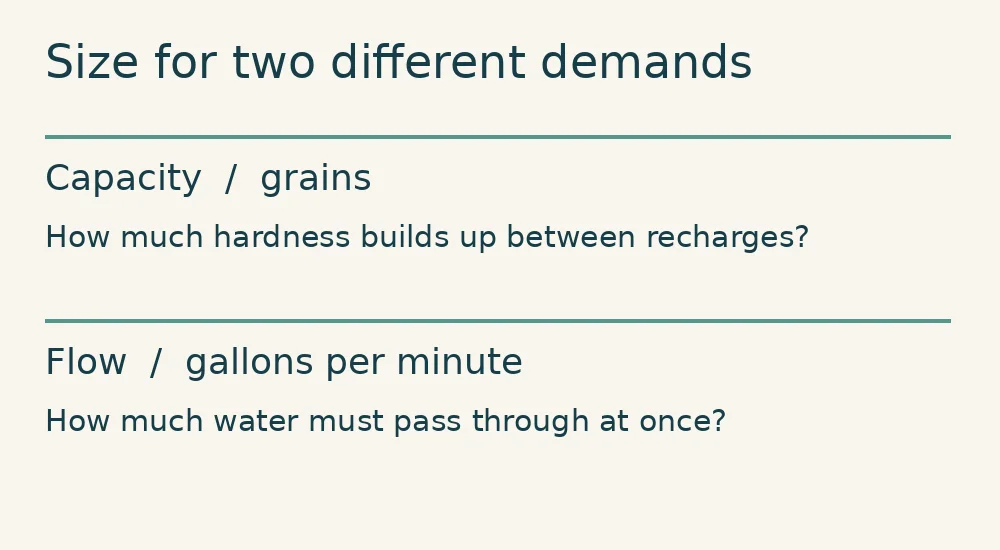
To size a water softener, work out how many grains of hardness your household needs to remove each day. Then compare two numbers on the equipment specification sheet: the usable grain capacity at the intended salt dose and the service flow rate when several fixtures run together. A family of four can need a very different softener from another family of four if their water hardness or daily use differs.
Water softener sizing calculator
Use US gallons of water that will actually pass through the softener. For a bill, enter the gallons used and the number of days covered. If you already know daily use, enter that number and set the period to one day. Enter hardness measured before the softener. The interval is a planning assumption you can change to compare scenarios.
Enter your household figures and select Calculate.
How to get a useful number from your water bill
Read the usage for the billing period, rather than the cumulative meter reading or the dollar amount. Check the units first. If the bill shows thousands of gallons, a usage of 6 means 6,000 US gallons. If it shows cubic feet, use the utility’s conversion to US gallons before entering the figure. Count the days between readings instead of assuming that every bill covers 30 days.
Subtract known bypassed uses. Suppose the household used 7,500 gallons in 30 days and a separate irrigation meter recorded 1,500 gallons that never entered the softener. Enter 6,000 gallons and 30 days. If outdoor use is unknown, compare with a period when irrigation was off. If you are estimating for a new home, multiply the number of residents by an explicitly assumed daily use per person. For example, three people at an assumed 60 treated gallons each gives 180 gallons per day. Substitute a meter reading when one becomes available.
Water softener sizing chart
These examples use seven days so you can compare homes on the same basis. Seven days is an illustration, not a controller setting. All figures are before any reserve allowance.
| Treated US gal/day | Hardness (gpg) | Grains/day | Grains in 7 days |
|---|---|---|---|
| 120 | 8 | 960 | 6,720 |
| 180 | 15 | 2,700 | 18,900 |
| 200 | 10 | 2,000 | 14,000 |
| 300 | 20 | 6,000 | 42,000 |
How the calculation works
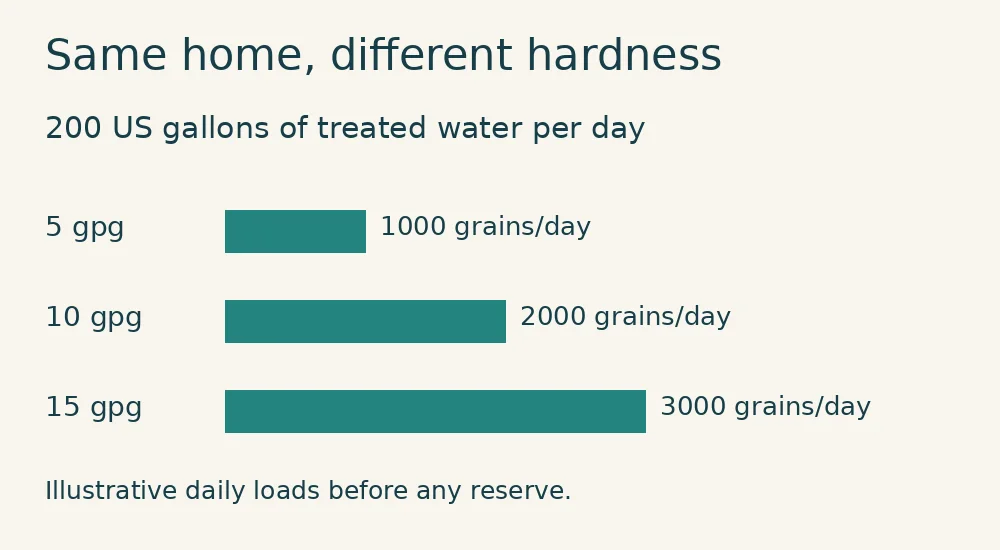
Daily load (grains) = treated US gallons per day × incoming hardness (gpg). Multiply daily load by the number of days you want to model. If a report gives total hardness in mg/L as calcium carbonate, divide by approximately 17.1 to get gpg. For example, 171 mg/L is about 10 gpg. At 200 gallons per day, that is 2,000 grains per day and 14,000 grains over seven days. A TDS meter reading cannot be substituted for a total hardness test. See how to measure incoming water hardness and Penn State Extension’s explanation of hardness units and softening.
Compare that load with a model’s usable capacity
Take the 14,000-grain example to the performance sheet. Find the capacity delivered at the salt dose you intend to use. Ask how the controller accounts for reserve before a scheduled recharge. For a hypothetical comparison, a system providing 18,000 usable grains at the selected dose, with 2,000 of those held in reserve, would leave 16,000 grains available against the example load. If the installer’s stated available capacity already subtracts reserve, use that figure directly. The reserve in this example is an assumption; check the actual controller logic.
Demand-initiated controls may vary the interval as usage changes. Use the calculator to compare plausible loads, then check the manual before changing any programming. Our guides to regeneration frequency and the hardness setting cover operation once a system has been selected.
Check peak flow separately before choosing a size
List the fixtures that normally run together and add their actual or rated flow in gallons per minute. For example, two showers at 2 gpm each and a faucet at 1.5 gpm would draw 5.5 gpm together. Compare that demand with the manufacturer’s rated service flow and stated pressure drop. A bill can tell you how much water passed in a month, but it cannot tell you how fast water flowed at the busiest minute.
For an example of what to look for, GE lists the GXSH40V with a 40,000-grain capacity designation and a 9.5 gpm service flow at a 15 psi pressure drop. These figures answer different questions. Confirm the capacity at the intended dose and whether the stated pressure drop is acceptable for your home. See GE’s residential softener specification table.
What to bring to a dealer or installer: your raw-water hardness result and units, estimated treated gallons per day, target interval, estimated simultaneous flow, and any measured iron or manganese. This calculator estimates hardness load only. For well water with iron or manganese, check the tested water against the model’s treatment limits before relying on the estimate. Nebraska Extension’s guide to water softening provides background on ion exchange and household equipment.