
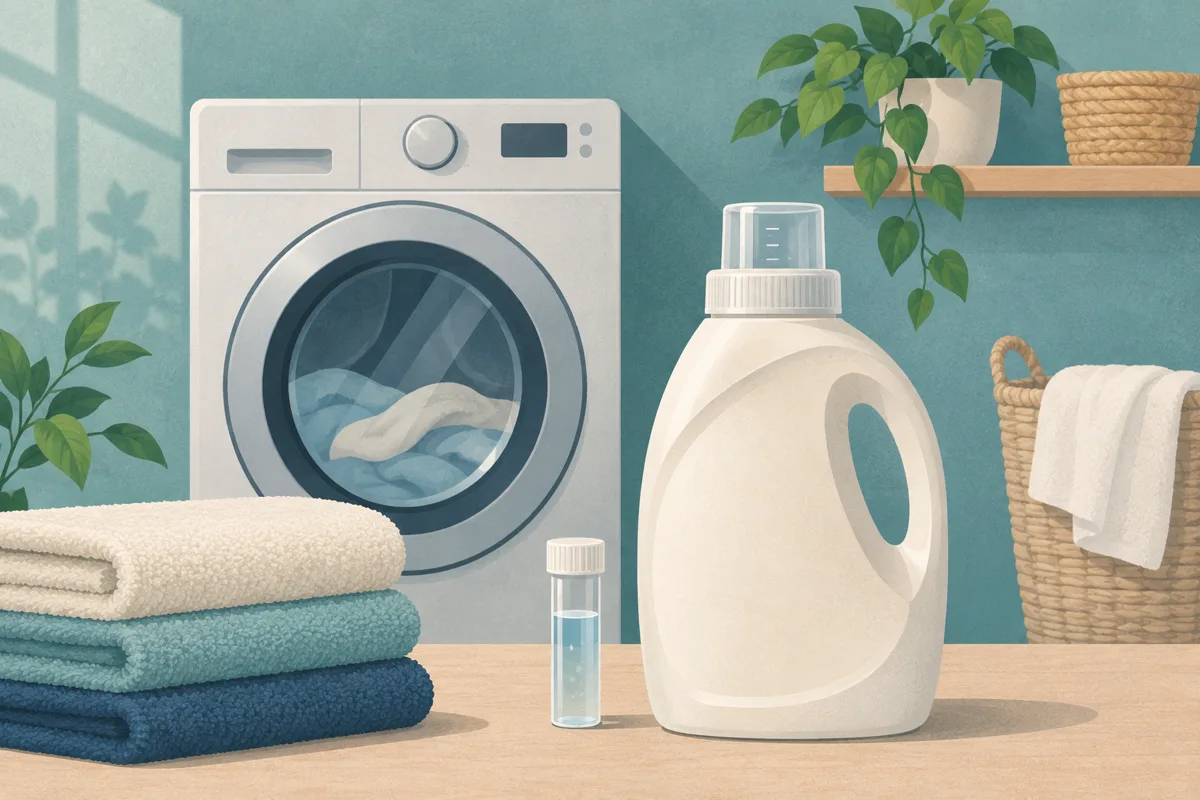
The right laundry detergent for hard water is compatible with your washer and fabrics, has clear dosing instructions, and cleans without leaving persistent residue. If some powder detergents leave mineral-related deposits, a suitable liquid is a reasonable alternative to try. That does not make every liquid better than every powder.
Start with a water-hardness check and your current product’s label. Increasing the dose blindly can create a new problem, and switching products cannot explain every stain. This guide focuses on choosing detergent and adjusting the wash; use our separate clothing-stain guide for marks already on garments.
Why hard water changes detergent performance
Hardness mainly reflects dissolved calcium and magnesium. The American Cleaning Institute explains that detergent builders interact with those minerals to help cleaning ingredients do their job. This is why formulation matters, not just fragrance or whether the package says “powerful.” [1]
Soap-based mixtures deserve particular caution as substitutes for formulated laundry detergent. University of Nebraska–Lincoln Extension describes how soap reacts with hard-water minerals to form deposits and how hardness can reduce cleaning performance. A homemade soap mixture is not automatically equivalent to a washer-compatible detergent. [2]
Liquid, powder, or pods for hard-water laundry?
| Format | Reason to consider it | Limitation to check |
|---|---|---|
| Liquid | Adjustable measured dosing; an option when a powder leaves mineral-related residue | Concentration and cap markings vary by product |
| Powder | Measured dosing and a range of formulations | Some powders can leave hard-water-related residue; also check dissolution and loading |
| Pods or packets | A defined unit dose without pouring | Follow whole-packet dosing and placement instructions; do not split packets to adjust the dose |
ACI identifies a specific problem in which some powders combine with hardness minerals and suggests liquid detergent or a suitable nonprecipitating water-softening additive as alternatives. That is guidance for a residue problem, not evidence that all powder detergents fail in hard water. [3]
If your washer requires HE detergent, choose a product labeled accordingly. Also consider garment restrictions and any need for a fragrance-free formulation. These requirements still apply when hard water is present.
How to choose a product without relying on “best” lists
- Check washer compatibility. Match HE requirements, dispenser instructions, and any automatic-dosing configuration.
- Check fabric needs. Everyday washable towels and a delicate garment may not accept the same formulation or cycle.
- Look for usable dose guidance. Identify how the label handles load size, soil, and hard water.
- Investigate the actual symptom. White residue, oily marks, and orange discoloration do not establish the same cause.
- Buy a manageable trial quantity. Keep the label and test a few comparable loads before committing to a larger supply.
Brand names are not enough to compare formulas. A manufacturer may sell several liquids, powders, and packets with different concentrations. Record the full product name instead of “one cap of detergent.”
How much laundry detergent should you use in hard water?
Use the current product’s directions for your load, soil level, water conditions, and washer. Tide identifies those factors as relevant to dosing and warns that both underdosing and overdosing can worsen results. Its advice is to use the package directions, not a universal milliliter amount copied from another detergent. [4]
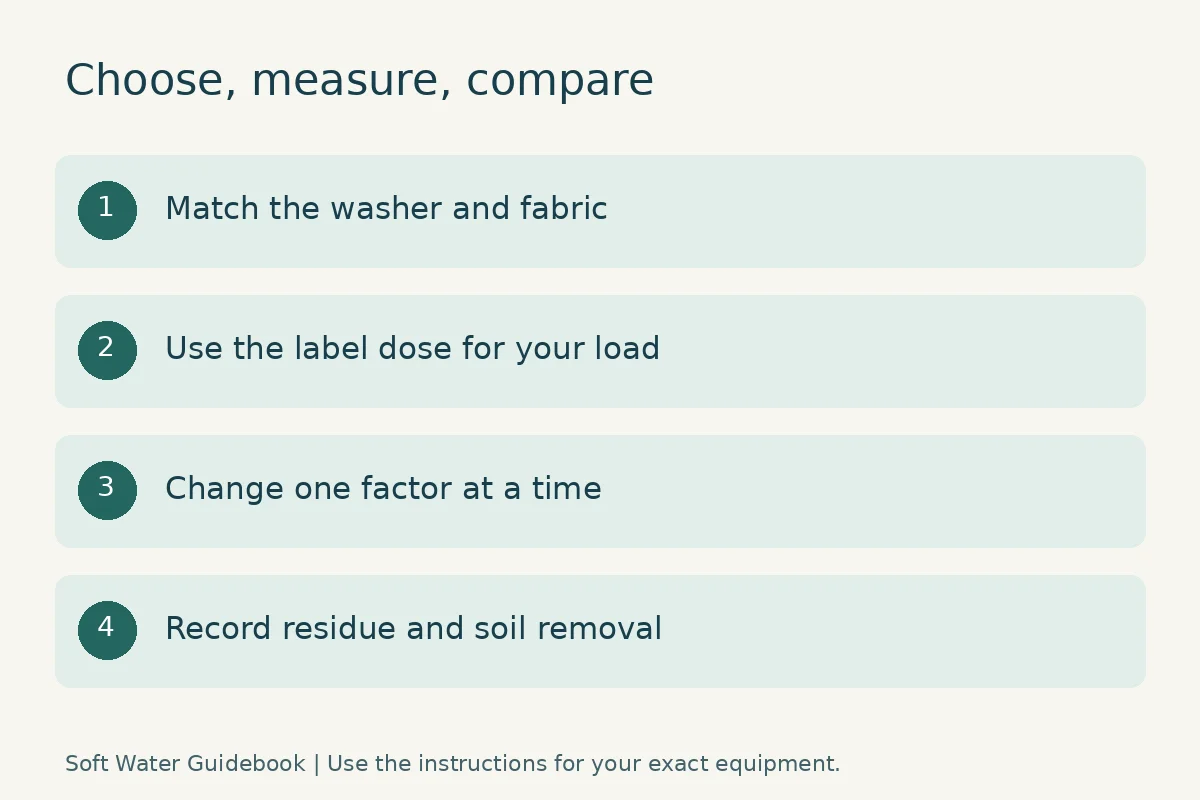
Here is a practical sequence:
- Confirm the water reaching the washer with a hardness test; an untreated outdoor faucet may not represent the laundry supply.
- Find the appropriate label dose and measure with the supplied cap or scoop.
- Keep within washer-dispenser limits and follow placement instructions.
- If the label does not explain hard-water dosing, ask the product maker rather than doubling the amount.
- For automatic dosing, check concentration and hardness settings in the washer manual before changing the product.
If you have recently restored a household softener, reassess the actual laundry supply. The old hard-water dose may no longer be appropriate. Verify treatment with a test and the softener maintenance checks.
Detergent boosters and fabric softener are not the same thing
A laundry water-softening additive is intended to help with minerals in the wash process. Fabric softener is a fabric-care product and should not be used as a substitute for correcting water hardness or detergent dosing.
Before adding a booster, establish that the product is intended for laundry and compatible with the detergent, garment, and washer. Follow its own dose and placement instructions. Do not put whole-house softener salt, pool salt, or a household-surface descaler into the washer as an improvised treatment.
Keep chemical treatments separate unless their labels explicitly direct combined use. In particular, do not mix chlorine bleach with vinegar or acid cleaners. This guide does not require a homemade chemical mixture. [5]
A three-load comparison you can actually interpret
Use similar everyday washable loads and keep the cycle, load size, and fabric mix as consistent as practical. This is a personal troubleshooting record, not a controlled laboratory comparison.
| Load | What to do | What to record |
|---|---|---|
| Baseline | Use the current product correctly according to its label | Product, measured dose, cycle, load, residue, and soil removal |
| Comparison | Change one factor: a permitted dose adjustment or a different compatible detergent | The exact change and the same outcome observations |
| Repeat | Repeat the better-performing setup on a similar load | Whether the result is repeatable |
Do not use fragrance strength as your cleanliness measure. Compare visible soil and residue on the same types of garments. If an item still has a stain, follow its care instructions before drying or treating it again. Keep valuable or delicate items out of a troubleshooting trial.
When to investigate something other than detergent
Persistent orange or brown marks, an overloaded drum, a dispenser problem, or an appliance error needs a separate check. The guide to laundry marks and residue helps distinguish these patterns. If water itself is discolored, use the water-color investigation guide rather than escalating detergent.
If an approved detergent and correct wash process still produce poor results, share your hardness reading and load record with the appliance or detergent manufacturer. That is more useful than replacing several products at once.
Common questions
Do I automatically need twice as much detergent?
No. The correct adjustment depends on the formulation and directions. “Hard water” alone does not establish a doubling rule.
Are pods unsuitable for hard water?
Not as a blanket rule. Check the formula, label dose, and washer compatibility. A packet format does not establish either success or failure.
Will liquid detergent remove old mineral deposits?
A format change may help prevent a recurring residue problem, but an existing mark needs its own diagnosis and fabric-compatible treatment.
Sources and review
Reviewed November 4, 2026. This is a documentation-based selection guide, not a hands-on detergent ranking.