
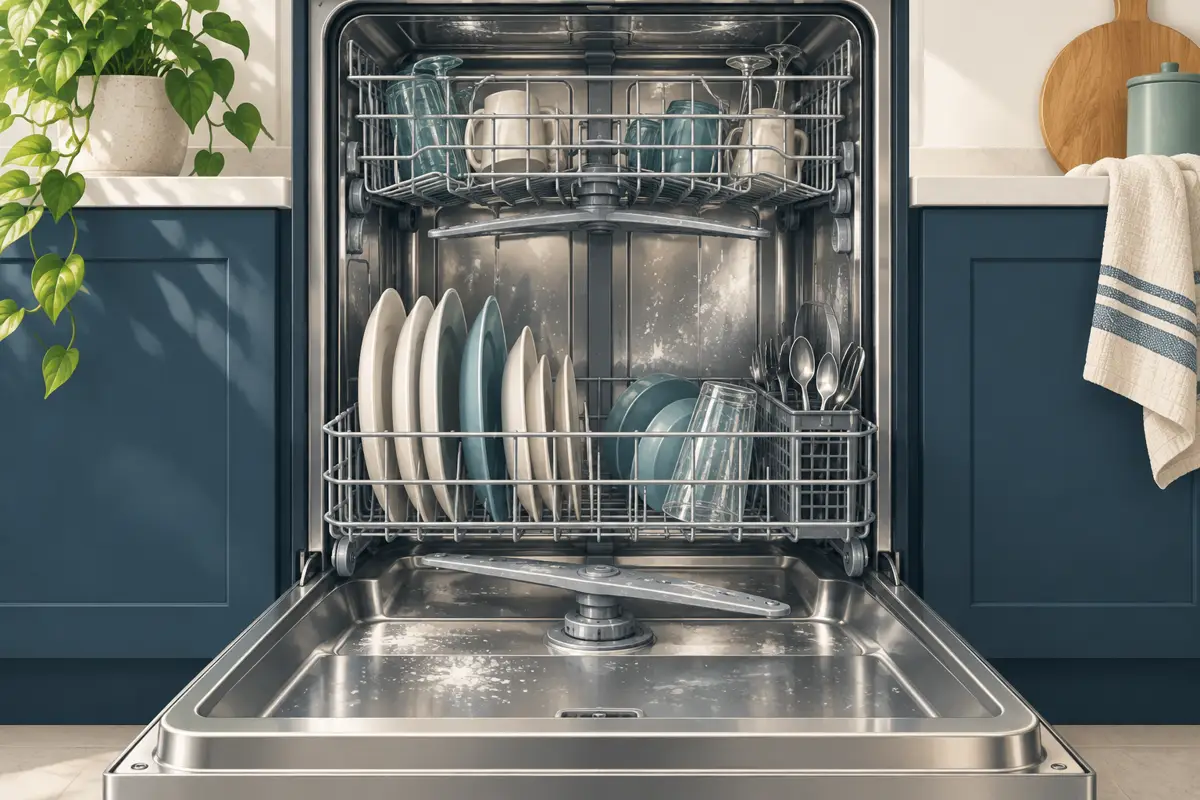
Hard water buildup in a dishwasher needs a descaling method approved for the appliance, not simply more detergent. First identify whether the residue is mineral scale, food debris, or grease. Check the manual and the cleaning product’s label before running a treatment cycle.
This guide focuses on the appliance interior. Cloudy drinking glasses may have a removable film or permanent surface damage, so a successful dishwasher cleaning does not guarantee that every glass will become clear.
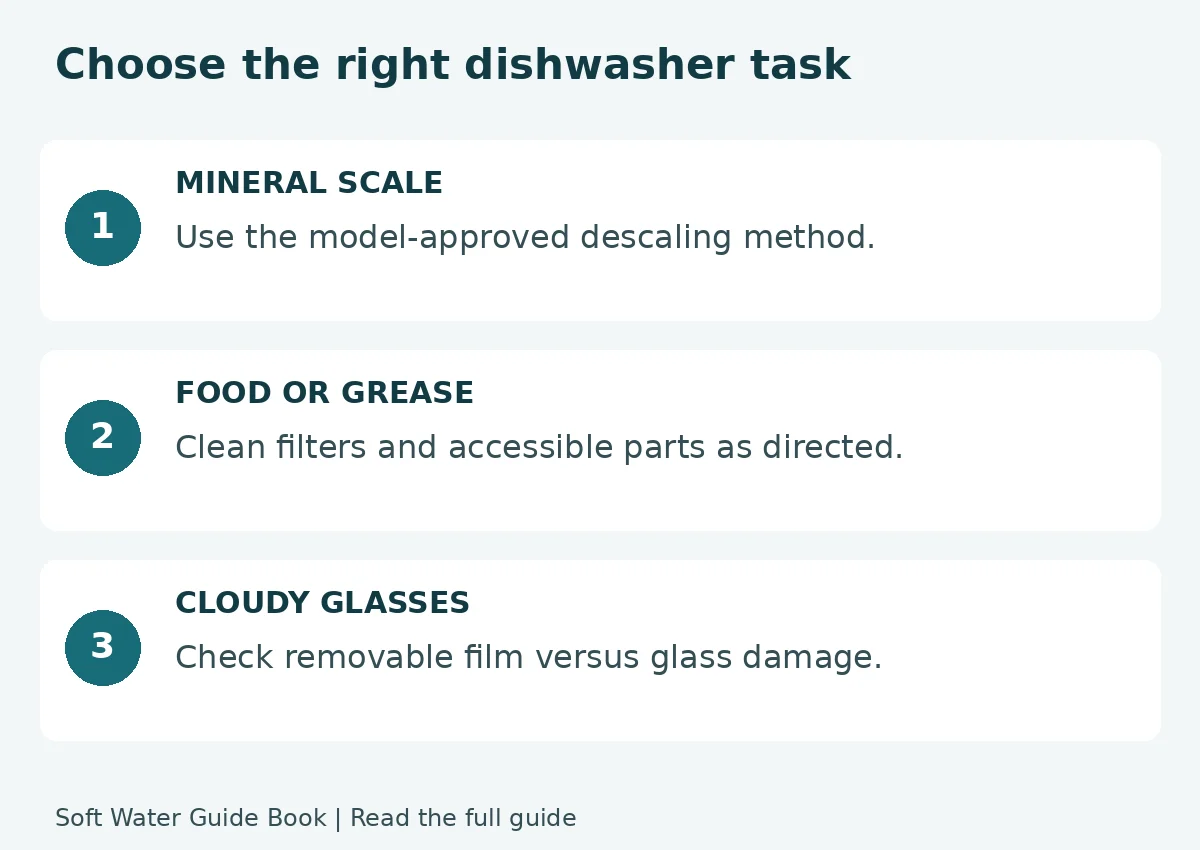
For everyday washing after the appliance is clean, use our dishwasher detergent selection and dosing guide to compare formats and change one factor at a time.
How to identify hard water buildup in your dishwasher
Look at the dry interior, accessible spray arms, and the items coming out of a completed wash. Photograph a representative area before cleaning. A white coating suggests a reason to investigate minerals, but its color alone cannot tell you which product to use.
| Observation | Useful next step | Avoid assuming |
|---|---|---|
| Chalky coating on the interior | Check the manual’s descaling instructions | All dishwasher cleaners remove mineral scale |
| Food caught in the filter | Follow the filter-cleaning procedure | The problem is necessarily hard water |
| Greasy residue | Review routine cleaning and wash performance | An acid descaler solves every residue |
| Glasses remain hazy | Assess the glass surface separately | A stronger machine-cleaning cycle repairs glass |
Bosch distinguishes a cleaner for food-related residues from a descaler for mineral buildup. It also treats filter and spray-arm maintenance as separate tasks. That distinction is more useful than choosing a product just because its packaging says “cleaner.” [1]
How to clean hard water from a dishwasher
1. Identify the model and compatible product
Find the model number and open its care instructions. Match the product to the task and the materials. Check whether the directions require an empty machine, a particular cycle, a specific dispenser location, or an additional rinse. Do not copy the dose from another appliance.
2. Remove accessible debris as directed
Let the appliance cool and follow the manual’s precautions. Remove and rinse only components the owner instructions identify as removable. Note their positions before taking them out. Avoid reaching blindly into the sump, where a broken item could leave sharp fragments.
3. Run the specified descaling procedure
For the procedure covered by Bosch’s support page: start the longest, hottest cycle with the dishwasher empty and no detergent; after 30 minutes, add one box of Bosch descaler to the bottom; let the cycle finish, then run another wash. Check the current product label and your model before using this sequence. [1]
Do not confuse this with Bosch’s cleaner for grease, starch and protein residue, which follows a different application sequence. Product purpose and timing matter as much as the word “cleaner” on the box.
Do not combine descaler, bleach, drain cleaner, and other household products in an attempt to make the cycle stronger. If a product was already applied, follow its rinsing and disposal directions before considering another one.
4. Compare the same area after cleaning
Inspect the area you photographed once the cycle has ended and the interior is cool. Record whether the coating reduced, stayed the same, or changed appearance. If the approved treatment fails, contact the appliance or product manufacturer before repeating stronger or longer treatments.
Reduce calcium buildup without guessing at detergent doses
The American Cleaning Institute recommends matching detergent use to water hardness and the appliance instructions. Too much and too little can both affect results; a rinse aid helps water run off dishes. A rinse aid is part of wash performance, not a replacement for removing existing scale from the machine. [2]
Use a hardness test at the relevant water supply rather than judging hardness from a glass alone. If the dishwasher receives softened water, keep that measurement with your water softener maintenance record.
Some dishwashers have an integrated salt-based softening system and others do not. Bosch explicitly tells owners to check their manual for this feature. Only fill a designated reservoir with the specified dishwasher salt; do not add salt loose to the tub. [1]
For a separate household softener, the incoming-hardness setting should be based on the water test and its own manual. A change in spotting does not justify turning that number up at random.
When cleaning is not enough
Arrange service if deposits accompany a recurring error, poor draining, a leak, or an unresolved spray problem. Share the model, photos, treatment product, and cycle used. This keeps a mechanical fault from being treated as a cleaning problem indefinitely.
Hazy drinking glasses need their own assessment: use the film-versus-etching guide. If residue also appears on laundry, compare laundry deposits and dosing before attributing both problems to the machine.
Editorial review November 7, 2026: consolidated repeated manufacturer guidance at the relevant cleaning step; retained material-specific limits.
Sources and care instructions
Sources reviewed September 30, 2026. Use the instructions for your exact product, material, and equipment.
- Bosch: Dishwasher cleaning and maintenance
- American Cleaning Institute: Hard-water residue
- GE Appliances: White film on glassware and dishwasher interiors
Manufacturer examples and task links checked October 16, 2026. The comparison is editorial guidance, not a report of hands-on cleaning tests.