
How much salt a water softener uses depends on the amount of water it treats, the incoming water quality, and how it regenerates. There is no single monthly bag count that fits every household. Whirlpool explains that recharge salt use varies with water use and incoming water quality. [1]
The most useful starting point is your own refill record. This guide helps you measure consumption and investigate a change. If you need to know how high to fill the tank, see how much salt to put in a water softener instead.
Calculate monthly salt use from your refills
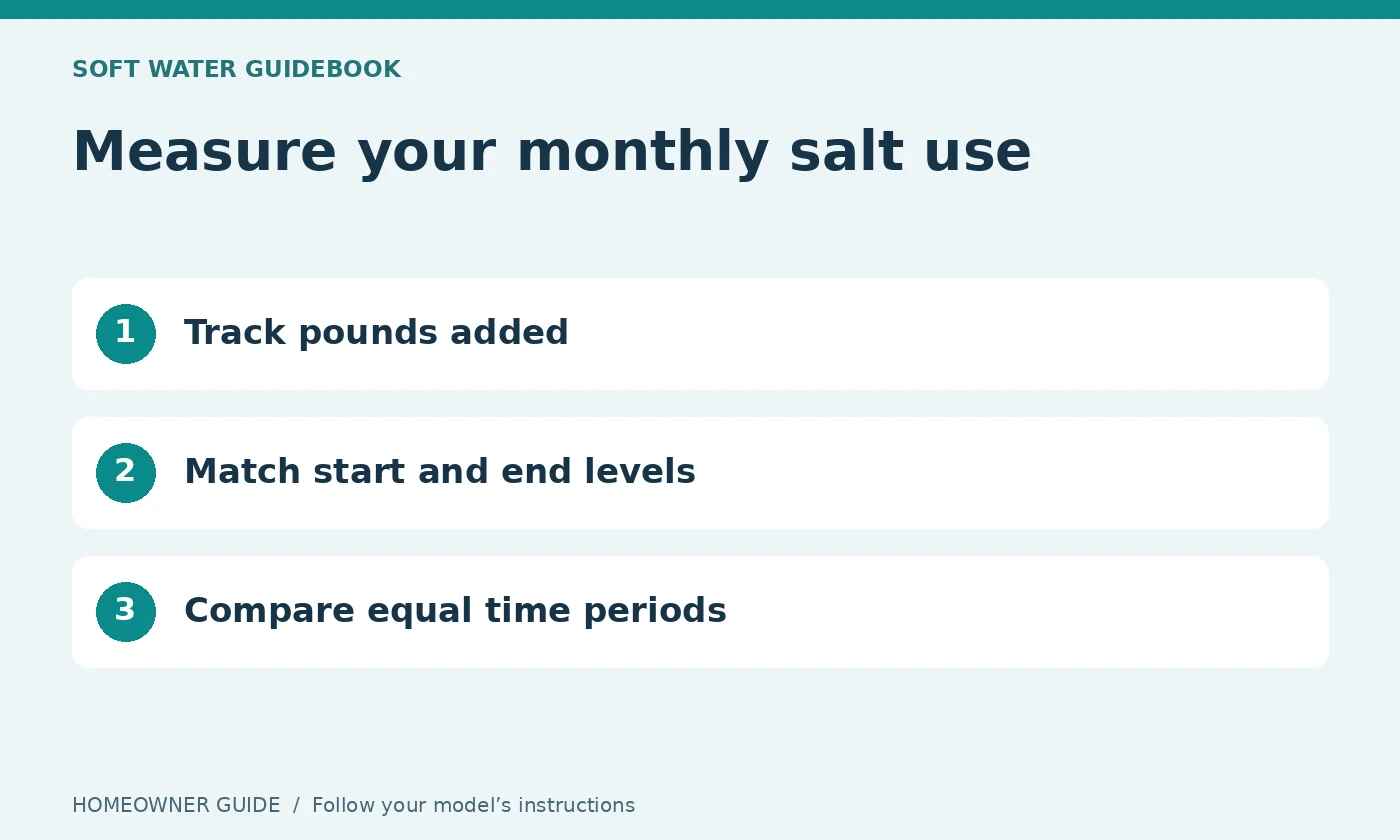
For an approximate tracking method, choose a reference level within your manufacturer’s recommended fill range. Start just after a refill, write down the date, and record the weight of every addition. End after a later refill to approximately the same level.
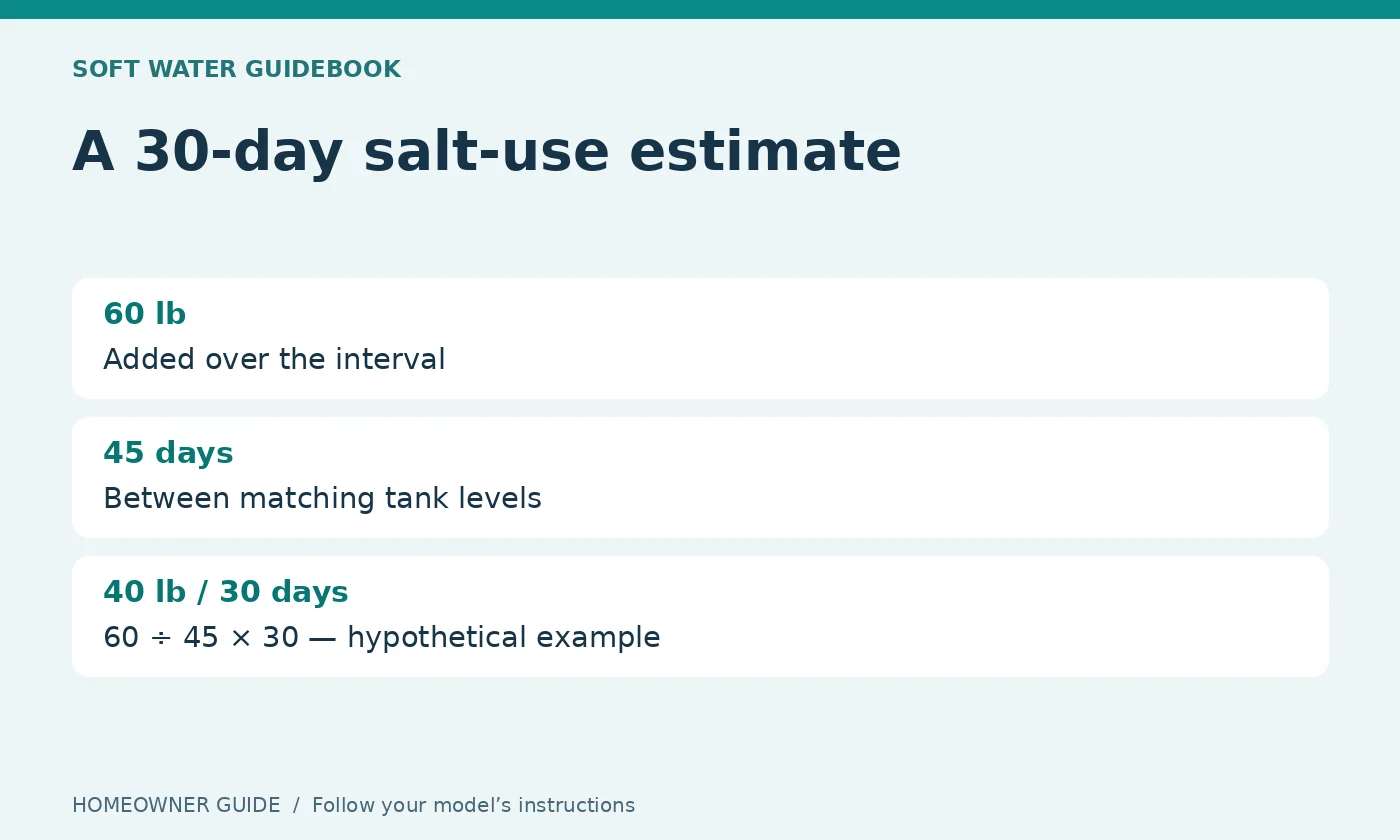
Approximate 30-day salt use = pounds added during the interval ÷ days elapsed × 30.
Do not count the refill that established the starting level. Do count the final refill that returns the tank to that level. The idea is to begin and end with roughly the same stored amount, so the additions replace what was used.
Hypothetical example: you begin at your reference level, add 40 lb later, then add 20 lb on day 45 to return to the same level. Your estimate is 60 ÷ 45 × 30 = 40 lb per 30 days. That is an illustration, not a recommended consumption target.
| Record | Example entry | Purpose |
|---|---|---|
| Starting date and level | Day 0, reference level | Defines the beginning of the interval |
| Salt added | 40 lb, then 20 lb | Tracks weight rather than vague bag counts |
| Ending date and level | Day 45, same reference level | Makes the comparison more useful |
| Unusual household use | Guests stayed for a week | Helps explain a change in demand |
This remains an estimate: uneven salt surfaces and different amounts left in the tank affect accuracy. If you know the stored weights, the fuller calculation is starting salt + salt added − ending salt. Avoid guessing precise pounds from an unfamiliar tank’s height marks.
Salt per cycle and cycles per month are different
Monthly consumption can rise because each recharge uses more salt, because the unit recharges more often, or both. Whirlpool notes that its covered systems can use a maximum salt dose for a manually initiated recharge, so a forced cycle may not represent routine operation. [1]
Check the manual for your specific model’s operating data. Then compare your log with its actual regeneration history, if available. Our guide to regeneration frequency explains the scheduling side.
Why is the water softener using more salt?
Before changing anything, look for a reason the household or controller would call for more treatment. Rheem’s frequent-recharge checklist includes hardness programming, plumbing leaks, and a maximum-days setting that forces regeneration too often. [2]
- More household demand: record guests, occupancy changes, or a new routine alongside your refill log.
- A possible leak: investigate unexplained water use, such as a toilet that keeps refilling.
- A programming change: compare the displayed settings with your model’s setup instructions and water test.
- Extra manual cycles: include troubleshooting recharges in the record rather than treating that month as normal.
Check the hardness setting using a current test. Do not deliberately understate hardness to reduce the bag count; evaluate whether the water is being softened properly as well as how much salt is used.
What if the salt level barely moves?
A low refill count alone does not prove efficient operation. If the water has become hard, check for a salt bridge and follow the not-using-salt troubleshooting guide. An apparently unchanged salt surface can make your log misleading.
Can you estimate the monthly cost?
Yes. Multiply your estimated pounds per 30 days by your actual cost per pound. For example, if your receipt shows a 40 lb bag costs $10, the salt costs $0.25 per pound. At the hypothetical 40 lb rate above, that is $10 per 30 days. These are example numbers, not current market prices, and they exclude water, electricity, and maintenance.
To track the other major regeneration input, compare your refill record with our guide to regeneration water use. Salt weight and water volume need separate records.
Salt-use and cost calculator
Start and finish at approximately the same stored salt level. Include additions after the initial reference refill, including the final refill. Use actual weights and receipt prices.
Enter your own figures, then select Calculate.
JavaScript is off. 30-day pounds = pounds added ÷ days × 30. Material cost = 30-day pounds × bag price ÷ bag weight. Excludes other operating costs.
Calculations run in this page. These entries are not submitted to us or saved by this tool. Reloading clears them.
Sources and review notes
Reviewed September 28, 2026. This guide compares manufacturer guidance; it does not report hands-on testing. Your model’s manual controls service procedures.
- Whirlpool: How much salt and water is used in a recharge cycle?
- Rheem: Softener Recharging Too Often
Updated October 16, 2026: added a working calculation or simplified overlapping explanations. Examples and records are not field-test results.