
Salty water from a water softener can point to a regeneration or rinsing problem. If the taste appears after a recharge, the useful question is whether brine was properly cleared before the unit returned to service. Rheem also identifies incorrect settings, a restricted drain, and leaking seals as possible causes on its systems. [1]
Start by recording the pattern. Adding extra salt or changing several settings at once makes the problem harder to trace. If the water has an unexpected strong taste, use a known safe drinking-water supply while the cause is investigated; a troubleshooting checklist cannot establish that water is safe to drink.
Why regeneration matters
During regeneration, salt dissolves in the brine tank and the resulting brine passes through the resin. Rinse stages then flush the system before normal service resumes. The brine is part of that cleaning cycle, rather than the water the softener is intended to deliver at your faucet. GE describes separate brining, brine-rinse, backwash, and fast-rinse stages. [2]
If you are unsure whether the cycle has finished, check the display and your model’s instructions. Our guide to regeneration duration explains why timing varies.
Record the symptoms before changing anything
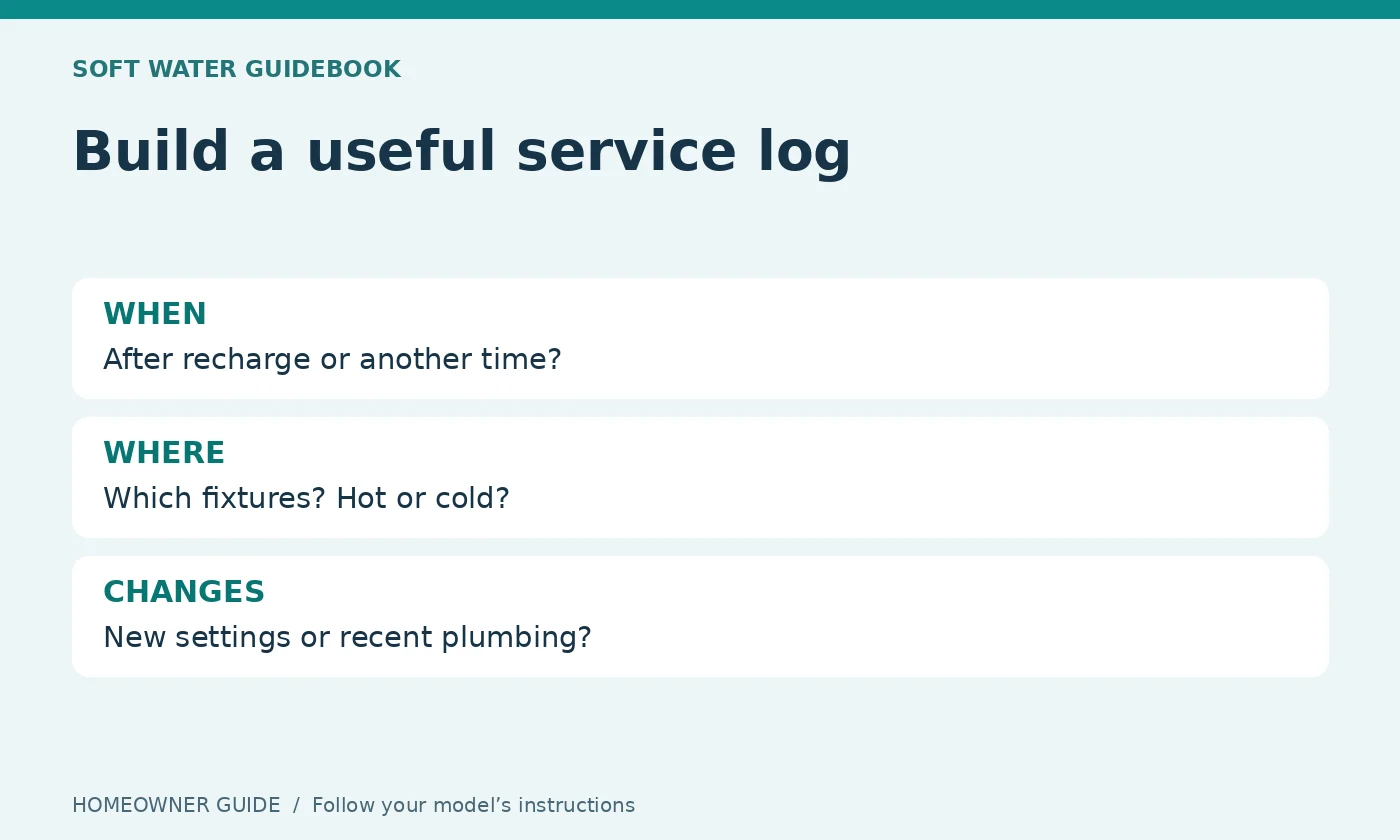
Use this table as a service log. These observations narrow the investigation; none confirms a failed part by itself. Do not repeatedly taste suspect water to collect information.
| Observation | What to record | Why it helps |
|---|---|---|
| First noticed after an overnight recharge | Cycle time and when the taste appeared | Gives the technician a reason to investigate the regeneration sequence |
| Reported at several treated faucets | Which fixtures and whether hot or cold water was affected | Separates a wider pattern from one fixture |
| Started after installation or programming | Model number and settings changed | Provides a concrete starting point for configuration checks |
| Also reported at a known untreated supply | How that supply is routed | Prevents assuming the softener is the only possible cause |
What you can check without opening the valve
1. Match the controller to the actual model
Photograph the model label and current settings. On controllers that use a model code, check it against the manual; Rheem specifically includes this in its salty-water troubleshooting. Avoid copying settings from a similar-looking unit. [1]
Keep the hardness setting tied to the incoming hardness and any manufacturer-required adjustment. Lowering it just to change the taste does not establish that the problem is fixed.
2. Inspect the visible drain route
Look for an obvious crushed, folded, or displaced drain hose. A partial obstruction is one of Rheem’s listed causes. Do not disconnect a pressurized line or dismantle the control valve; cleaning procedures and pressure relief are model-specific. [1]
If the brine tank is also unusually full, use the separate high brine-tank water checklist. Water level and salty tap water are related observations, but they are not interchangeable diagnoses.
3. Follow the manufacturer’s recovery procedure
Use only the rinse or recharge procedure prescribed for your unit. If the symptom returns, arrange service instead of repeatedly forcing cycles. Rheem’s guide progresses from settings and drainage checks to seal checks and model-specific rinse adjustments. Those are not universal settings to copy. [1]
What to send the service technician
- Model and serial number, plus a photo of the controller.
- Whether the issue followed every recharge or just one event.
- The affected fixtures and any recent plumbing or programming changes.
- Photos of the visible drain route and brine-tank level.
A water-hardness test answers a separate question: whether the sample is hard or soft. It does not identify the cause of a salty taste or replace water-quality testing when needed.
Does salty water mean there is too much salt in the tank?
Not necessarily. The amount stored in the brine tank and the system’s ability to draw and rinse brine are different issues. Follow the manufacturer’s fill guidance, but do not treat removing stored salt as a diagnosis for salty water at the faucet.
If discharge continues after the unit should have returned to service, use the separate guide to a water softener draining continuously. Record that symptom alongside the taste change.
Sources and review notes
Reviewed September 28, 2026. This guide compares manufacturer guidance; it does not report hands-on testing. Your model’s manual controls service procedures.