
How long does water softener regeneration take? Check your model: published examples range from 70–90 minutes in Culligan’s guidance to about 2–2½ hours in Whirlpool’s recharge guide. These are examples, not a universal operating range or a deadline after which every softener is faulty. Use the duration specified for your equipment and its current settings. [1] [2]
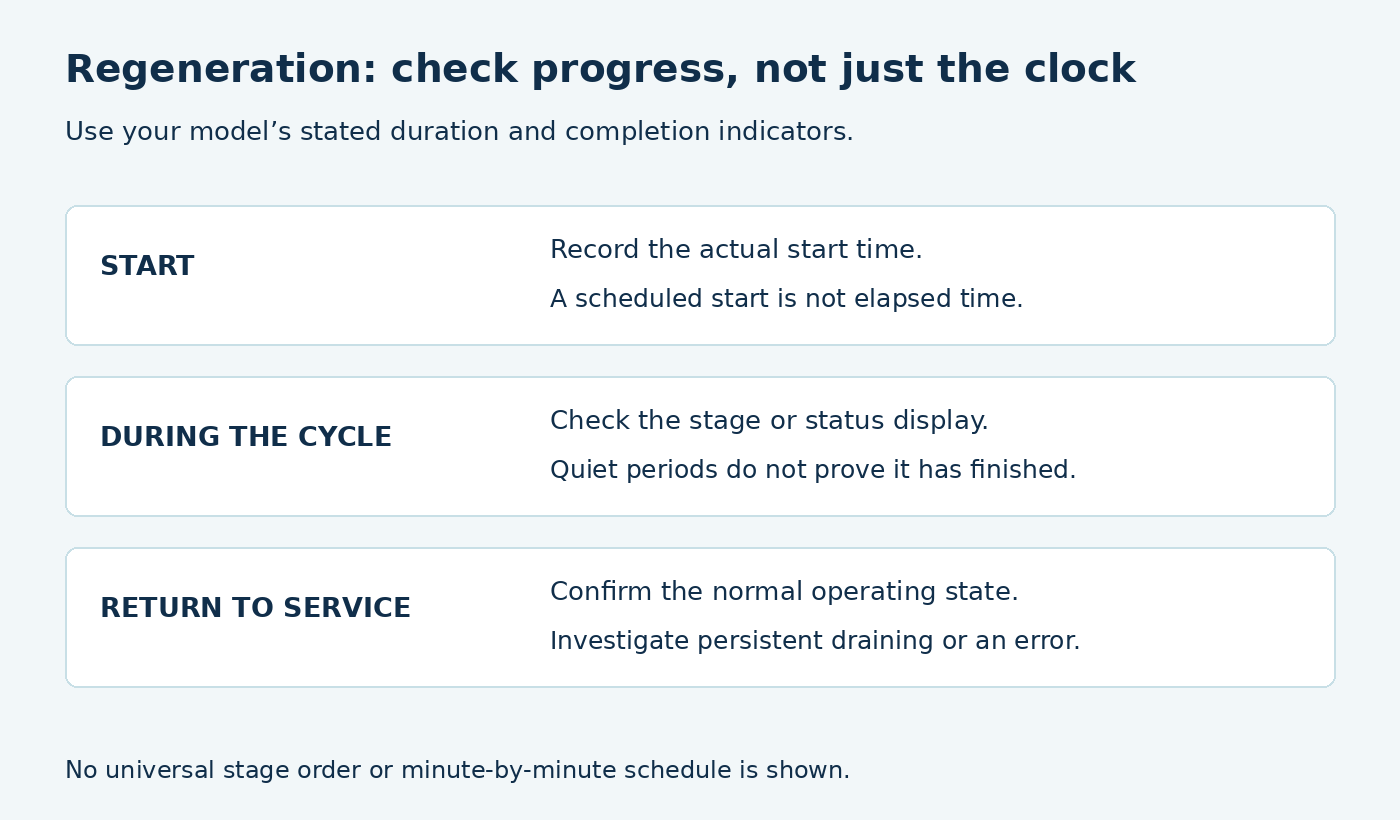
Start timing when the cycle actually begins. A scheduled recharge time is not the same as elapsed time, and the interval between regenerations is a separate question.
Diagram above: Check your model’s operating indicators as well as elapsed time. This is not a universal cycle schedule.
Documented duration and display examples
| Equipment / document | Duration or display | Conditions / limitation |
|---|---|---|
| GE GXSH40V / GXSH45V | About two hours for recharge. Manual 49-6000299 Rev. 1, p. 17 | An estimate for the cited recharge operation; do not apply it to all brands or faults. |
| Whirlpool WHES40 / WHES44 | Countdown shown except during fill. Manual, p. 14 | This section does not give a universal total duration. |
| Pentair 5600SXT VT softener systems | Display reports remaining time in the current stage. System manual, p. 9 | A stage countdown is not the remaining time for the entire regeneration. |
| Date / model | Actual start | Stage and time observed | Return to service | Errors / options enabled |
|---|---|---|---|---|
| ____ | ____ | ____ | ____ | ____ |
Calculate elapsed time from the actual start to return to service. Record optional cleaning or extended-brine operation separately. This log measures duration; the frequency guide measures the interval between cycles.
What affects regeneration time?
The equipment’s design, resin volume, and configured stages matter. Culligan identifies system size and resin volume among the reasons duration varies. Its cited time should not be applied to a different softener without checking the owner’s manual. [1]
Optional cleaning stages also change what you observe. Whirlpool describes an optional backwash-and-rinse sequence before the main recharge on some models. A unit with that option enabled should be assessed against its configured process, not a shorter sequence from another installation. [2]
Check whether someone has intentionally started a special maintenance procedure. Whirlpool’s extended-brine instructions deliberately prolong brine withdrawal in a specific troubleshooting context. That is different from an ordinary automatic cycle and should not become a routine adjustment just to make a tank drain. [3]
What happens during regeneration?
Regeneration uses brine to restore the resin’s ability to soften water. The table explains common stage names; the order and timing depend on the model. [1] [2]
| Stage | Purpose |
|---|---|
| Fill | Adds water to the salt tank for brine preparation |
| Brine draw and slow rinse | Moves brine through the resin and continues the rinsing process |
| Backwash | Passes water upward through the resin bed and sends material to the drain |
| Rinse | Rinses and prepares the resin bed for normal service |
| Service | Normal water-softening operation, rather than a regeneration stage |
How to tell when regeneration is finished
Use the controller’s completion or normal-service indication described in the manual. Noise alone is unreliable. Whirlpool explains that its motor runs briefly when a manual recharge starts, while the recharge indicator remains active during the process. A motor becoming quiet does not mean that the whole cycle has ended. [4]
Record the start time, any stage or countdown displayed, and the time normal operation returns. If the equipment has no digital display, use the operating indicators specified by its manufacturer rather than assuming a screen-based check applies.
Keep “cycle completed” separate from “water treatment confirmed.” The first is an operational observation; the second requires testing the treated water’s hardness. If hard-water symptoms remain, follow the model’s performance checks instead of simply starting another cycle. Culligan notes that regeneration problems can involve controls or other operational issues. [1]
If the cycle has finished but the tap water tastes salty, use the salty water after regeneration checklist to record the symptoms and identify the model-specific checks.
Can you use water during regeneration?
Whether softened water remains available depends on the system. Kinetico explains that its alternating twin-resin-tank systems keep one tank in service while the other regenerates. That design can continue supplying soft water during a cycle. [5]
A single-resin-tank system may not provide softened water while regenerating. Check whether your installation passes untreated water, interrupts supply, or has another arrangement. For tasks where softened water matters, plan around the cycle if your model cannot provide it throughout. For shower timing and hot-water considerations, see showering during water softener regeneration. Do not assume every faucet has lost water—or that every faucet is still receiving treated water.
Count resin tanks, not simply containers: a resin vessel beside a salt tank is not an alternating twin-resin-tank softener. Kinetico’s distinction concerns two treatment tanks, not a treatment tank plus brine storage. [5]
Why is regeneration taking longer than expected?
First check the basis of the comparison. Did you observe the actual start? Is the controller showing an active cycle or a future reminder? Has an optional or extended cycle been selected? Write down the displayed wording before changing anything.
Persistent draining after the expected return to service warrants a different investigation. Rheem’s constant-draining guidance identifies a valve remaining in a rinse position and excessive supply pressure as possible causes. It begins with checking for an error code and then follows a model-specific diagnostic sequence. Those possibilities are not a diagnosis you can make from elapsed time alone. [6]
What to do if the cycle will not finish
- Record the evidence. Note the model, actual start time, current display, any error, and whether water is still draining.
- Compare with the correct instructions. Include any optional stage or maintenance procedure already in use.
- Follow the relevant troubleshooting entry. A control error, continuous drain flow, and an overflowing brine tank are different symptoms.
- Request help if the condition remains unexplained. Give support your observations before agreeing to replace parts.
Do not unplug the system as a universal way to stop water flow. Whirlpool’s extended-brine procedure illustrates why: on the covered equipment, removing power at that stage leaves the valve in its draining position. Follow your model’s bypass or shutdown procedure when needed. [3]
For an active leak or overflow, stop routine timing checks and safely isolate the water supply as instructed. Keep clear of wet electrical equipment and obtain service help if you cannot identify the correct controls.
Frequently asked questions
Is it normal to hear water draining?
Water goes to the drain during parts of regeneration. Persistent discharge outside the expected process is different. Compare the stage and operating state with the manual; Rheem provides a separate procedure for constant draining. [6]
Can I skip the remaining stages?
Do not advance or cancel stages just to shorten the wait. Button presses can move a valve between positions on some controllers, so only follow that approach when the exact maintenance procedure directs it.
Why does the remaining time seem different from the clock?
Identify what the screen is displaying. It may show the clock, a scheduled start, a stage, or a countdown. If the manual identifies a countdown and it stops progressing unexpectedly, record the value and contact support rather than assuming it is normal.
What should I do after a power interruption?
Check the model’s power-loss instructions and displayed time before restarting anything. Whirlpool’s manual-start guide requires a steady clock display showing the correct time. Resume or recovery behavior must be checked for your specific controller. [4]
Keep these checks in your regular water softener maintenance routine.
Sources and model-specific guidance
Manufacturer documentation checked September 24, 2026. Published durations are references for the equipment described, not universal settings.
- Culligan: Regeneration process and duration
- Whirlpool: Recharge duration and stages
- Whirlpool: Extended brine cycle
- Whirlpool: Starting a manual recharge
- Kinetico: Single and dual resin tanks
- Rheem: Constant draining
Updated October 6, 2026: Added model-specific duration/display examples and a cycle log.