
Troubleshooting · Salt & cleaning
Your salt tank looks full, but hard water is back. A hidden crust could be keeping the salt from reaching the water below. Here’s how to check—and what to do next.
The quick answer: A salt bridge is a hardened layer of salt suspended above the water in a softener’s brine tank. It can stop the system from making enough brine to regenerate properly. Check your model’s manual before gently loosening the crust with an approved blunt tool. Then follow its recovery instructions and test the treated water.
What is a water softener salt bridge?
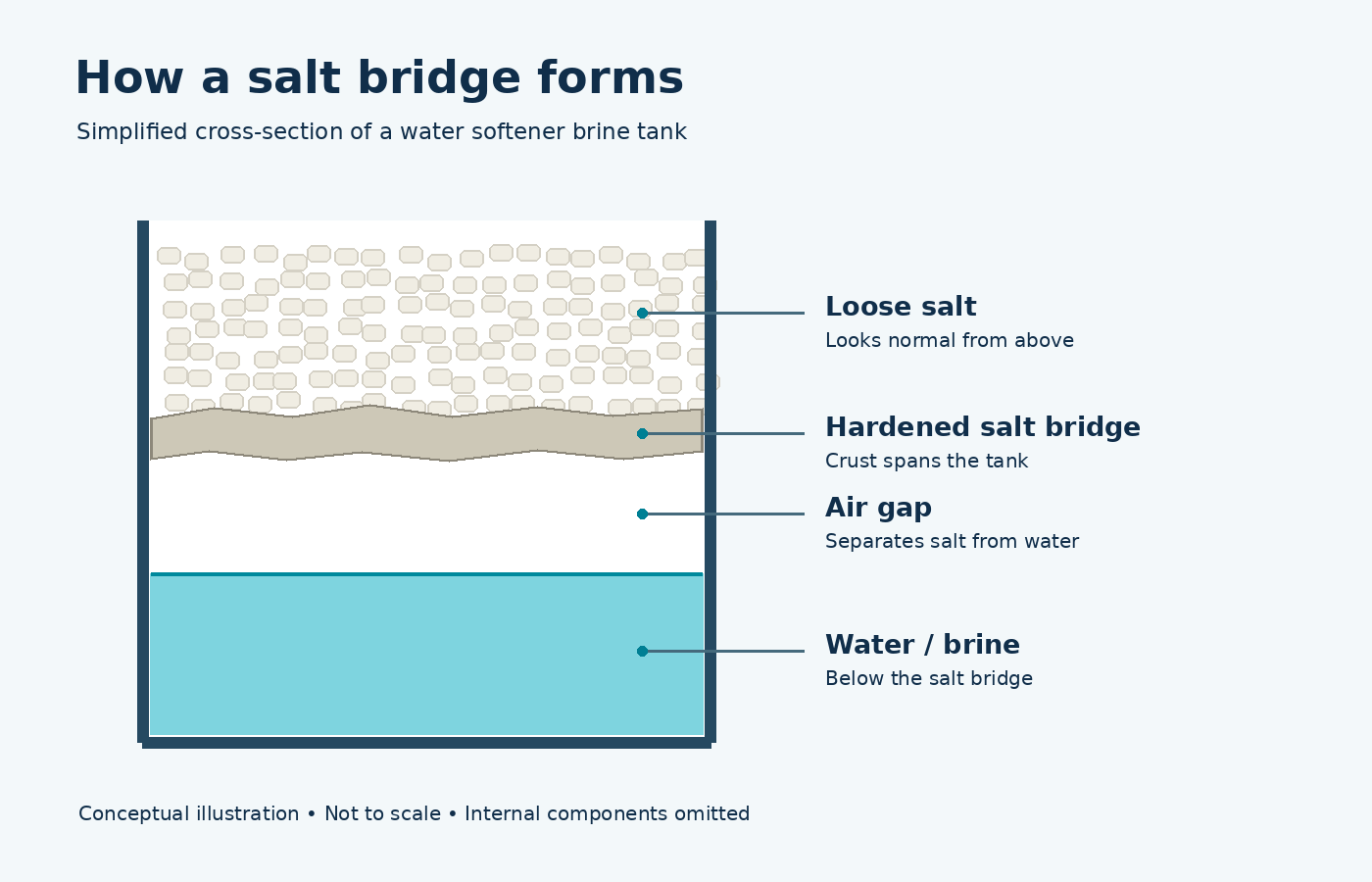
A salt-based softener uses brine—water with dissolved salt—to recharge its resin during regeneration. A bridge creates a gap between the stored salt and the water beneath it. The tank may contain plenty of salt while producing too little brine.
The crust can sit underneath loose salt, making a quick glance misleading. Simply pouring in another bag does not establish that salt and water are in contact. Rheem’s maintenance manual describes this separation and explains why a bridge can leave the resin without an effective recharge. [1]
Diagram above: A salt bridge creates a gap between the salt and the water below. Simplified illustration; internal components omitted.
Signs of a salt bridge
- The salt level appears unchanged over time. Compare it with earlier observations rather than expecting a visible drop every day.
- Hard water symptoms return. You might notice more spotting, soap residue, or poorer lather despite having salt in the tank.
- The salt feels like a solid layer. A careful inspection may reveal a crust with a hollow area beneath it.
These clues make a bridge worth checking; they do not confirm it on their own. Culligan lists several other explanations for poor performance, including regeneration and flow problems. Record what you see before changing settings or adding salt. [2]
Salt bridge vs. salt mushing
The location and texture of the salt buildup help distinguish these two problems. A crust above the water and sludge at the bottom call for different responses. [2]
| What to compare | Salt bridge | Salt mushing |
|---|---|---|
| Appearance | Hardened crust with space underneath | Thick salt sludge at the bottom |
| Effect | Salt cannot dissolve normally in the water below | Buildup can interfere with brine formation or withdrawal |
| Next step | Follow the manual’s bridge-removal procedure | Check the tank-cleaning procedure; service may be needed |
How to check for and break a salt bridge
1. Find the instructions for your model
Locate the model number and open the owner’s manual to salt bridging or routine maintenance. Read the complete procedure before starting. Identify the brinewell—the tube inside many salt tanks—and other internal components so you can keep tools clear of them.
Recovery procedures vary. For example, Rheem’s support guide includes a measured addition of hot tap water, a waiting period, and a recharge. Those details belong to its procedure; they are not a universal recipe for every softener. Do not add water or remove covers based on another model’s instructions. [3]
2. Check for a crust without forcing the tool
Where the manual allows it, use a blunt wooden handle to probe gently at several locations. Rheem’s manual describes marking a handle against the tank’s outside height as a depth reference. Resistance above the tank bottom may indicate hardened salt.
Stop if you cannot tell what the tool is touching. Never use a sharp implement or strike the tank’s sides. The purpose is to locate the crust, not drive a tool through the tank. [1]
3. Loosen the bridge using the approved procedure
If your manual permits mechanical removal, work gently with the recommended blunt, nonmetal tool and keep away from internal parts. Remove loose large pieces only as directed. A crust that cannot be reached or loosened safely is a reason to arrange service, not apply more force. [2]
Before restarting: Complete the remaining steps in your model’s procedure, including any specified soaking or recharge sequence. Breaking the visible crust is only one part of restoring brine production. [3]
What to check afterward
Follow the manufacturer’s instructions for regeneration, and let the cycle finish before assessing the result. Rheem recommends hardness testing as part of checking softener operation. Use a hardness test designed for water and follow its sampling and reading instructions. Water feel alone is not a reliable confirmation. [4]
Choose a cold-water faucet supplied by the softener; an outdoor or bypassed outlet may not receive treated water. Compare results from the same sampling location. Stored hot water can still reflect conditions before the repair, so a hot-water result may lag behind. [1]
Keep a short record: date, salt level, whether a crust was found, regeneration completed, and hardness result. That creates a useful starting point if the symptoms return and avoids relying on memory.
How to prevent another salt bridge
- Adjust refills to the conditions. GE advises smaller, more frequent additions in humid locations. Follow your own model’s minimum and maximum fill guidance. [5]
- Check for unwanted moisture. GE also recommends looking for leaks and protecting outdoor installations from rain. Recurring bridges deserve investigation rather than repeated topping up. [5]
- Use the approved salt consistently. Rheem advises against mixing salt shapes and suggests checking periodically for hardening. Its numbered tank scale is specific to its equipment, so do not transfer those marks to another brand. [6]
- Consider purity before price. Culligan notes that rock salt can leave more insoluble residue. Use the product your manual recommends, and check compatibility before changing salt type or switching to potassium chloride. [7]
When the problem needs further troubleshooting
If there is no crust, or the softener still uses little salt after recovery, follow the model’s troubleshooting sequence. Whirlpool’s low-salt-use guidance checks recharge behavior and then directs owners toward the fill cycle when a bridge has been ruled out. This is a useful reminder that salt consumption depends on more than the amount in the tank. [8]
Do not keep repeating bridge removal when your observations point elsewhere. Note any error code, whether a recharge completed, and whether the water level differs from normal. Give those details, along with the model number and hardness result, to the manufacturer or service provider.
Frequently asked questions
Can a full salt tank still have a salt bridge?
Yes. Loose salt can hide the crust underneath. A full-looking tank does not prove that enough salt is dissolving to make brine. [7]
Do I need to empty the entire tank?
That depends on what you find and the approved repair procedure. Do not assume a simple crust requires a complete cleanout. If you find sludge instead, review how to clean a water softener brine tank alongside the model’s instructions before proceeding.
How soon should I test the water?
Follow your manufacturer’s recovery instructions and test after the required regeneration has finished. Use a treated-water outlet and the test kit’s directions. There is no single waiting time that applies to every installation. [4]
Will adding more salt fix the bridge?
Adding salt does not remove the existing separation between the crust and the water. Confirm and resolve the obstruction first, then refill according to the manual. [3]
Keep these checks in your regular water softener maintenance routine.
Sources and model-specific instructions
Manufacturer documentation checked September 24, 2026. This guide covers salt-based water softeners. Your model’s manual takes priority for maintenance procedures.
- Rheem — Water softener owner’s manual (PDF)
- Culligan — Common problems and troubleshooting
- Rheem — Salt Block/Bridge
- Rheem — How do I know if my softener is working?
- GE Appliances — Salt bridging guidance
- Rheem — Adding Salt to the Tank
- Culligan — Choosing water softener salt
- Whirlpool — Little/No Salt Use