
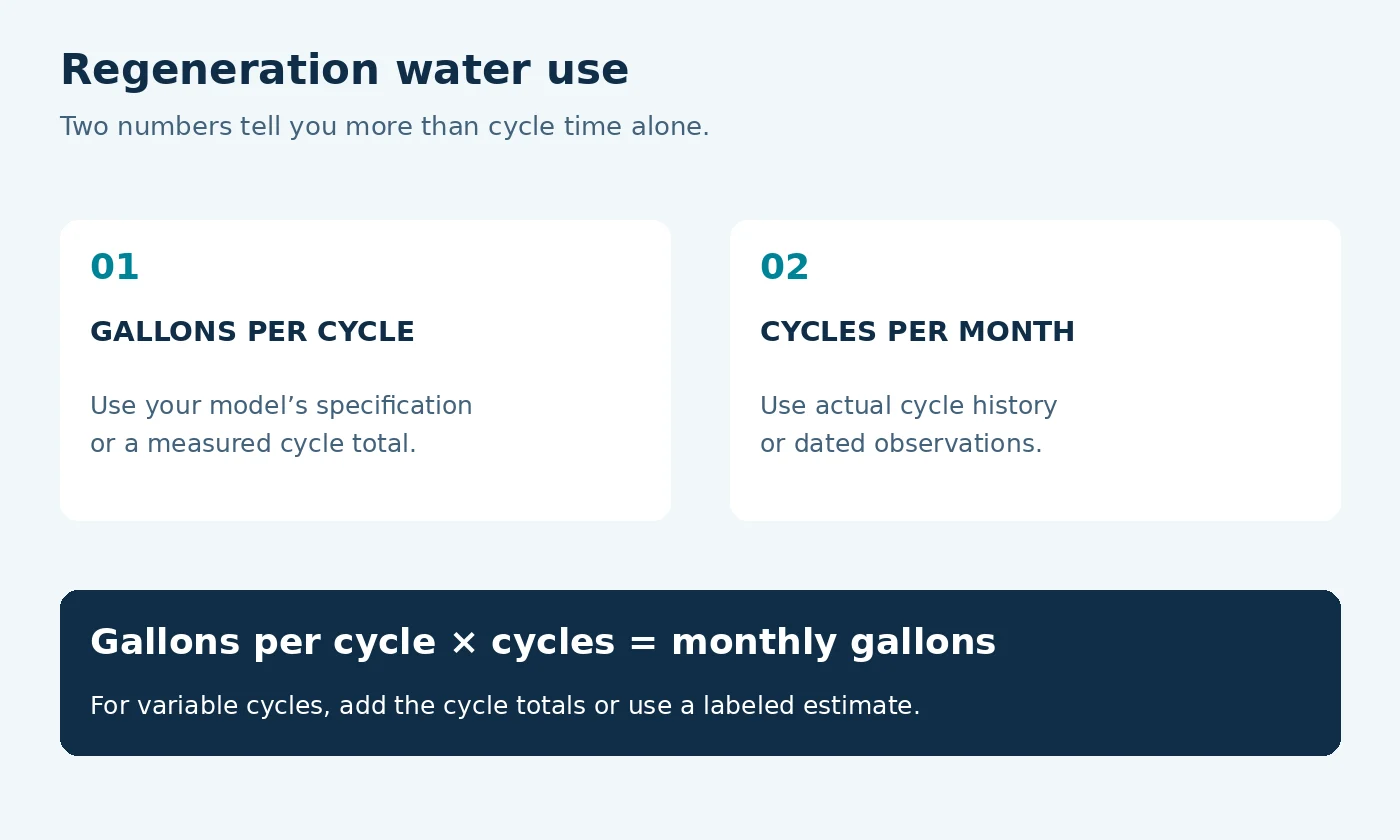
How much water does a water softener use during regeneration? The amount depends on the model, its settings, and the regeneration it runs. Use the water-consumption specification for your exact equipment, then multiply gallons per cycle by the number of cycles to estimate monthly use. A number copied from another softener can give you a misleading answer.
For a documented example, Whirlpool’s recharge support article shows a maximum of 35.2 gallons at a 13.1-pound salt dose for the system illustrated. That is an example at a stated dose, not an average for all household softeners. Whirlpool also explains that automatic-cycle consumption can change with incoming water quality and household use. [1]
This guide covers salt-based residential water softeners. It will help you distinguish water per regeneration from monthly consumption, read the right specification, and investigate a rise in use without sacrificing softening performance.
How much water does a water softener use to regenerate?
The most useful answer is a model-specific amount tied to an operating condition. Look in the owner’s manual or performance data sheet for regeneration water consumption, water used per recharge, or a water-efficiency rating. Check the units and any footnotes before comparing numbers.
| Figure | What it describes | How to use it |
|---|---|---|
| Gallons per regeneration | Water used for a stated recharge cycle or setting | Multiply by observed cycles to estimate use over a period |
| Maximum regeneration water | A maximum under the stated operating conditions | Do not label it typical consumption |
| Gallons per 1,000 grains removed | Water consumption relative to treatment output | Compare only with ratings using the same basis |
| Service flow in gallons per minute | Flow while supplying treated water | Do not multiply it by the full regeneration time |
| Rated capacity in grains | Hardness-removal capacity at a specified salt dose | Do not interpret grains as gallons |
If the sheet gives several values for different salt doses or settings, find the one matching your installation. If that is unclear, ask the manufacturer which figure applies. Keep the model number and a photograph of the settings handy.
Where the water goes during regeneration
Regeneration restores the resin’s ability to remove hardness. Depending on the equipment, water is used to backwash the media, move brine through the resin, rinse it, and refill the brine tank. The sequence and flow rates are model-specific.
Pentair’s 5600SXT system manual, for example, describes backwash, brine draw with slow rinse, rapid rinse, and refill functions. Its stages do not all perform the same job or have the same flow. [2] This is why the total time alone does not tell you the total gallons.
For timing questions, see how long water softener regeneration takes. Water visible in the salt tank is also not a measure of the complete cycle’s consumption. If that level looks unusually high, use our separate guide to a water softener full of water.
Calculate monthly regeneration water use
Estimated monthly gallons = gallons per regeneration × regenerations that month. Use actual cycle history where available. If cycle size changes, add measured cycle totals or use a representative average and label the result an estimate.
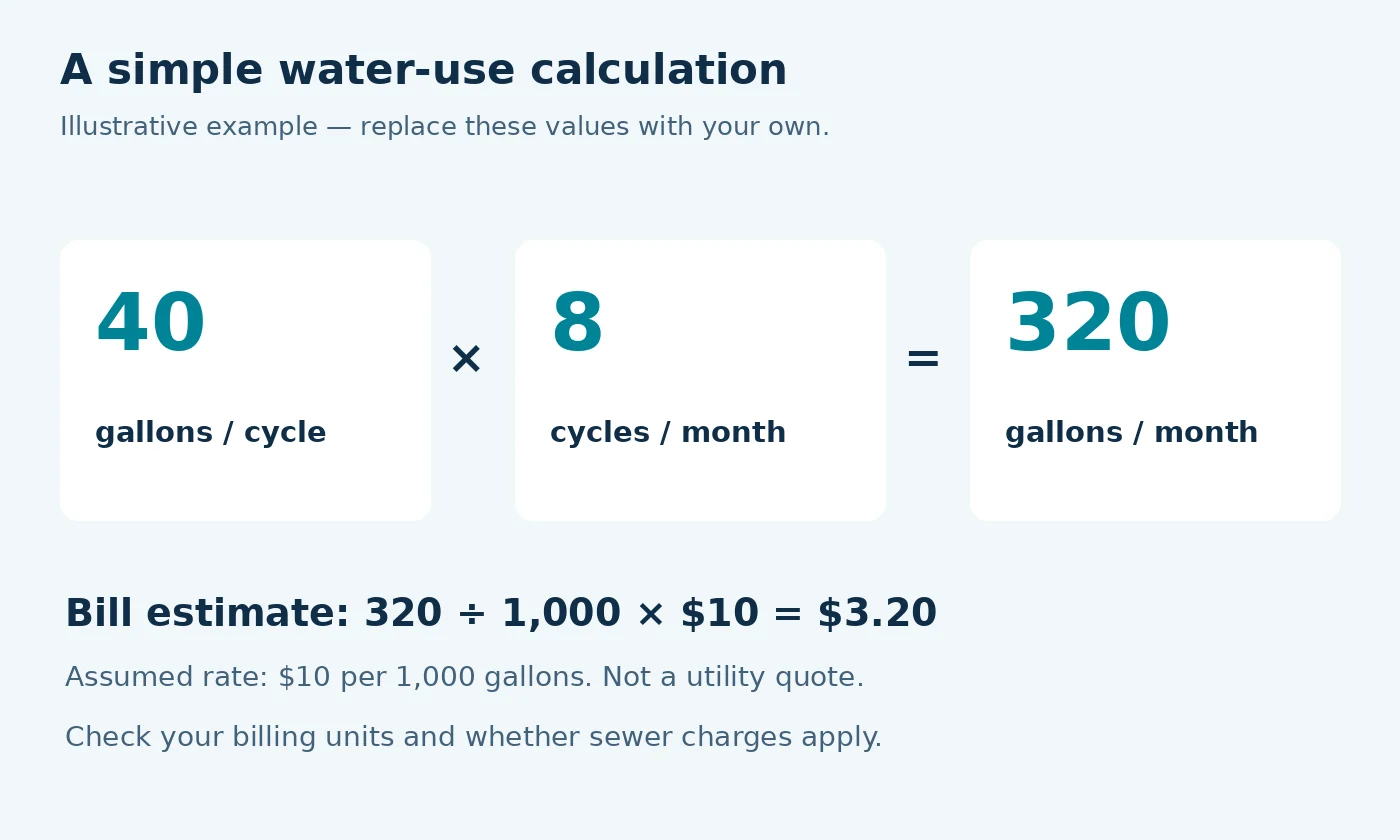
Here is an illustrative calculation, not a prediction for your home. Suppose a softener uses 40 gallons per cycle:
| Cycles in the month | Calculation | Monthly gallons |
|---|---|---|
| 4 | 40 × 4 | 160 |
| 8 | 40 × 8 | 320 |
| 12 | 40 × 12 | 480 |
These scenarios show why frequency matters as much as cycle size. A smaller cycle repeated more often does not automatically mean lower monthly use. Our guide to regeneration frequency explains the factors behind the interval.
Estimate the water-bill contribution
Divide the monthly gallons by your utility’s billing unit, then multiply by the applicable usage rate. For example, 320 gallons ÷ 1,000 × an assumed $10 per 1,000 gallons = $3.20. Both the consumption and rate in this example are hypothetical.
Include sewer charges only as your utility calculates them. Fixed account charges generally do not change because of an extra regeneration. If your bill uses cubic feet, remember that 100 cubic feet is approximately 748 US gallons; do not apply a per-1,000-gallon rate directly to a cubic-foot reading.
How to check your own cycle consumption
A household meter can help estimate the additional water used during a complete cycle, provided other consumption is excluded. A softener’s own display may record treated household water rather than its regeneration supply, so check the display’s definition first.
- Choose a normal cycle. Observe a scheduled regeneration if practical instead of triggering extra cycles just to collect data.
- Record the starting meter reading and units. Use the utility’s instructions for reading the meter.
- Avoid other water use. Account for toilets, ice makers, irrigation, laundry, and other automatic equipment. Background use makes the estimate less reliable.
- Wait for the full documented cycle. Include refill if it belongs to that cycle; do not stop after the loudest drain stage.
- Record the ending reading. Subtract the starting value and note any other water use, errors, or interruptions.
If you cannot isolate the softener’s consumption, label the difference as whole-home use during the observation window. Do not detach drain tubing, obstruct a drain, or alter an air gap to collect water for this check.
Why regeneration water use may increase
Start by separating more cycles from more water in each cycle. A monthly bill alone cannot tell you which has changed.
Rheem’s troubleshooting guidance identifies incorrect hardness programming, unnoticed household flow, and an unnecessarily short maximum-days setting as checks for excessive recharge frequency. [3] Review those settings against your manual, especially after a service visit or controller change. Use a current untreated-water result when reviewing the hardness setting.
For the Whirlpool systems covered by its recharge article, manual recharges use the maximum salt and water dose. [1] Repeated manual cycles can therefore distort a comparison with normal automatic operation. Other controllers may behave differently.
A water softener draining continuously after a completed cycle presents a different symptom. Record the operating state and consult the model’s drain or valve troubleshooting instructions. Do not assume a running drain is normal just because the equipment sometimes regenerates at night.
Reduce unnecessary use without under-treating the water
- Correct settings using measured incoming hardness and your manufacturer’s instructions.
- Investigate leaks or unexplained household flow before blaming the softener.
- Keep a short log of completed cycles, settings, and meter observations.
- Avoid repeated manual recharges unless a documented recovery procedure requires them.
- Follow the maintenance checks for your equipment.
Do not lower hardness artificially or shorten backwash and rinse stages simply to reduce a bill. The goal is efficient treatment that still delivers the intended water quality. Confirm performance with a hardness test after any approved programming correction.
When reviewing a persistent mismatch between demand and cycle frequency, review the softener’s capacity and sizing assumptions with the installer.
Regeneration water and variable-cost calculator
Use the consumption for your exact operating cycle and the observed cycle count for the period. The cost uses a variable charge per 1,000 US gallons; leave out fixed fees.
Enter your own figures, then select Calculate.
JavaScript is off. Period gallons = gallons per regeneration × cycles. Variable cost = period gallons ÷ 1,000 × rate. Meter readings must exclude other uses.
Calculations run in this page. These entries are not submitted to us or saved by this tool. Reloading clears them.
Sources and model-specific documentation
Reviewed September 28, 2026. Manufacturer examples apply to the equipment covered by each source. Calculations explicitly labeled illustrative are not measured results.
- Whirlpool: Salt and water used in a recharge cycle
- Pentair: 5600SXT Softener System Operation Manual
- Rheem: Softener Recharging Too Often
Updated October 16, 2026: added a working calculation or simplified overlapping explanations. Examples and records are not field-test results.