
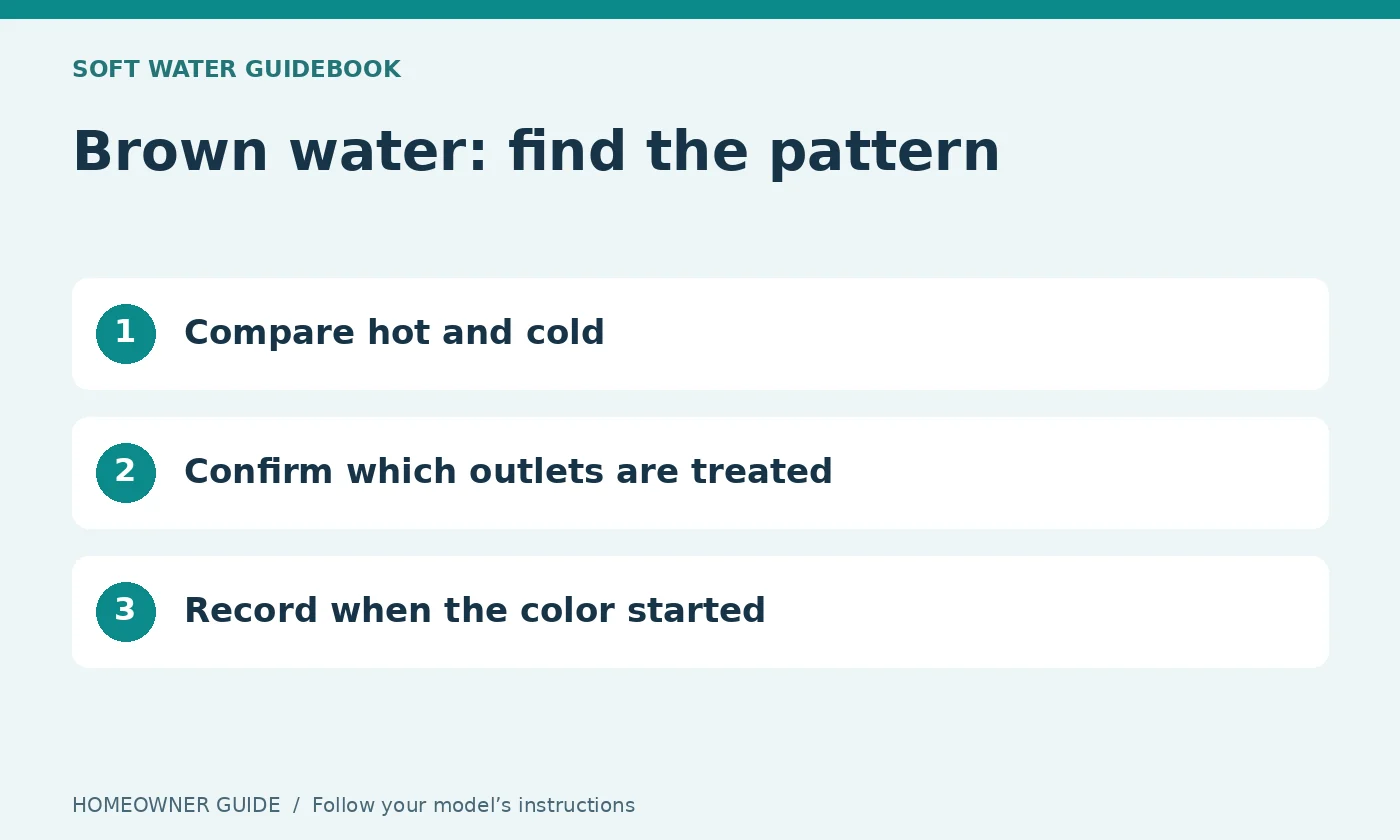
Brown water in a home with a water softener does not automatically mean the softener caused it. The color may originate in the incoming supply, household plumbing, or treatment equipment. Start by recording where it appears: inside the brine tank, at one faucet, or throughout the house.
Until the cause is understood, use a known safe supply for drinking and cooking and follow any local utility advisory. Portland’s Water Bureau recommends considering stored or bottled water during discoloration events and limiting hot-water use and light-colored laundry. [1] Your own provider’s instructions take precedence.
Water softener brown water: locate the pattern first
Look at small samples in clear containers against a white background. Record the faucet and whether it is hot or cold. Do not taste the samples. Confirm the plumbing route before calling an outside faucet “untreated”; installations differ.
| Where the color appears | Next investigation |
|---|---|
| Only at hot-water outlets | Have the water heater and hot-water plumbing assessed |
| At one fixture, while others stay clear | Investigate that fixture and its local plumbing |
| At both known untreated and treated cold-water outlets | Check the incoming supply and upstream plumbing |
| Only downstream of the softener | Ask the installer to investigate treatment equipment and downstream plumbing |
| Inside the brine tank, with clear tap water | Assess the tank separately; do not assume the same water reaches the faucet |
The hot/cold and fixture comparisons follow the diagnostic approach used by Portland’s Water Bureau. It identifies household plumbing, water-system work, and disturbed deposits as possible sources of discoloration. [2] The table is a routing aid, not a diagnosis from color alone.
If the water turned brown after a new installation
Give the installer the date, model, and startup steps completed. Rheem notes that new resin can release temporary color, and its guidance calls for the prescribed sanitizing and rinsing process during installation. [3]
That is a model-specific possibility, not proof that every brown sample is harmless. Ask the installer to confirm whether the startup procedure was completed and whether the observed color fits that explanation. Do not improvise a bleach dose or add resin cleaner to an unidentified system.
If the color appears after regeneration
Record the recharge start and finish times, then note which outlets were affected. A repeatable timing pattern gives the service technician something specific to investigate. Timing alone does not identify a failed resin bed, valve, or source-water contaminant.
Use the regeneration-duration guide to understand the cycle display. Avoid repeatedly forcing recharges as a general cure for discoloration; first establish whether the color is also present before the softener.
If the brine tank itself looks brown
Photograph the water and any deposits without stirring them up. Record the salt product, the last tank cleaning, and whether tap water has changed too. Water-Right explains that insoluble material from salt can accumulate in brine tanks and that cleaning requirements depend on the system. [4]
Use our brine-tank cleaning guide with your manual when cleaning is appropriate. If the water level is also unusually high, follow the separate high-water checklist. A dirty tank and a filling or draining fault may require different action.
Who should you contact?
- Municipal water provider: report persistent color in the incoming supply and ask about local work or advisories.
- Well or water-treatment professional: arrange appropriate testing if a private supply has changed.
- Plumber: investigate a pattern confined to a fixture or the hot-water system.
- Softener installer or service company: investigate a pattern associated with installation, recharge, or treated outlets.
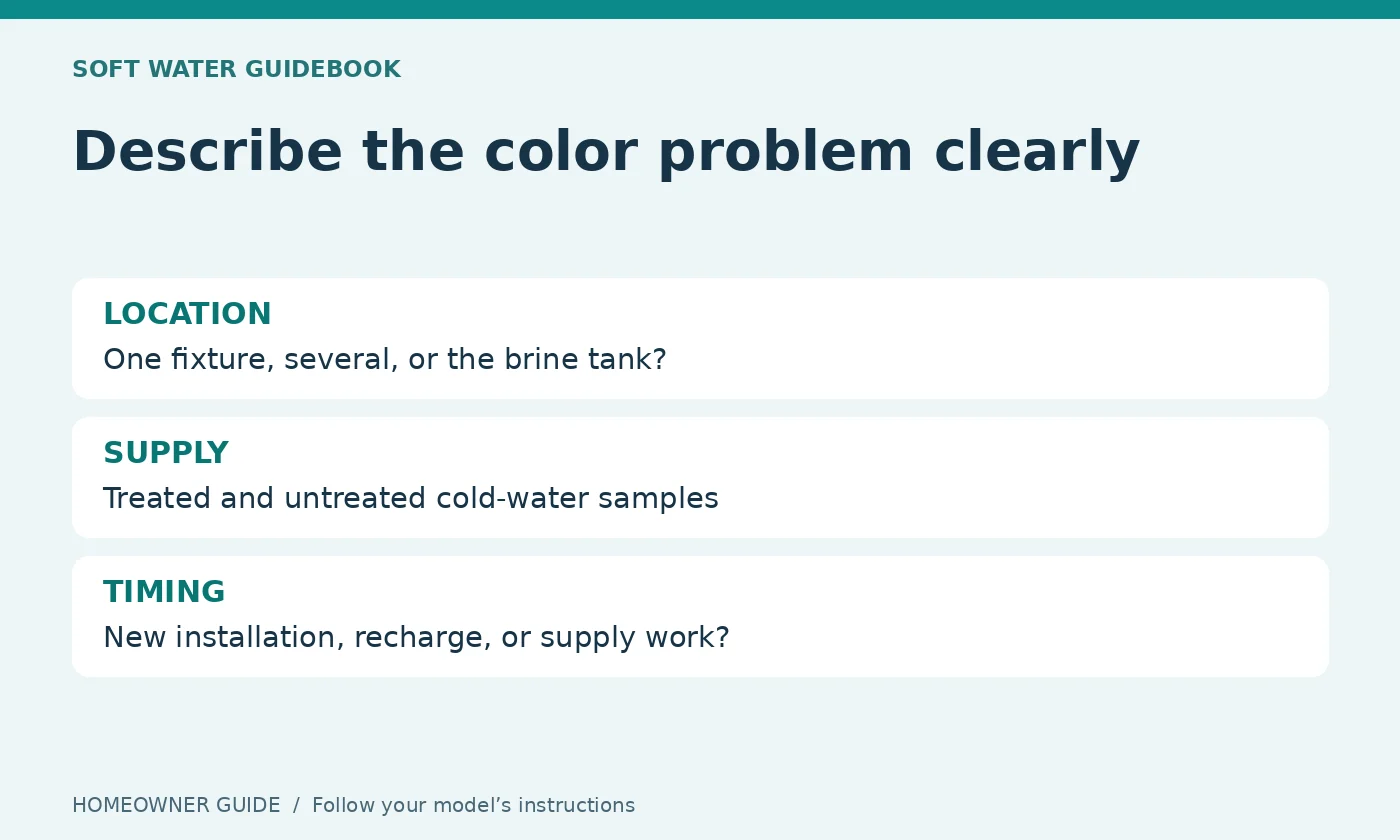
Send the sample locations, photos, onset time, and recent work history. Those details are more useful than asking for a replacement based only on a brown color.
Questions homeowners ask
Will a hardness test tell me what the brown material is?
No. A hardness test measures hardness, not the identity of a discolorant. Ask the utility or laboratory which tests fit the observed problem.
Should I run the taps continuously until it clears?
Follow the water provider’s flushing instructions. Portland specifically advises against continuous running during its discoloration events. [1] Do not assume an unlimited flush will fix a supply or equipment fault.
Sources and review notes
Reviewed September 28, 2026. This guide compares manufacturer guidance; it does not report hands-on testing. Your model’s manual controls service procedures.